- An AI SEO audit covers five areas: technical crawler access, content structure for AI extraction, entity recognition, off-site brand authority, and AI visibility measurement — traditional SEO audits cover only the first
- Technical failures are the most urgent: if AI crawlers cannot access your website, every other improvement is wasted effort until they are fixed first
- Most Malaysian business websites fail in two areas most consistently — content that leads with vague marketing language instead of direct answers, and no systematic tracking of AI brand visibility
- AI SEO is not a one-time audit — it is a continuous measurement cycle; brands that run prompt tests monthly catch competitive shifts before they compound
- 58% of Malaysian consumers have used AI tools for purchasing decisions, making AI search visibility a current commercial priority, not a future one
Your Google rankings might look healthy. Traffic might be steady. But there is a growing share of search happening in a place your analytics cannot see — inside ChatGPT, Perplexity, Gemini, and Claude, where users are asking questions and getting answers that never produce a click to your website.
If your business is not appearing in those answers, you are invisible to those users. And unlike Google rankings, you cannot check your AI visibility by logging into Search Console. You have to actively test it.
This checklist covers every area that determines AI search visibility for a Malaysian business in 2026. Work through each section in order — technical access first, because everything else depends on it. Use the priority tags to identify what to fix immediately versus what to schedule for later.
Technical Access
Fix FirstAI crawlers need to be able to reach, read and index your content before any citation can happen. If AI crawlers cannot reach your content then every other improvement becomes useless. This is the foundation of AI visibility. If access is broken your content may never get into the systems that produce answers.
In practice, Technical Access boils down to a few basic questions: Can AI crawlers enter the site? Can they find the pages that matter? Can they understand what those pages contain? The following checks break that process into the Technical Access signals that should be reviewed first.
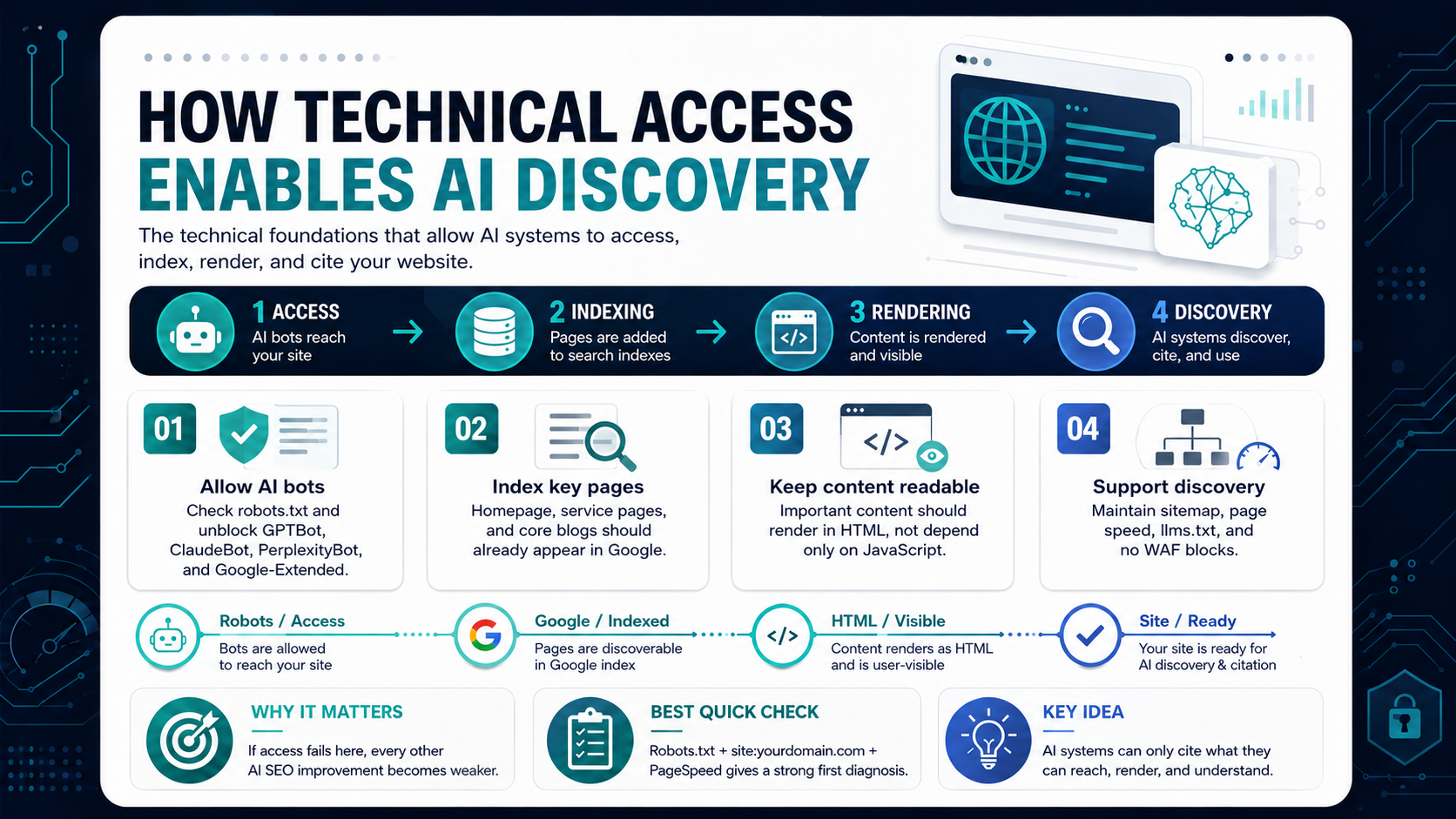
Technical access is the step toward making your content visible to AI systems. Before any AI can understand or use your information its crawlers must be able to get to your website find the pages and read them properly.
This means your technical setup must support crawling, indexing and rendering. Your main pages should be search-important content must be in readable HTML and things like XML sitemaps, fast page speed llms.txt (if needed) and correct security settings should make it easier and safer for AI bots to discover your site.
Why Technical Access Matters
- Crawler access. AI bots like GPTBot, ClaudeBot and other search crawlers need to be able to reach your website without issues.
- Indexing. Your homepage, service pages and core content should be searchable and easy to find.
- Content. Critical information should not rely only on JavaScript to appear.
- Discovery. If AI systems cannot access, index or read your site correctly even great content may never be used in AI answers.
Useful links: PageSpeed Insights · llms.txt Generator · llms.txt Guide · Is It Agent Ready?
Content Structure for AI Extraction
Highest ImpactAI systems take passages. Reuse them instead of reading whole pages like humans. Clear structure lets important information stand alone which makes it easier for AI to find understand and cite the answer.
Once your content is technically accessible, the next challenge is making it easy for AI systems to interpret. This is where the way information is organised becomes as important as the information itself. A clear structure gives AI systems obvious passages to extract, understand and reuse in an answer.
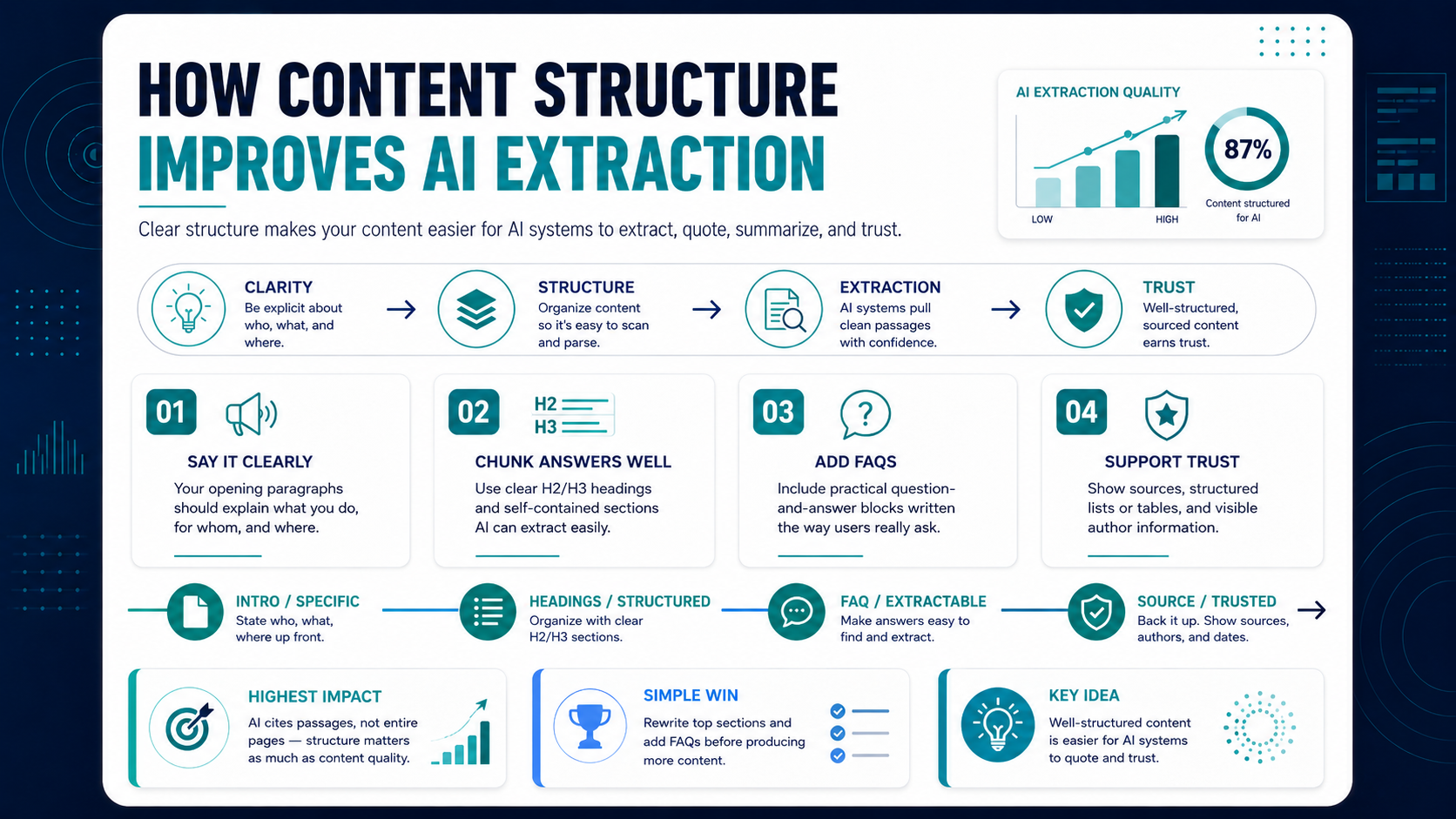
AI systems often work with passages instead of reading a full page from start to finish. That’s why each important section should stand on its own and answer a question directly.
A structured page uses clear opening statements, descriptive H2 and H3 headings focused answer sections, useful FAQs and supporting elements like lists, tables, sources and author details. This helps AI systems quickly find the helpful parts of your content and reuse them without needing to create new pages.
How Structure Helps AI Extract Answers
- Openings. Start with a direct statement about what the business does who it serves and where it is located.
- Focused sections. Separate topics clearly using H2 and H3 headings.
- Useful FAQs. Answer the questions users actually ask.
- Supporting context. Include lists, tables, sources and author information to add clarity and trust.
Useful link: Researcher's Method Content Structure Guide
Entity Recognition
Brand FoundationAI and search systems need an understanding of who your businesss before they can reference or recommend it confidently. Consistent business details, structured data and strong brand signals help link your website and external profiles into one recognised entity.
Being crawlable and well structured does not tell an AI system exactly who your business is. Entity Recognition needs signals that connect your website, brand information and external profiles to the same real-world organisation. The stronger those connections are, the less ambiguity there is around your business identity.
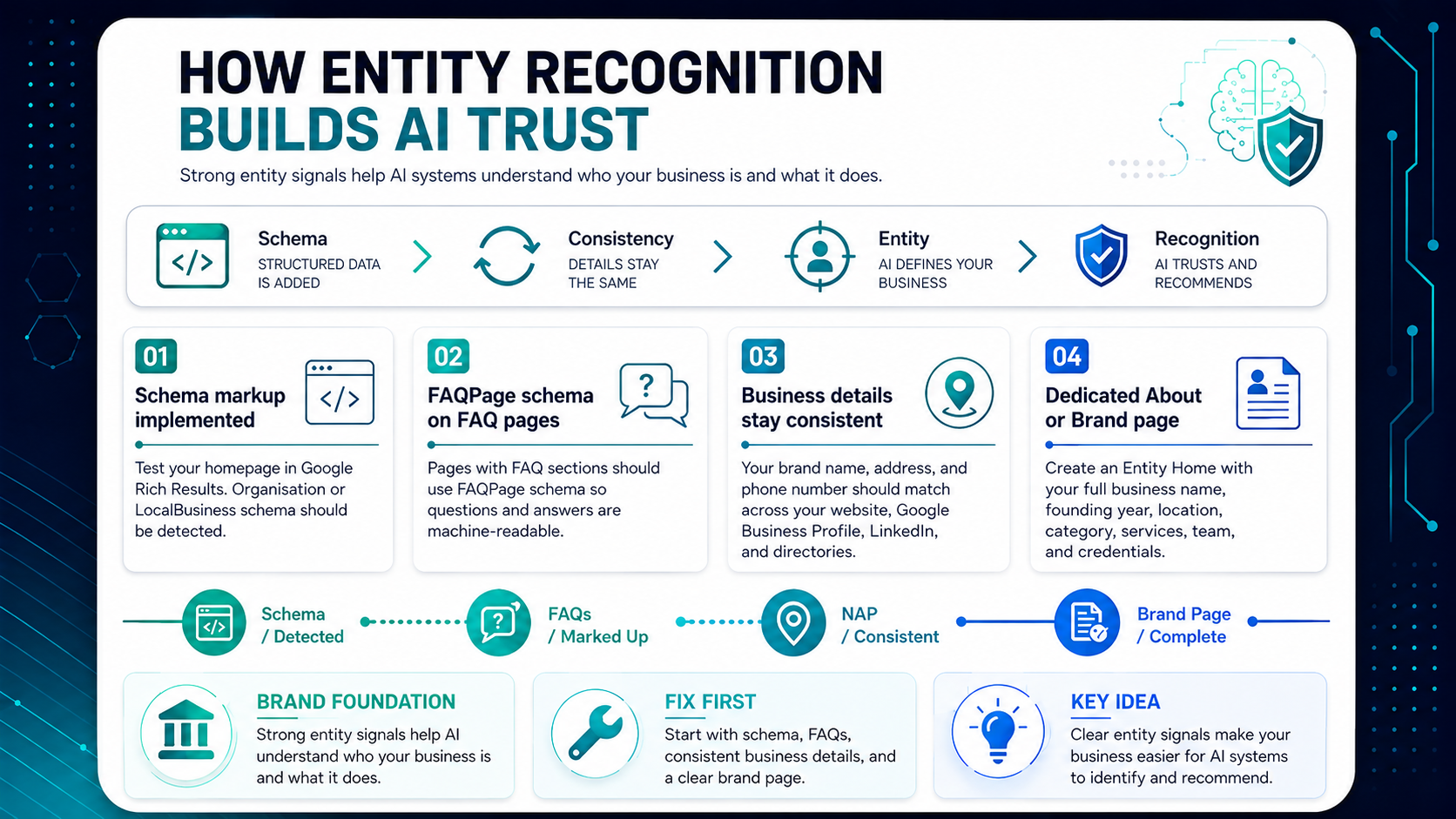
Entity recognition helps AI and search systems understand that your website, your Google Business Profile, your LinkedIn page and your directory listings all point to the real business. When these signals are clear and consistent it becomes easier for AI to identify your business correctly.
Schema markup gives machines structured data about your organization. Consistent brand details and a dedicated About or Brand page give AI a reference point. The consistent the company name, address, phone number and business description are across platforms the easier it is for AI to connect the dots.
Building a Clear Business Entity
- Structured data. Use schema markup to give AI and search systems machine- business information.
- Consistent details. Make sure your business name, address and phone number match across all platforms.
- Strong brand page. Clearly present your company name, location, services, team, history and credentials.
- Cross-platform consistency. Matching signals across platforms help AI recognize one entity.
Useful links: Google Rich Results Test · Wikidata
Off-Site Brand Authority
AI Recommendation DriverYour own website is one source of information, about your business. Mentions, directories, trusted profiles and third-party references help AI systems confirm that your business is credible and recognised beyond your marketing.
After your business identity is clear, AI systems also look for evidence beyond your website. What independent platforms, directories and other sources say about your brand can strengthen—or weaken—the confidence AI systems have in that information. This is where Off-Site Brand Authority becomes an important part of visibility.
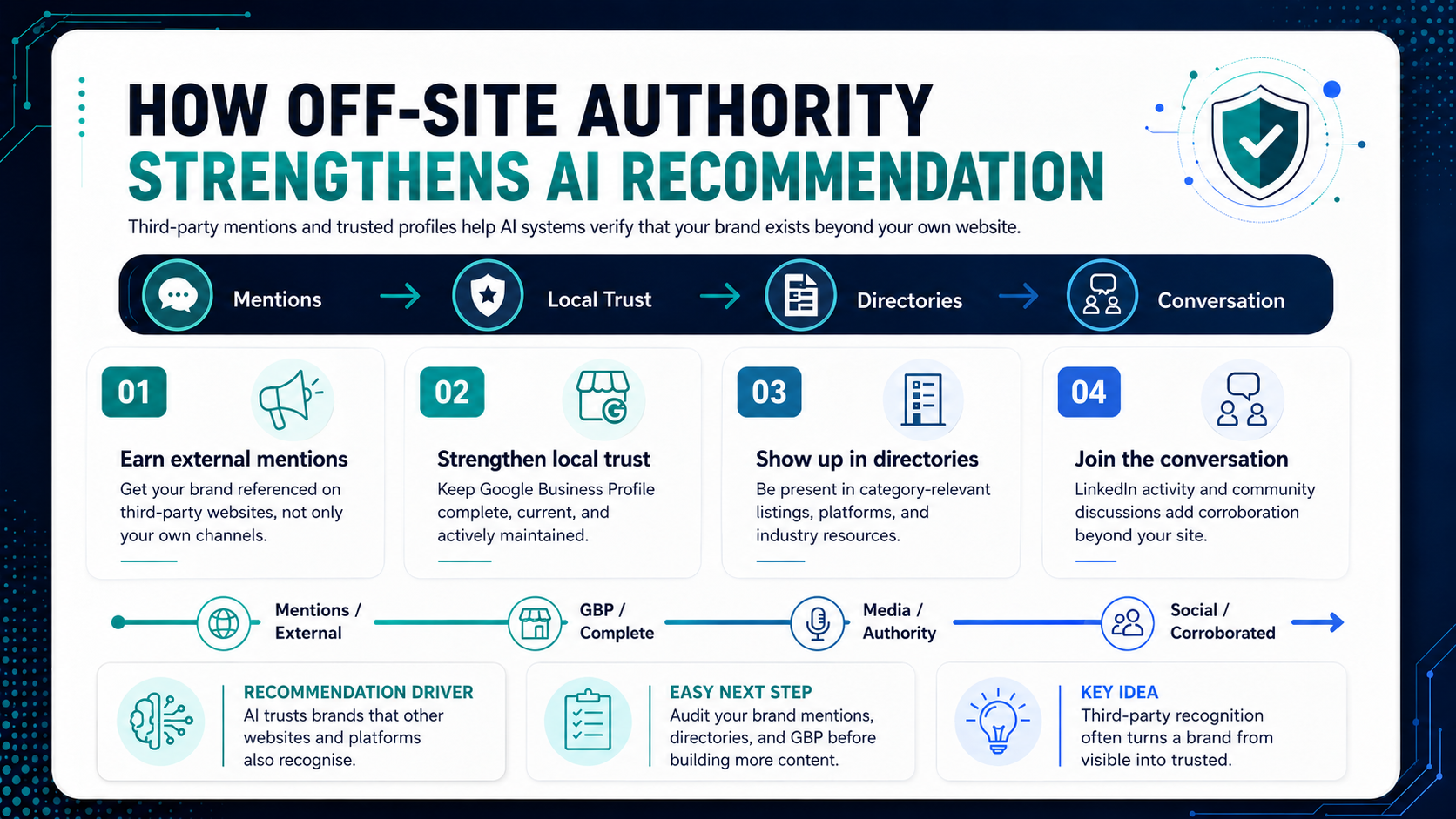
Your website is not the place AI can learn about your business. AI systems can also look at what other websites, directories and online communities say about your brand. That’s why external recognition matters.
Credible mentions, an up-to-date Google Business Profile, relevant directory listings and active LinkedIn profiles all add third-party context. When multiple independent sources describe your business in the way AI systems have more proof to confirm what you do and whether you are trustworthy.
Why External Signals Matter
- Independent mentions. Reputable websites and industry publications show recognition beyond your marketing.
- Local trust. A complete and current Google Business Profile builds credibility.
- Directory presence. Relevant listings reinforce your category, location and services.
- Community activity. LinkedIn and professional discussions provide context and support for your brand.
AI Visibility Measurement
Know Your BaselineAI visibility should be measured, not assumed. Regular testing shows where your brand appears how competitors perform and whether technical, content and authority improvements are actually making a difference.
The final step is understanding whether all of these improvements are actually changing how your brand appears in AI-generated answers. AI Visibility Measurement can shift over time and differ from one platform or prompt to another. It needs to be checked consistently rather than judged from a single search.
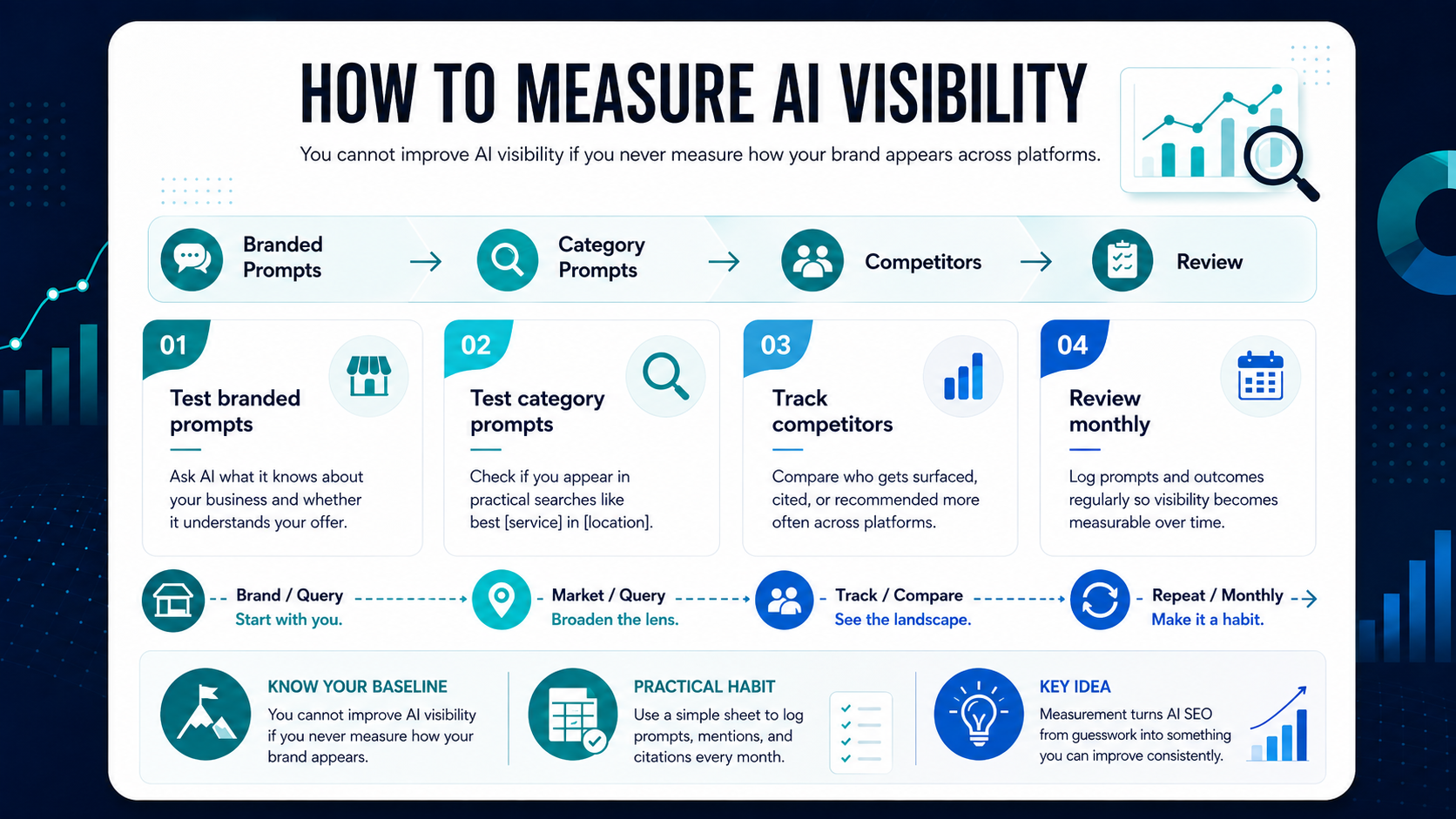
Improving AI visibility is easier when you measure it consistently. Without a starting point it’s hard to know if your brand is appearing often if competitors are being recommended instead or if your recent changes are actually helping.
Start by testing branded prompts. Then try category-based searches that reflect how real users search for a service. Compare your results with competitors and track which brands are mentioned cited or recommended. Reviewing the set of prompts regularly helps you notice changes and decide what to improve next.
How to Measure Progress
- Branded prompts. See what AI systems currently know about your company.
- Category searches. Test prompts like “[service] in [location]”, without naming your brand.
- Competitor comparison. Check which businesses appear get cited or are recommended more.
- Monthly tracking. Record prompts, mentions, citations and visibility changes to build a baseline over time.
Useful links: Otterly.AI · Profound · How to Measure AI SEO Performance
Your Priority Fix Order
Once you have completed the audit, use this table to sequence your fixes. Do not try to work on everything simultaneously — depth in one layer is worth more than surface-level activity across five.
Use this order, as a roadmap not as a rigid rule. First start with anything that blocks access; then improve the content and entity signals that help AI understand the site and finally build authority and measurement into a process. The aim of the order is to fix the foundations so every later improvement has something solid to build on.
| Priority | What to Fix | Timeframe | Why It Comes First |
|---|---|---|---|
| 1st | Any Critical failures in Technical Access | This week | AI crawlers cannot read your content at all until these are fixed — every other improvement is wasted |
| 2nd | Homepage and service page content rewrite | This week | The highest-impact, lowest-cost fix — requires no developer, produces immediate citation improvement on restructured pages |
| 3rd | Schema markup on key pages | This month | Explicitly labels your content type and entity for AI systems — closes the entity recognition gap faster than any other single technical fix |
| 4th | FAQ sections on key pages | This month | Highest-citation-rate content format — each FAQ is a separate citation target for long-tail AI queries |
| 5th | Off-site mention building | This quarter | Takes time to develop — start now so it compounds alongside content and technical improvements |
| 6th | Monthly AI visibility testing | Ongoing | Measures whether the above fixes are producing results and identifies what to prioritise next |
Your Total Audit Score
Add up your passes across all five sections. Maximum score: 35 checks.
Final Thoughts
An AI SEO audit is not a one-time project. It is the start of an ongoing measurement cycle — run it quarterly as a baseline, monthly if you are actively building AI visibility, and any time you make significant changes to your website or content.
The businesses that close the AI visibility gap fastest are the ones that start with an honest assessment of where they are today. This checklist gives you that. Use it, act on the Critical failures first, and measure whether the improvements are showing up in your AI citation rates.
Stay current with how AI search signals evolve by following our AI SEO updates.