
- Google deleted over 3 billion entities from its Knowledge Graph in June 2025 — the largest-ever cleanup — prioritising unambiguous, high-confidence entities to power AI features more reliably
- An entity is not a keyword — it is a recognised concept in a search engine's knowledge database, with defined attributes, relationships, and a distinct identity that distinguishes it from other similar things
- AI answer engines like ChatGPT and Google AI Overviews reason in entities, not in keywords — if your brand is not recognised as an entity, it cannot confidently appear in AI-generated answers
- Topical authority — demonstrating comprehensive expertise around a core subject — is built by creating interconnected content clusters, not isolated pages targeting individual keywords
- Entity recognition requires consistency: the same brand name, description, and category signals across your website, schema markup, directories, and third-party sources are the signals that make an entity legible and trustworthy to search systems
There is a version of SEO that many businesses are still running — find the keywords your customers search, put those keywords on your pages, build links to those pages, watch traffic grow. It worked for over a decade. It still produces some results today.
But something fundamental has changed in how search engines — and increasingly, AI tools like ChatGPT and Perplexity — understand content. Google is no longer just looking for pages that contain the right words. It is asking a deeper question: does this business actually exist as a real, specific, well-understood thing in the world? Does Google know who this brand is, what it does, and who recognises it — beyond what the brand says about itself on its own website?
In June 2025, Google provided the clearest possible signal of this direction: it deleted over 3 billion entities from its Knowledge Graph in a single week — the largest contraction in the database's history. According to Search Engine Land's analysis by Jason Barnard, the cleanup contracted the graph by 6.26%, and was described as a deliberate "clarity-first" move to build a leaner, higher-quality dataset to underpin AI features including AI Overviews and AI Mode. The message was unambiguous: being in the knowledge system is no longer enough. Being legible, unambiguous, and well-corroborated is what survives.
This guide explains what entity-based SEO is, why it matters now more than ever, and how to build the kind of brand recognition that search systems and AI tools actually trust.
What Is an Entity — And Why Does It Matter More Than a Keyword?
A keyword is a string of text. "Best renovation company PJ" is a keyword — it tells Google what words to look for. An entity is a real-world thing that Google has formed a mental model of — a specific business, person, place, or concept with known attributes. "Edge KL Interior Design" is an entity — or at least it can be, if Google has enough consistent information about it to know what it is, what category it belongs to, and who else recognises it.
The practical difference: a keyword match finds pages. An entity match finds brands. And increasingly, AI-generated answers are built from entity knowledge, not keyword matches.
Here is how search processes them differently:
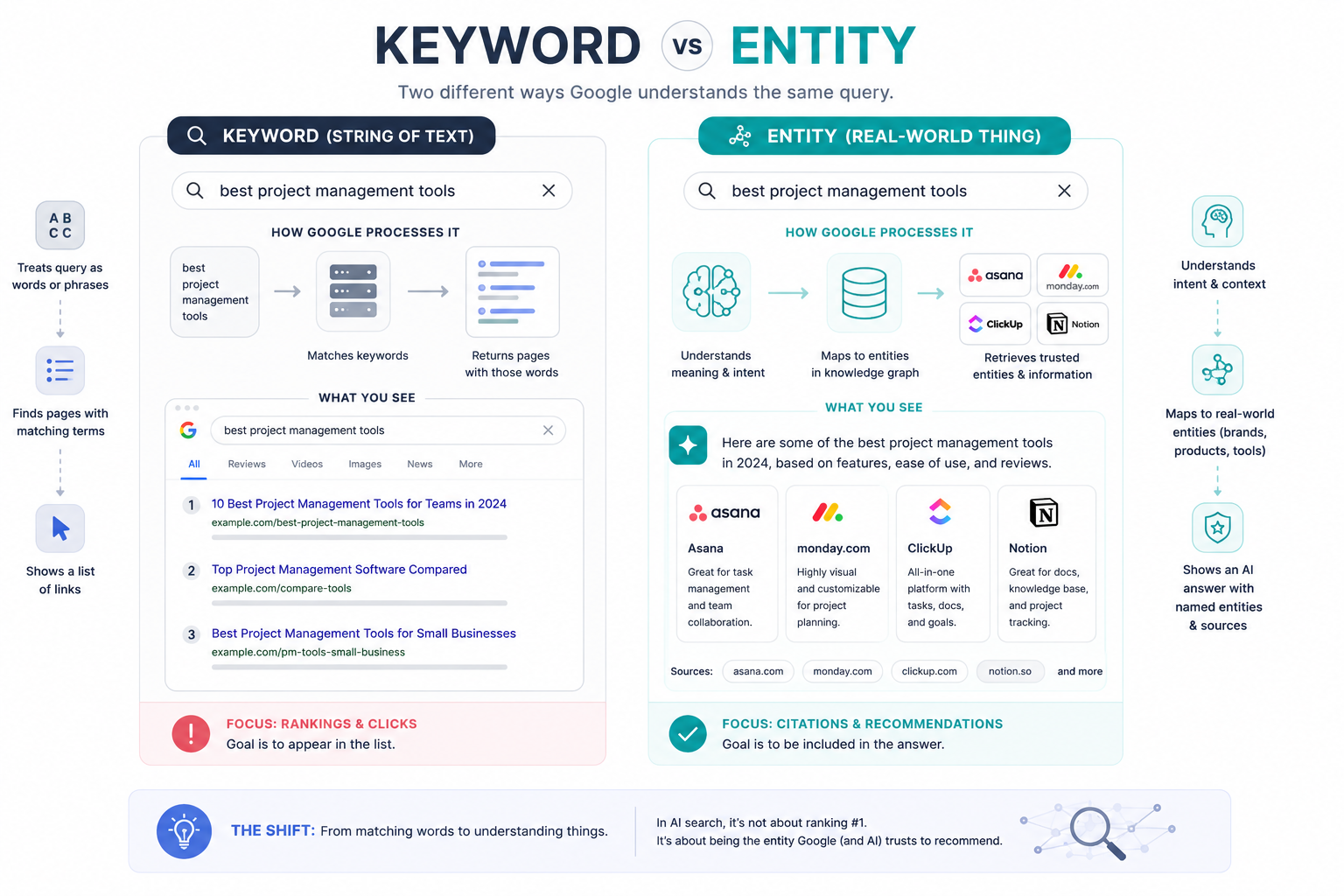
The practical consequence: two pages with identical keyword targeting and similar backlink profiles can produce dramatically different results in AI search if one brand is a recognised entity and the other is not. As Jottler's knowledge graph SEO analysis notes, large language models during training repeatedly see an entity name near associated concepts, learning tight entity-concept associations — when a user later asks a question, the model retrieves the entities most strongly associated with that concept space. Keyword presence on your page matters far less than whether your brand is embedded in those concept associations.
The clearest way we have seen this play out with Malaysian businesses: a company can have a well-optimised website, strong rankings for their target keywords, and still be completely absent from ChatGPT or Perplexity answers about their category. When we ask those AI tools to describe the company, they either draw a blank or produce a vague, inaccurate summary. That is an entity recognition problem, not a content quality problem. The content exists — the search engine just has not formed a reliable mental model of what the business is, who it serves, or how it relates to the surrounding landscape of their industry.
What Entity SEO Looks Like in Practice — A Malaysian Business Example
Consider two renovation companies in Petaling Jaya. Both have professional websites with good photography, similar service descriptions, and comparable Google reviews. Company A ranks marginally higher for "renovation company PJ" due to slightly more backlinks.
But when a buyer asks ChatGPT "which renovation company in Petaling Jaya is best for condo interior design?" — Company B appears in the answer. Company A does not.
| Signal | Company A | Company B |
|---|---|---|
| Schema markup | None | LocalBusiness + HomeAndConstructionBusiness schema on every key page |
| About page | Generic "Welcome to our company" content | Specific entity home: founding year, team, service areas, specialisations, project types |
| Wikidata entry | None | Entry with official name, category, location, and sameAs links |
| NAP consistency | Different name format on Google Business and website | Identical name, address, and phone across all platforms |
| Off-site mentions | Only Google reviews | Featured in 3 home renovation articles, listed in 2 industry directories, quoted in a property blog |
| Content cluster | One generic "Our Services" page | Separate pages for kitchen, bathroom, condo, landed property, and commercial — all internally linked |
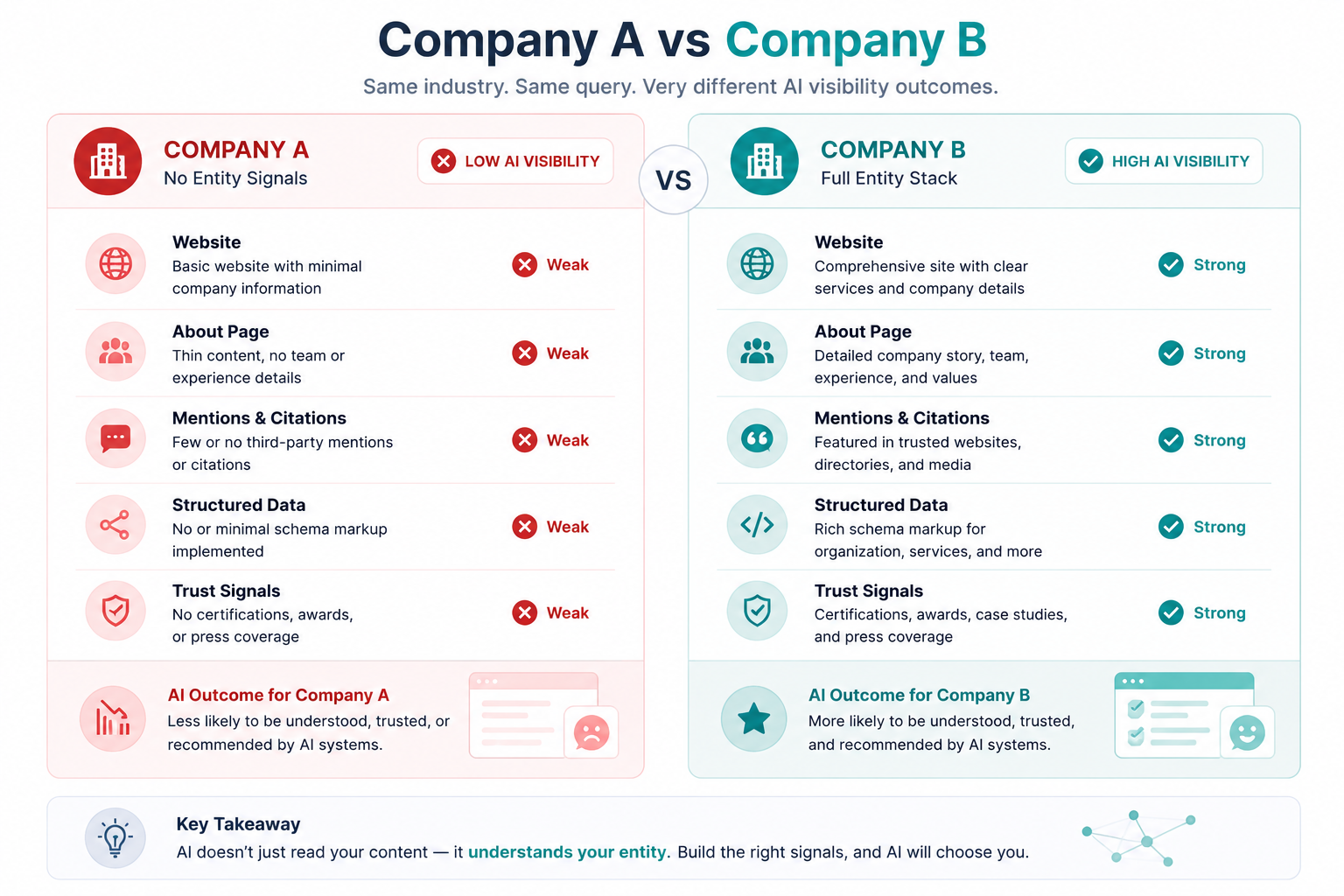
Company B has built an entity. Company A has built a website. The difference is invisible in traditional SEO metrics — but in AI search, it is the entire game.
The June 2025 Knowledge Graph Cleanup — What It Tells Us
Google's Knowledge Graph — launched in 2012 — is essentially a giant database of real-world things and how they relate to each other. Not documents. Not pages. Things. Brands. People. Places. Concepts. And the connections between them. When Google knows that "Klinik Utama Damansara" is a medical clinic in Damansara Uptown, founded in 2015, offering GP consultations — that is an entity in the Knowledge Graph. When a user asks Google or an AI tool a question, the answer is often assembled from this entity database rather than from a keyword search across web pages.
For over a decade the Knowledge Graph expanded steadily, reaching approximately 8 billion entities. Then, in June 2025, Google did something it had not done at this scale before.
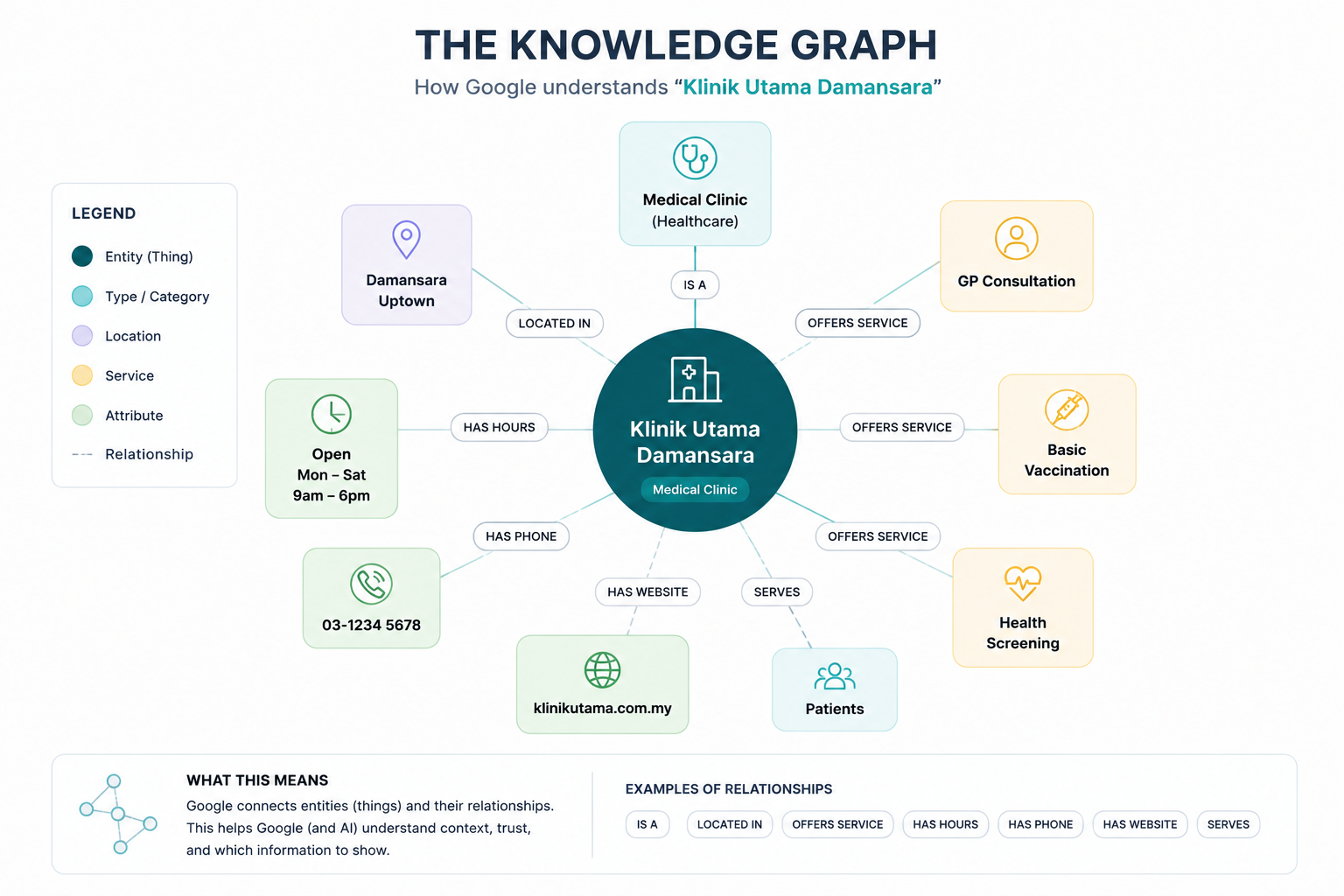
Source: Jason Barnard, Kalicube / Search Engine Land, August 2025 — "Google's Great Clarity Cleanup." Barnard tracks Knowledge Graph entity counts using Kalicube's sensor, which monitors the database daily.
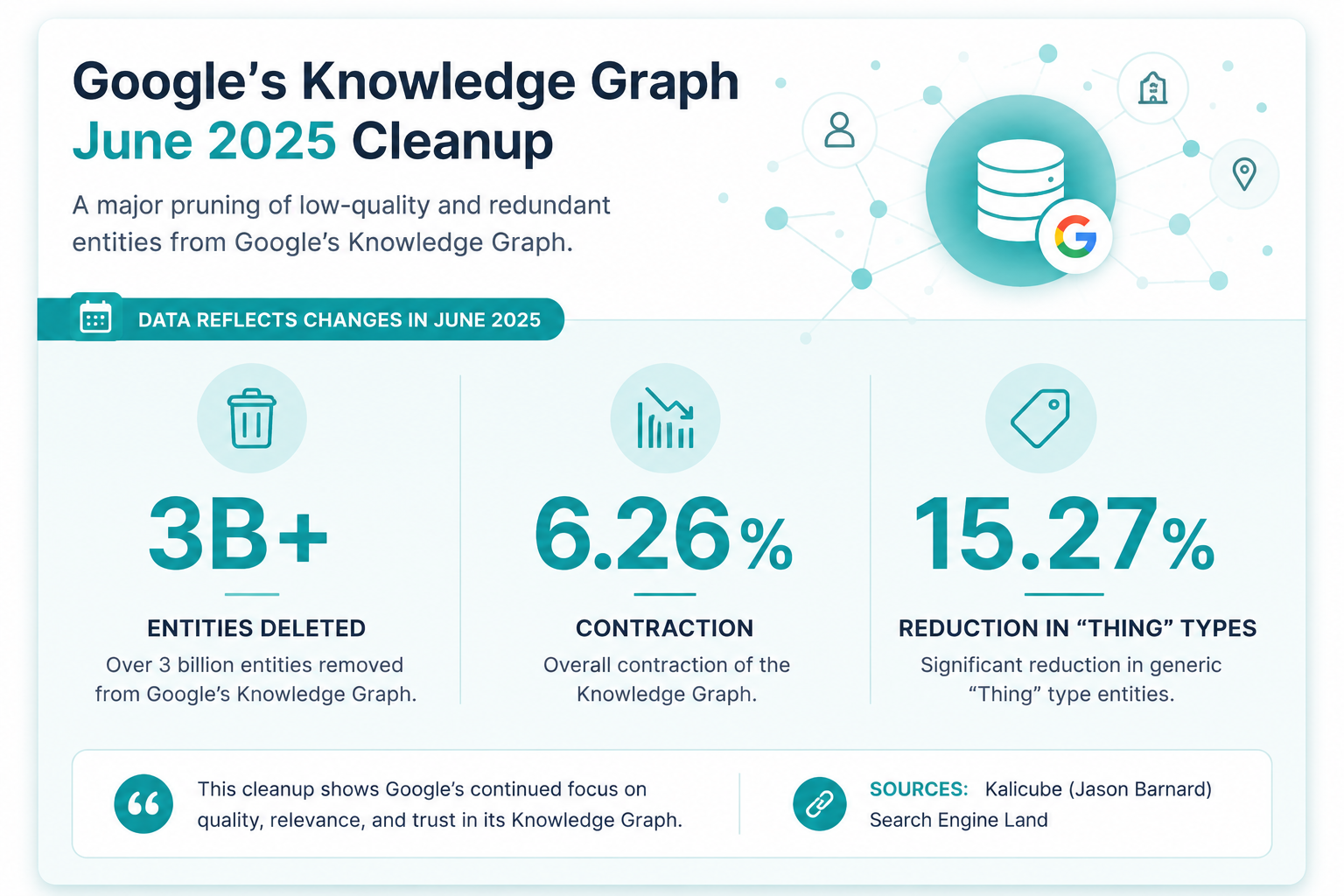
In plain terms: Google decided it was better to have 5 billion well-understood entities than 8 billion vague ones. A database full of ambiguous entries is worse than a smaller, cleaner one — especially when that database is powering AI answers that millions of people read every day.
Ahrefs interpreted the move as Google prioritising a leaner, higher-quality dataset to power its AI features more reliably, with the clear lesson for practitioners: quality and consistency of entity signals matter more than ever.
According to Kalicube's analysis, the cleanup shifted the composition of the graph — entities with a single, definitive type rose from 23.9% to 28.7% of the total, while the count of entities labelled with the generic "Thing" type shrank by 15.27%. In other words: Google is not just removing entities — it is making the remaining entities more precise and unambiguous.
The cleanup is the clearest signal yet that vague entity presence is worse than no entity presence at all. A brand that exists in Google's Knowledge Graph as an ambiguous "Thing" — with inconsistent descriptions across platforms, no clear category, and weak corroborating signals — is now more likely to be pruned than a brand that is not in the graph at all but has consistent, coherent signals across all its touchpoints. The lesson is not "get into the Knowledge Graph as fast as possible." It is "get into the Knowledge Graph with unambiguous, consistent, well-corroborated signals — or don't bother yet."
Entity SEO vs Keyword SEO: A Framework Comparison
Entity SEO is not a replacement for keyword SEO — it is an additional layer that determines whether your keyword-optimised content is trusted and cited rather than just found and ranked. As Wire Innovation's 2026 SEO entities guide notes, the smartest brands weave both together: entity signals establish meaning and relationships, keyword research discovers search demand and context.
| Dimension | Keyword SEO | Entity SEO |
|---|---|---|
| What it targets | Text strings in user queries | Recognised concepts in knowledge systems |
| What it optimises | Pages and URLs | Brand identity and relationships |
| Primary signal | Keyword density and backlinks | Entity consistency and corroboration |
| How it is measured | Keyword rankings and organic traffic | Knowledge Panel presence, AI Overview citations, branded search volume |
| Time horizon | Days to weeks for ranking changes | Months for entity recognition to build |
| AI search impact | Indirect — affects what pages are crawled | Direct — determines whether brand appears in AI answers |
As OutpaceSEO's entity SEO guide states plainly: generative engines like ChatGPT and Google's AI Overviews rely on entity relationships to assemble answers, not keyword density. Topical authority is built by creating comprehensive content clusters that thoroughly cover a primary entity and its related sub-entities. Structured data is the machine-readable language that explicitly tells search engines which entities your content references.
What Topical Authority Actually Means — And How Entities Build It
Topical authority sounds like a buzzword, but it has a simple meaning: when someone asks an AI tool or search engine about your subject area, does your brand come to mind as a go-to source? Or is it just one of many generic results?
In entity terms, topical authority means your brand has been associated — consistently, across multiple sources and content pieces — with a specific subject domain, until it becomes a default reference for queries in that space. The AI has formed a reliable mental model: "This brand knows about X."
CONTADU's semantic SEO analysis describes topical authority as a function of how pages relate to one another across an entire domain — building interconnected clusters of articles that collectively establish topical authority around a core entity, mirroring the structure of the Knowledge Graph itself.
The Difference Between Isolated Pages and a Content Cluster
When AI systems encounter your content, they are not evaluating each page independently. They are forming an entity model of your brand — what it stands for, what it knows, who it serves — based on the pattern of content across your entire domain. A single well-optimised page creates a weak signal. A cluster of interconnected, consistently focused pages creates an entity association that is much harder to dislodge.
This is exactly why we structure our own content at AI SEO Agency around interconnected pillars rather than individual keyword targets. Every blog post we publish strengthens the same entity associations — AI SEO, GEO, AEO, AI visibility, generative engine optimisation. Over time, those associations compound. When an AI tool encounters a question about AI search in Malaysia, the pattern of signals pointing to our brand becomes harder to ignore. One blog post is a weak signal. Fifteen blog posts, all consistently pointing to the same expertise domain, with consistent author attribution and consistent internal linking — that is an entity statement.
How to Build Entity Recognition for Your Brand
Entity recognition is built through consistency and corroboration — the same signals, repeated across multiple trusted sources, until search systems can resolve your brand as a single, unambiguous entity.
sameAs links to your Wikidata entry, LinkedIn, and major directories. Think of sameAs as telling Google: "This page about our business and that Wikidata entry and that LinkedIn profile are all the same company." It is how search systems confirm that different online mentions of your brand are all referring to the same real-world entity — rather than several different businesses that happen to have similar names.Entity SEO Audit: Where to Start
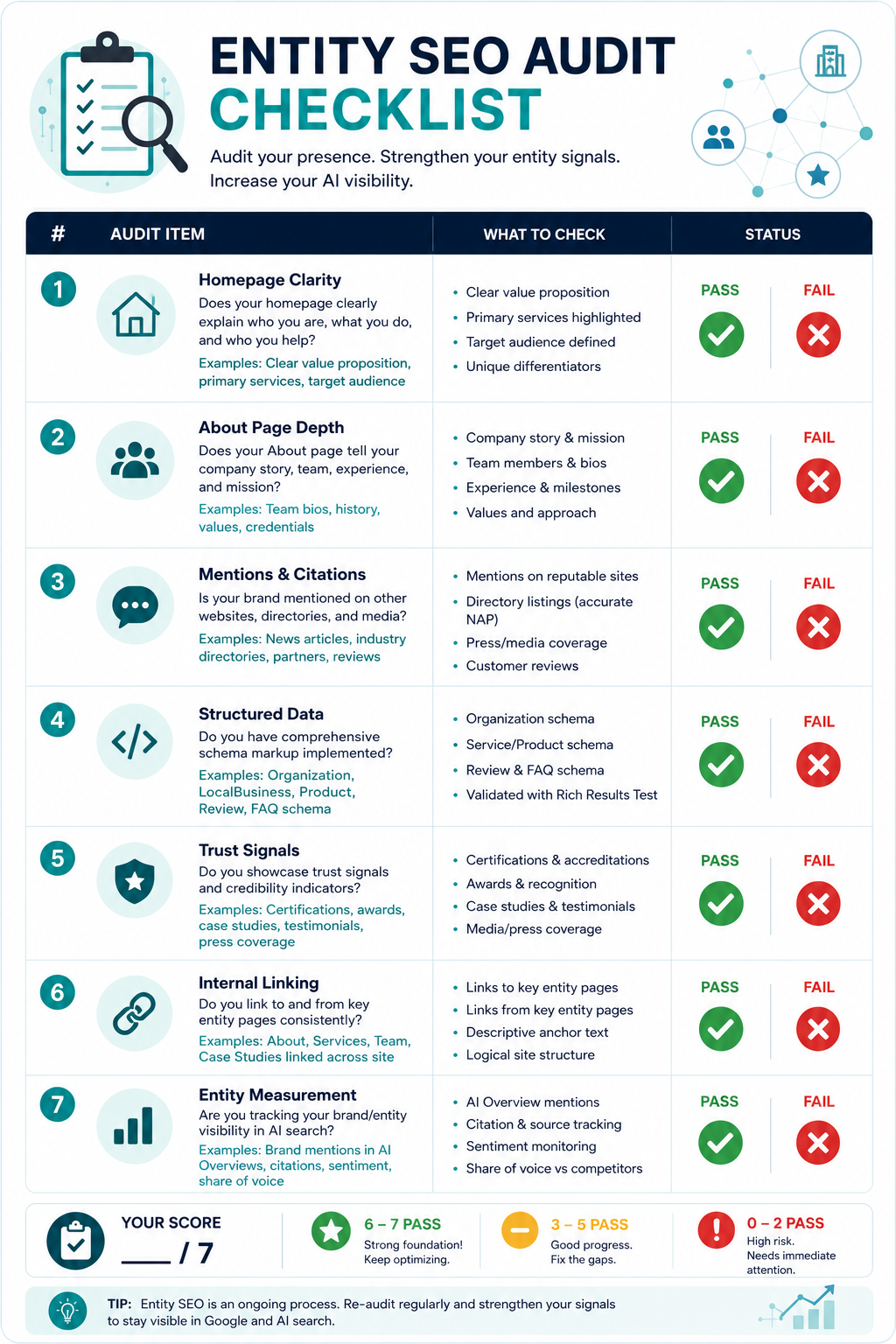
- ✓ Google your own brand name and check whether a Knowledge Panel appears — its presence (or absence) signals your current entity recognition status
- ✓ Ask ChatGPT or Perplexity to describe your brand — note whether the description is accurate, vague, or missing entirely
- ✓ Check your website for an Entity Home (a specific About page) — does it describe your brand as a defined entity with attributes, history, and relationships?
- ✓ Check your schema markup using Google's Rich Results Test — are you declaring Organisation or LocalBusiness schema with
sameAslinks? - ✓ Check Wikidata for a brand entry — if it does not exist, creating one is a high-value, low-effort task
- ✓ Audit your NAP consistency — Google your business name and compare how it appears across your website, Google Business Profile, LinkedIn, and any directories
- ✓ Count your off-site mentions — search "[brand name]" and filter to third-party sites; fewer than 5–10 substantive off-site mentions is a weak corroboration signal
Final Thoughts
Keywords are how search worked for the first twenty years of the web. Entities are how it works now — and increasingly, how AI systems decide who to trust, cite, and recommend.
The June 2025 Knowledge Graph cleanup was not a warning. It was Google making explicit what had been true for years: the search systems that power AI answers are built around unambiguous, well-corroborated entities. Brands that have invested in entity recognition — consistent presence, structured data, topical depth, third-party corroboration — are the brands that survive algorithm updates and show up in AI responses.
Brands that are still optimising only for keywords are competing well in an environment that is shrinking. The opportunity to build entity recognition is real, and the window for competitive advantage is open now — because most businesses have not started yet.
Follow our AI SEO updates to stay current as entity recognition and AI search signals continue to evolve.