
- Each AI platform has a different retrieval mechanism — Perplexity uses its own live index, Gemini grounds against Google Search via query fan-out, ChatGPT blends training data with selective web search, and Claude uses Brave Search with a longer freshness window
- Perplexity cites nearly 3× more sources per response than ChatGPT — but citation volume does not equal citation quality; each platform has distinct source-type preferences that determine who gets selected
- Only 38% of Google AI Overview citations now come from the top 10 organic results, down from 76% a year earlier — ranking alone no longer guarantees Gemini or AI Overview visibility
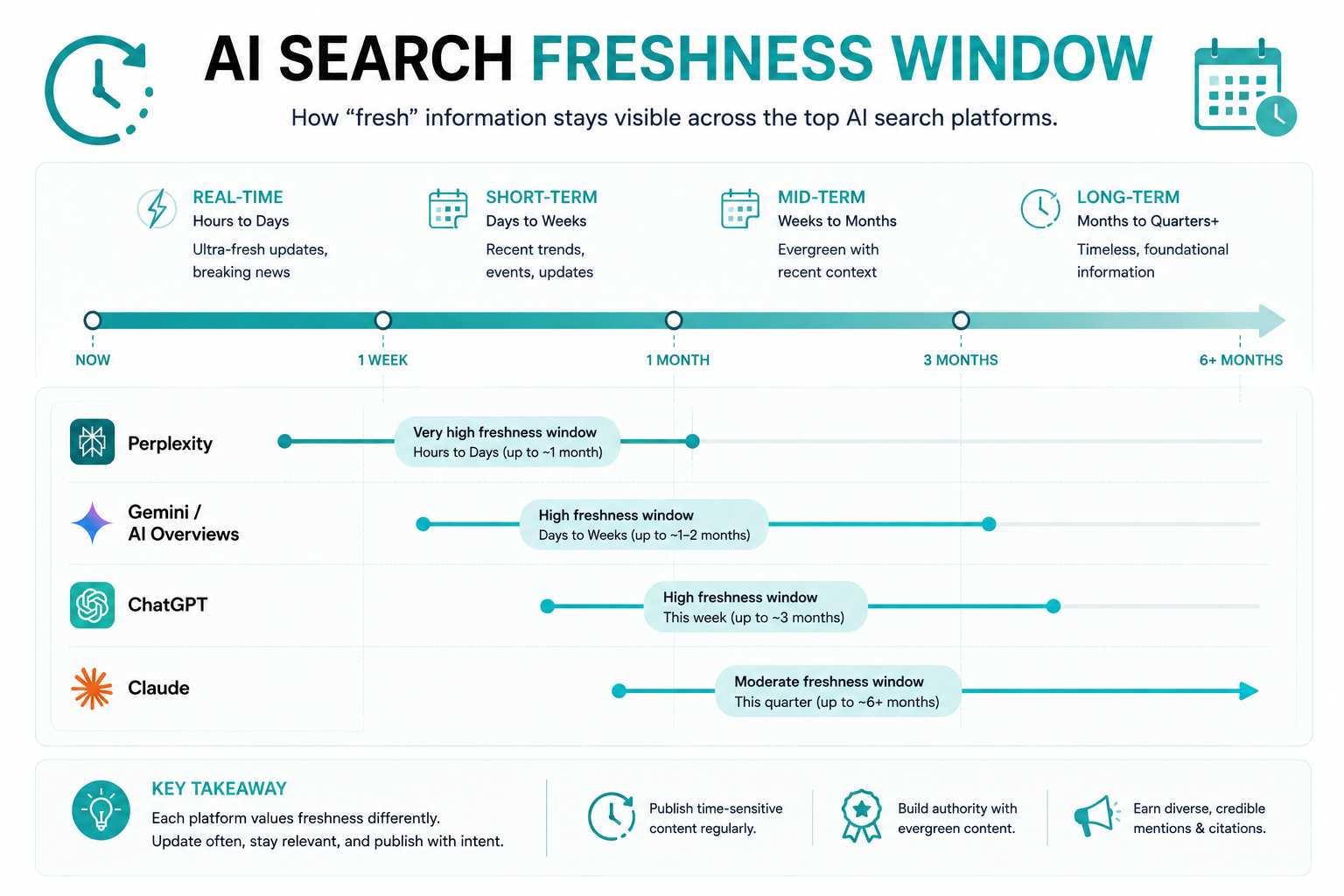
- Content freshness windows differ dramatically: ChatGPT rewards content from the past week, Perplexity from the past month, Claude from the past quarter — the same piece of content can be "fresh" on one platform and "stale" on another simultaneously
- A shared foundation — clean technical access, answer-first structure, sourced statistics, and off-site authority — improves visibility across all four platforms, with platform-specific adjustments layered on top
When a potential customer asks an AI tool about your product category, you might assume all AI tools behave roughly the same — that appearing in one means you appear in all, and that the same content strategy works across the board.
The data says otherwise.
As Vydera's 2026 AI visibility research puts it: the same content can be highly visible in Perplexity, partially cited by ChatGPT, well interpreted by Gemini, and completely absent from Claude — because each assistant has its own search, selection, and citation logic. These are not cosmetic differences in interface. They are structural differences in how each platform retrieves, evaluates, and selects sources — and they require meaningfully different content and technical decisions.
This guide breaks down the retrieval mechanism, citation behaviour, content preferences, and optimisation approach for each of the four major AI search platforms. At the end, we cover the shared foundation that covers all four simultaneously.
Why the Platforms Behave So Differently
To understand why the same piece of content gets cited by Perplexity and ignored by ChatGPT — or cited by Gemini for one query and not another — you need to understand that each platform was built with a fundamentally different retrieval architecture. This is not a matter of preference or algorithm tuning. It is structural.
| Platform | Retrieval Mechanism | Index Source | Avg Citations/Response | Freshness Priority |
|---|---|---|---|---|
| Perplexity | Native live web index + RAG | Own crawl index | 7–10 (cites multiple sources per claim) | Very high — hours to days |
| Gemini / AI Overviews | Query fan-out → Google Search index | Google's full index | Varies by query complexity | High — Google index freshness |
| ChatGPT | Training data + selective web search | Bing + training data | 2–4 (selective, broader domain range) | High for recent queries — "this week" |
| Claude | Training data + Brave Search retrieval | Brave Search index | 5.67 average | Moderate — "this quarter" |
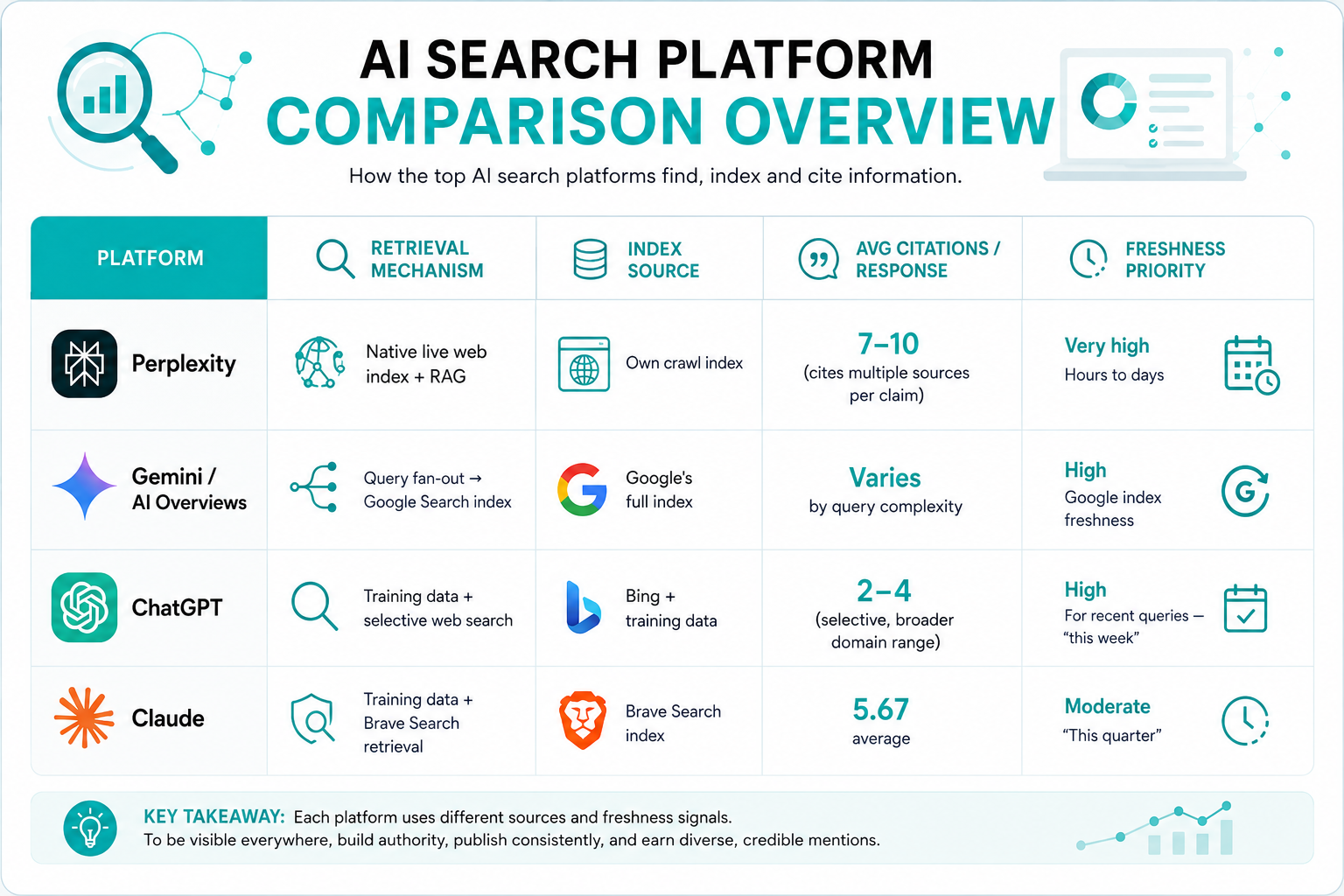
Source: Qwairy analysis of 118,000 AI responses, Jan–Mar 2026; QuickSEO citation pattern analysis, 2026
The most common mistake we see is brands optimising for "AI search" as a single channel. A business that publishes one well-structured blog post and checks whether it appears in ChatGPT — without testing Perplexity, Gemini, or Claude — has measured one surface out of four. We have seen cases where a brand appears consistently in Perplexity answers but almost never in ChatGPT — because their content is structured to cite multiple specific facts (Perplexity's strength) but is not recent enough or from a domain that ChatGPT's selective retrieval prioritises. Platform-specific testing is not a premium activity. It is basic measurement.
Perplexity is structurally different from the other three platforms. It was built as an answer engine first — every response natively includes clickable citations, and the interface is optimised for the research workflow. As AI Magicx's 2026 head-to-head analysis notes, you can get ChatGPT or Claude to cite sources, but Perplexity does it natively and reliably — the citation is not a feature, it is the product.
Qwairy's analysis found Perplexity cites nearly 3× more sources per response than ChatGPT, but draws from a similar-sized unique domain pool — reflecting Perplexity's strategy of citing multiple sources per claim, rather than selecting a single best source. This matters for your strategy: appearing in Perplexity requires your content to be factually specific enough that Perplexity can cite one of your claims as a supporting source for a larger answer, not just as the primary answer itself.
What Perplexity Prioritises
- Specific, verifiable claims — statistics with named sources, defined terms, specific how-to steps
- Freshness — Perplexity's live index crawls continuously; recently published or updated content has a citation advantage
- Factual density — pages that contain multiple discrete, citable facts per section perform better than pages with broad, flowing prose
- B2B and technical content — for tech and developer brands, Perplexity and Claude are the absolute priority; the developer and B2B research audience has shifted heavily to these two platforms
Gemini is the only platform where traditional SEO remains directly relevant — because it retrieves from Google's full search index. But the relationship between Google rankings and Gemini citations has weakened significantly in 2026. Ahrefs' March 2026 study of 863,000 SERPs found that only 38% of AI Overview citations come from the top 10 organic results, down from 76% less than a year earlier. About 37% of cited URLs don't appear in the top 100 for the original query at all.
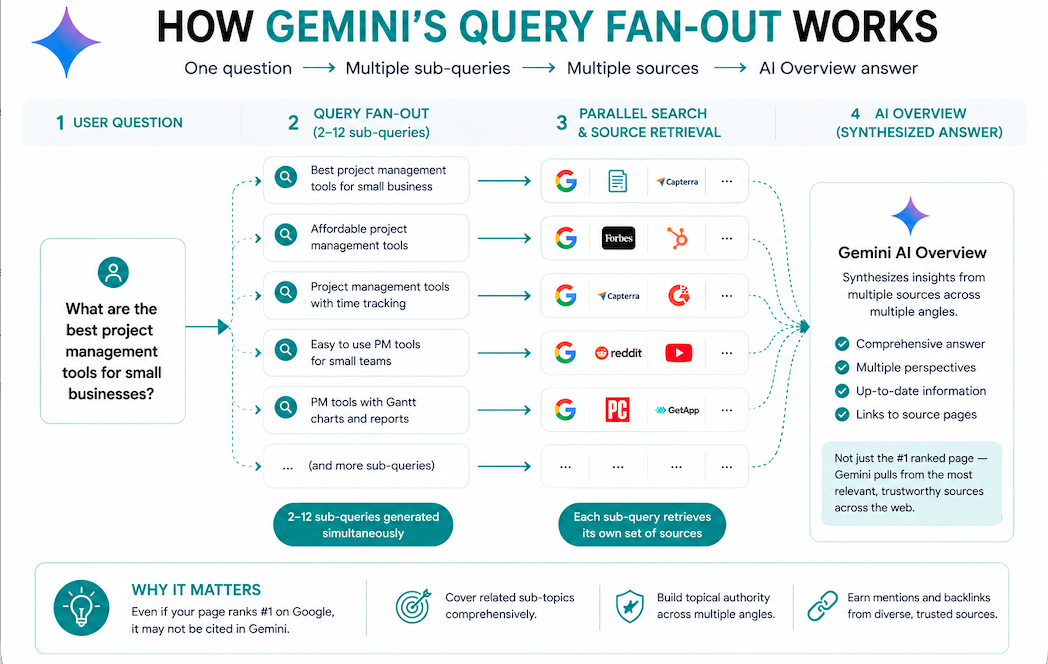
The mechanism driving this change is query fan-out. When a user asks Google AI Mode a question, it parses entities, constraints, and intent, then decomposes the prompt into multiple sub-queries that run simultaneously across Google's search index — typically 2 to 12 sub-queries per prompt, each retrieving candidate passages independently. A page that ranks #1 for the original query may not rank highly for any of the sub-queries. A page that ranks moderately across many sub-queries may get cited more consistently than the #1 result.
What Gemini Prioritises
- Topical depth and cluster coverage — a pillar page linking to multiple spoke pages each covering sub-topics creates more fan-out citation surfaces than a single well-optimised page
- Google indexability as a prerequisite — Gemini is the only major AI that renders JavaScript correctly; sites built on React, Vue, or Next.js that are poorly configured may be invisible to ChatGPT and Claude but readable by Gemini
- Entity clarity and structured data — Google's index is entity-aware; schema markup and consistent entity signals directly improve Gemini citation probability
- Google-owned and partner sources — Reddit (via Google's $60M data partnership), YouTube, and Google's own properties appear frequently in AI Overview citations
ChatGPT remains the highest-volume AI platform — OpenAI claims 800 million weekly users in Q1 2026 — which makes appearing in ChatGPT responses commercially significant for most B2C and B2B brands. But its citation behaviour is the most selective and least transparent of the four major platforms.
ChatGPT blends training data with selective web search. For informational queries within its training window, it often answers from training data without citing any live sources. When it does search, it uses Bing and applies a selection layer that prioritises fewer, higher-authority sources over the multi-source citation approach Perplexity uses. Qwairy's analysis found ChatGPT is more selective — it picks fewer sources than Perplexity but from a marginally broader spectrum of domains.
ChatGPT's content freshness window is the sharpest of the four: its citations are on average 25.7% more recent than Google's organic results. If Perplexity rewards "this month" and Claude rewards "this quarter," ChatGPT rewards "this week."
What ChatGPT Prioritises
- Recency — freshly published or recently updated content has a disproportionate citation advantage; updating older content with new data or a new date is a meaningful tactic
- Brand recognition from training data — this is where the Seer Interactive post-hoc citation hypothesis is most visible; ChatGPT is more likely to cite content from brands it already has associations with in training data
- News and authoritative publications — news sources dominate citation patterns in ChatGPT's source type analysis; earning coverage in industry publications creates training data associations that owned content cannot replicate
- Answer-first formatting — ChatGPT's selective retrieval rewards content that delivers a clear, complete answer in the first paragraph rather than building to it
Claude is the platform with the most distinctive citation philosophy among the four. Suprmind's multi-model divergence analysis positions Claude as the leading model for calibration — at 36% hallucination rate on the AA-Omniscience benchmark versus ChatGPT's 86%, Claude achieves this primarily by refusing to answer when it is uncertain rather than generating a confident but incorrect response. That calibration-first approach shapes its citation behaviour: Claude is more likely to decline to cite than to cite inaccurately.
Claude has the longest freshness window of the four platforms. Claude is roughly 3× more likely than ChatGPT to cite content that is 2–4 weeks old, and only 36% of its journalism citations come from the last 12 months versus ChatGPT's 56%. This means evergreen, high-quality content remains competitive in Claude citations long after it would have aged out of ChatGPT's selection window.
What Claude Prioritises
- Trust and accuracy signals — Claude's calibration focus means it prioritises sources with named authors, verifiable expertise, clear publication dates, and external corroboration
- Technical and B2B content — developer and B2B researcher audiences have shifted heavily to Claude and Perplexity; technical content with precise specifications, clear methodology, and named sources performs well
- Evergreen depth over recency — unlike ChatGPT's freshness bias, Claude rewards comprehensive, well-structured content that holds up over time; a thorough guide published three months ago can outperform a recent but thin update
- E-E-A-T signals — named authors with verifiable credentials, author bio pages, and consistent expert attribution directly improve Claude citation probability
The Data: What Gets Cited Across All Four Platforms
Despite the structural differences above, five content signals consistently improve citation rates across all four platforms. Every large-sample study we reviewed — Qwairy's 118,000 responses, Semrush's 150,000 citations, and Ahrefs' 863,000 SERP analysis — converges on the same patterns.
What Works Across All Four
| Signal | Why It Works Across All Platforms | How to Apply It |
|---|---|---|
| Answer-first structure | All four platforms retrieve the most relevant passage per section — an answer capsule at the top of each H2 is the primary citation target regardless of platform | Open every section with a 40–60 word direct answer before any context or explanation |
| Sourced statistics with named attribution | All four reward verifiable, attributable claims over generic assertions — the source name must appear in the sentence, not just as a hyperlink | "According to [Source Name]'s [Year] study, [specific stat]" rather than just a linked number |
| Clean technical access | All four crawlers must be able to access your content — robots.txt blocks, JavaScript-only rendering, and page speed failures affect all platforms | Allow GPTBot, PerplexityBot, ClaudeBot, and Googlebot; ensure key content renders in static HTML |
| Schema markup | Structured data helps all four platforms identify content type, author expertise, and entity relationships more reliably | Article + FAQPage + Author schema on all key pages; LocalBusiness or Organization on your homepage |
| Off-site authority signals | All four platforms are trained on or index the broader web — third-party mentions and citations build the brand recognition that determines whether you get into the consideration set at all | Earn mentions in publications each platform is known to draw from: industry blogs, review platforms, news outlets |
The temptation when you read platform-specific data is to carve out separate content strategies for each AI tool. We think that is largely the wrong move — especially for businesses that do not yet have strong visibility on any platform. A shared foundation executed well covers 80% of what matters across all four. The platform-specific adjustments — freshness cadence for ChatGPT, topical cluster depth for Gemini, factual density for Perplexity, author trust signals for Claude — are meaningful but secondary optimisations. Fix the foundation first, then calibrate per platform once you have baseline citation data to work from.
Platform-Specific Priority Guide
If you have limited resources and need to choose where to focus first, here is how to prioritise based on your business type and audience:
| Business Type | Primary Platform Focus | Secondary Focus | Reason |
|---|---|---|---|
| Local service business (clinic, renovation, F&B) | Gemini / AI Overviews | ChatGPT | Gemini dominates local queries via Google index; ChatGPT has the largest user base for discovery |
| B2B SaaS or technology | Perplexity + Claude | ChatGPT | Developer and B2B research audiences have shifted heavily to these two platforms |
| E-commerce / consumer products | ChatGPT | Perplexity | Largest user base for product research queries; Perplexity for comparison research |
| Content / media / publishing | All four equally | — | Content brands benefit from multi-platform citation presence; no single platform dominates |
| Professional services (legal, accounting, consulting) | Claude + Perplexity | Gemini | Trust and accuracy signals dominate; Claude's calibration-first approach rewards expert credentials |
Your Platform-Specific Action List
To improve ChatGPT citations:
- ✓ Update your most important pages with fresh data, new examples, or current date stamps — ChatGPT's recency bias strongly favours recently updated content
- ✓ Earn mentions in news and industry publications — ChatGPT's training data bias means off-site brand recognition drives selection more than page optimisation
- ✓ Ensure your content answers the question in the first paragraph — ChatGPT's selective retrieval rewards content that delivers immediately
To improve Gemini / AI Overview citations:
- ✓ Build topical content clusters — a pillar page linked to five or more sub-topic pages creates multiple fan-out citation surfaces from a single user query
- ✓ Verify Googlebot access and ensure your key pages are indexed — Gemini cannot cite what Google cannot find
- ✓ If you are on React, Vue, or Next.js, audit server-side rendering — Gemini is the only AI that renders JavaScript reliably, but misconfigured JavaScript sites may still fail
- ✓ Add entity-level schema markup — Gemini's Google Search grounding makes entity clarity a direct citation lever
To improve Perplexity citations:
- ✓ Increase factual density — add more specific statistics, named case studies, and verifiable claims per section
- ✓ Publish or update content consistently — Perplexity's live index rewards freshness aggressively
- ✓ Allow PerplexityBot in your robots.txt — check
yourdomain.com/robots.txtand confirm it is not blocked - ✓ Structure content for multi-citation extraction — each section should contain multiple discrete, citable facts rather than one flowing argument
To improve Claude citations:
- ✓ Add a detailed author bio with verifiable credentials — Claude's calibration-first approach rewards named expertise over anonymous content
- ✓ Focus on evergreen depth rather than recency — Claude's longer freshness window means a comprehensive guide published three months ago can outperform a thin recent update
- ✓ Include publication date and "last updated" signals prominently — Claude uses date signals to assess reliability
- ✓ Prioritise accuracy and hedging over confident generalisations — Claude is trained to prefer sources that acknowledge uncertainty over sources that overpromise
Final Thoughts
The four major AI search platforms are not interchangeable distribution channels. They have different architectures, different source preferences, and different definitions of what makes a source worth citing. A brand that treats them as one channel will always optimise for the wrong thing on at least two of them.
The practical approach is not to build four separate strategies — it is to build one strong foundation and then layer platform-specific optimisations on top once you have citation data to guide prioritisation. A well-structured, technically accessible, authoritatively written piece of content will out-cite a keyword-optimised page on every one of these platforms. The platform-specific tactics are a multiplier on a solid base — not a substitute for it.
Stay current with how AI citation behaviour evolves across all four platforms by following our AI SEO updates.