Key takeaways
- AI SEO performance is no longer measured by rankings alone, but by visibility inside AI-generated answers.
- The most important KPIs are brand mentions, citations, and AI-driven impact metrics.
- Citation frequency matters more than backlinks in AI search environments.
- Visibility across platforms like ChatGPT, Google AI Overviews, and Perplexity is becoming essential.
- Brand presence across the web strongly influences whether AI systems include your content in responses.
Table of Contents
Search has fundamentally changed.
Today, users don’t just browse results — they get direct answers from AI tools like ChatGPT, Google AI Overviews, and Perplexity. That means your brand doesn’t just need to rank — it needs to be mentioned, cited, and trusted inside those answers.
If you’re still purely based on traffic and rankings to measure AI SEO performance, you’re missing the real picture.
Because in AI search:
- You can influence users without clicks
- You can build awareness without visits
- And you can lose visibility without noticing
This shift is why frameworks around generative engine optimisation metrics are starting to redefine how performance is measured.
What is AI SEO Performance (And Why is it Different)?
AI SEO — often called Generative Engine Optimization (GEO) — focuses on how your brand appears in AI-generated answers.
Unlike traditional SEO:
- You’re not just competing for positions
- You’re competing for inclusion in answers
And that changes what you measure.
Modern KPI models now include:
- Brand mentions in AI responses
- Citation frequency
- AI-driven traffic
- Sentiment and accuracy
These reflect how AI search visibility KPIs are evolving beyond traditional ranking signals, while still connecting back to foundational SEO performance indicators used to measure traffic, conversions, and growth.
The 3 Core Pillars of AI SEO performance
To simplify things (and avoid vanity metrics), you can break AI SEO into three main areas:
- Visibility (Are you showing up?)
- Citations (Are you being referenced?)
- Impact (Is it driving results?)
Everything else fits into these.
1. Visibility KPIs: Are you Appearing in AI Answers?
This is your baseline metric.
If your brand isn’t appearing in AI responses, nothing else matters.
Key Metrics to Track
- AI Mentions
How often your brand is mentioned in AI-generated answers.
- This indicates whether AI models recognise your brand as relevant
- Even without links, mentions influence perception
This closely mirrors how brand visibility in search ecosystems has traditionally been evaluated — just applied in a different environment.
- Share of Voice (SOV) in AI
Your visibility compared to competitors.
- If 10 brands are mentioned and you appear in 7 → strong SOV
- If you appear in 1 → weak positioning
The principle remains the same — you’re measuring presence relative to competitors, just within AI-generated outputs instead of search listings.
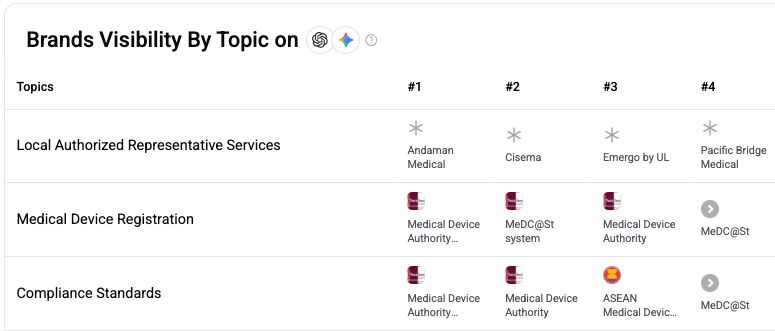
- Brand Visibility Across Platforms
Track visibility across:
- ChatGPT
- Google AI Overviews
- Perplexity
- Gemini
Each platform pulls from different sources — so your visibility may vary depending on where your brand is being referenced.

Key Insight
More mentions across the web = more AI visibility.
There’s still a strong tendency to equate content volume with performance, but the relationship between brand mentions and visibility is often stronger than simply publishing more pages.
2. Citation KPIs: Are You Being Used as a Source?
Visibility is step one.
But citations are where authority is built.
What counts as a citation?
In AI search:
- A citation = your content is referenced or linked
- A mention = your brand is named
Citations are more valuable because they:
- Drive traffic
- Signal credibility
- Reinforce authority
Key Metrics To Track
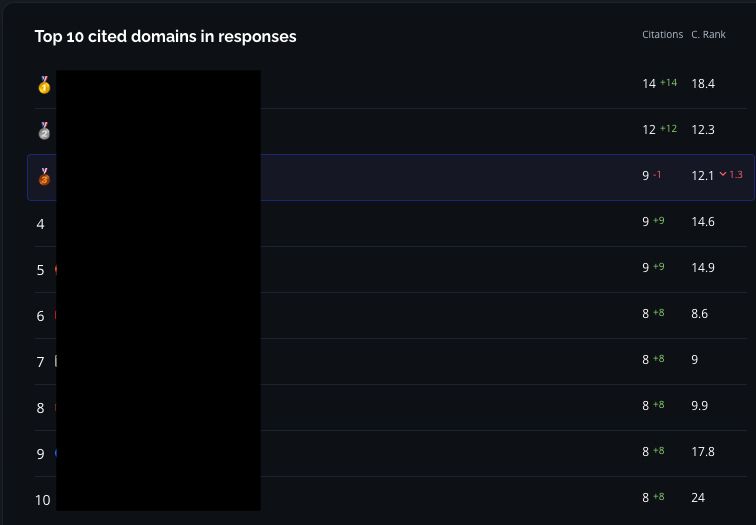
- AI Citation Frequency
How often your site is cited in AI answers.
Example:
- Your blog appears in 3 out of 10 responses → 30% citation rate
- Citation Sources
Where AI is pulling your content from:
- Blog posts
- Product pages
- Guides
- External mentions
- Retrieved vs Indexed Pages
Not all indexed pages are used by AI.
You need to track:
- Which pages AI retrieves
- Which pages it ignores
This reflects a growing distinction between content that is simply available and content that is actually used in AI-generated responses.
- Backlinks vs AI Citations
Traditional SEO focuses on backlinks.
But in AI SEO:
- Backlinks = authority signals
- Citations = actual usage in answers
Example
A finance blog might have:
- 500 backlinks
- But only 2 AI citations
This means:
- It ranks well
- But isn’t considered “answer-worthy”
3. Impact KPIs: Is AI Visibility Driving Results?
This is where most strategies fail.
Because visibility alone ≠ business growth.
Key Metrics to Track
- AI-Driven Traffic
Traffic coming from:
- ChatGPT
- Perplexity
- AI Overviews
- Conversion Rate from AI Traffic
Are these visitors converting?
- Assisted Conversions
AI often influences users before they click.
- Brand Lift
Indirect effects:
- Increased branded search
- Higher trust
- Better recall
These are the same signals traditionally used to evaluate brand strength — now influenced by AI exposure.
The New KPI framework (AI SEO vs Traditional SEO)
| Category | AI SEO KPI | Traditional SEO KPI | What it means |
|---|---|---|---|
| Visibility | AI mentions | Rankings | Are you included in answers? |
| Authority | Citations | Backlinks | Are you trusted as a source? |
| Reach | Share of voice | SERP visibility | How often you appear vs competitors |
| Traffic | AI referrals | Organic traffic | Are users clicking through? |
| Impact | Conversions | Conversions | Is it driving revenue? |
What Actually Influences AI Visibility?
Let’s challenge a common assumption:
“If I rank high, I’ll show up in AI.”
Not necessarily.
What matters more is:
1. Brand Mentions Across the Web
A strong presence across multiple platforms plays a bigger role than isolated content performance.
2. Content Clarity and Structure
AI prefers:
- Clear answers
- Structured content
- Direct explanations
3. Multi-Platform Presence
AI pulls from:
- Blogs
- Forums
- Videos
- Documentation
Which means your visibility depends on your broader digital footprint — not just your website.
4. Sentiment and Reputation
How your brand is perceived affects:
- Whether it appears
- How it is described
This is increasingly part of AI visibility evaluation models.
Common Mistakes Businesses Make
Tracking rankings only
AI doesn’t show rankings — it shows answers
Ignoring brand mentions
Mentions influence visibility more than links
Chasing traffic only
AI reduces clicks — but still drives decisions
Overproducing content
More pages ≠ more visibility
How to Actually Improve Your AI SEO Performance
1. Optimise for “Answerability”
Ask:
- Does this content answer a question clearly?
- Can AI extract this easily?
2. Build Brand Presence Beyond Your Website
You need mentions from:
- Blogs
- Media
- Communities
- Social platforms
3. Strengthen Entity Signals
Make your brand:
- Recognisable
- Consistent
- Well-defined
4. Track AI Visibility Regularly
Use tools (or manual prompts) to check:
- Are you appearing?
- Where are you missing?
If you’re exploring tools for this, your breakdown of AI SEO tools in 2026 already covers platforms that are starting to include visibility tracking features.
5. Focus on Authority, Not Volume
High-quality, trusted content consistently outperforms high-volume publishing — especially in AI-driven environments
Building a Connected SEO Strategy
AI SEO doesn’t work in isolation.
It connects directly with:
- Your AI SEO tools strategy (tracking visibility and citations)
- Your SEO pricing and investment decisions (resource allocation)
- Your understanding of AI SEO terminology and frameworks
When these are aligned, you’re not just optimising content — you’re building a system.
Final Takeaway: What Really Matters in AI SEO
AI SEO performance comes down to:
- Are you being mentioned?
- Are you being cited?
- Is it driving real impact?
Because in AI search:
You’re not trying to rank.
You’re trying to be the answer.
FAQ
What is AI SEO performance?
AI SEO performance measures how often your brand appears in AI-generated responses, rather than just traditional search rankings. It focuses on visibility, citations, and influence across AI platforms.
How is AI SEO different from traditional SEO?
Traditional SEO focuses on rankings and traffic, while AI SEO focuses on inclusion in AI answers, brand mentions, and citation frequency across generative search systems.
What are the most important AI SEO KPIs?
The main KPIs include AI mentions, citation frequency, share of voice in AI platforms, AI-driven traffic, and conversion impact from AI-generated visibility.
Why are citations more important than backlinks in AI SEO?
Backlinks help with authority in traditional search, but citations show whether AI systems actually use your content as a source when generating answers.
How do I track AI SEO performance?
You can track AI SEO performance by monitoring brand mentions across AI tools, analysing referral traffic from AI platforms, and checking which pages are being cited in AI responses.