
Key takeaways
- Optimising for AI search requires answer-first content, strong structure, and clear entity signals
- Websites are more likely to appear in AI results when content is easy to extract, summarise, and cite
- Building visibility depends on topical authority and consistent internal linking across related content
- Long-term success comes from combining structured content, real examples, and external trust signals
Table of Contents
AI search optimisation isn’t about ranking anymore — it’s about being selected as the answer.
If your content isn’t structured in a way that AI tools can extract, summarise, and trust, it won’t appear — no matter how strong your SEO is. Businesses that are winning right now focus on answer-first content, strong topical authority, and clear structure, which is why many are shifting toward AI search optimisation strategies instead of traditional keyword-heavy approaches.
In this blog, we will guide you step by step on how to optimise your website for AI Search.
Why AI Search Is Changing SEO
Traditional SEO was simple:
Rank higher → get clicks
AI search flipped that:
Be the best answer → get cited
Platforms like ChatGPT and Google AI Overviews don’t just list results — they generate responses. That means your content is competing to be used, not just seen.
The shift toward optimising for AI-generated answers has made structure, clarity, and credibility more important than keyword density.
If your content is:
- Hard to scan
- Too fluffy
- Not directly answering questions
It gets ignored.
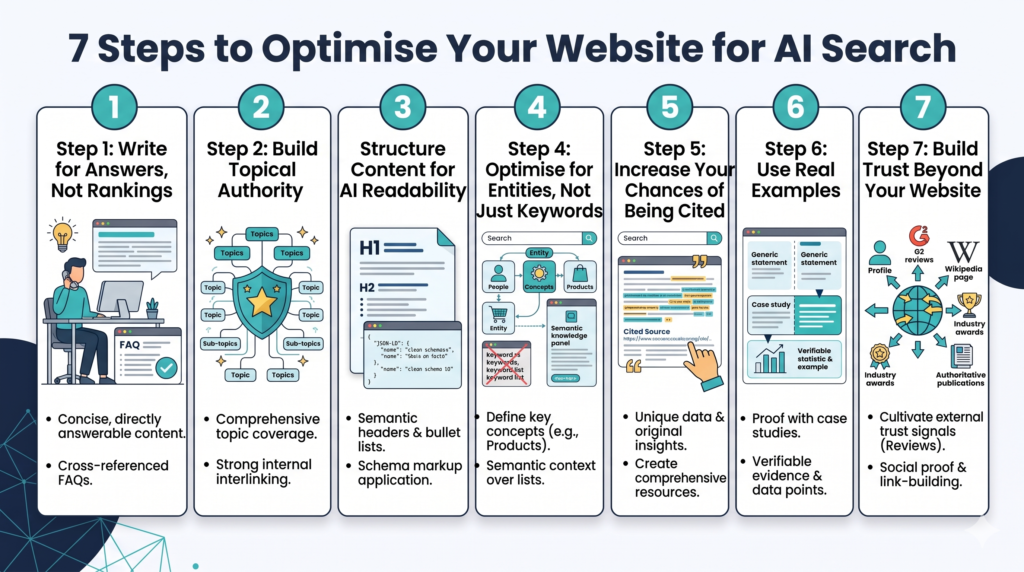
Step 1: Write for Answers, Not Rankings
Most content still reads like it’s trying to impress Google.
AI doesn’t care about that — it cares about clarity.
What works now:
- Direct questions as headings
- Immediate answers (first 2–3 lines)
- No filler intros
Example:
Bad:
“AI SEO is becoming increasingly important in today’s digital landscape…”
Better:
“What is AI SEO? AI SEO is the process of structuring content so AI tools can extract and cite it in generated answers.”
That second version is what gets picked up.
Step 2: Build Topical Authority (Not Just One Article)
One strong blog won’t make you visible in AI search.
You need content depth.
AI systems evaluate whether your site consistently covers a topic, which is why understanding LLM optimisation and content ecosystems is critical if you want long-term visibility.
What this looks like:
Instead of publishing one post:
You build:
- AI SEO tools
- AI SEO ROI
- AI SEO strategy
- AI SEO mistakes
And connect them.
Internal Linking (Example)
Many businesses struggle to justify investment early on, especially when measuring AI SEO ROI, which directly impacts how aggressively they scale their strategy over time.
That’s how you:
- Build context
- Strengthen authority
- Help AI connect your content
Step 3: Structure Content for AI Readability
Structure isn’t design — it’s strategy.
AI breaks content into chunks and evaluates each section independently. If your formatting is weak, your content doesn’t get selected.
What works best:
- Bullet points
- Tables
- Short paragraphs
- Clear headings
Example Comparison
| Element | Traditional SEO | AI SEO |
|---|---|---|
| Focus | Rankings | Answer selection |
| Content style | Long-form | Structured + direct |
| Keywords | Primary | Secondary |
| Authority | Backlinks | Context + trust |
Businesses applying practical AI search strategies are already restructuring content this way — and seeing faster results.
Step 4: Optimise for Entities, Not Just Keywords
Here’s where most strategies fall apart.
AI doesn’t just read words — it understands entities:
- Brands
- Tools
- People
- Concepts
If your content lacks clear references, it becomes vague.
Example:
Instead of:
“Use SEO tools to improve performance”
Write:
“Tools like Semrush, Ahrefs, and SE Ranking help businesses track visibility and optimise performance across search and AI platforms.”
Now you’re:
- Providing clarity
- Adding context
- Increasing trust
This is a key part of optimising websites for AI understanding rather than just keyword relevance.
Step 5: Increase Your Chances of Being Cited
This is the part most people ignore.
You’re not trying to rank — you’re trying to be quoted.
So your content needs to be:
- Specific
- Clear
- Confident
Weak statement:
“SEO helps businesses grow”
Strong statement:
“A well-structured SEO strategy can deliver 3x–5x ROI when supported by consistent content and proper tracking.”
AI prefers:
- Numbers
- Definitions
- Clear claims
Step 6: Use Real Examples (Not Just Theory)
AI models favour content that feels grounded.
That means:
- Case studies
- Real scenarios
- Practical insights
Writers who focus on actionable SEO strategies tend to outperform those who stay theoretical.
Example Case Study:
A small renovation company in Malaysia shifted from traditional blog content to AI-optimised structure:
What they changed:
- Rewrote articles into Q&A format
- Added internal linking across related topics
- Focused on specific, answer-driven sections
Results (within 6 months):
- +180% organic traffic
- Featured in Google AI Overviews
- 2x increase in inbound leads
Step 7: Build Trust Beyond Your Website
AI doesn’t rely only on your site.
It looks at:
- Mentions
- Consistency
- External validation
If your brand exists in multiple places, you’re more likely to be selected.
What helps:
- Being referenced in articles
- Active presence on platforms like LinkedIn
- Consistent brand messaging
Without these signals, even good content struggles to get picked up.
AI Search Optimisation Framework
| Step | Focus | Outcome |
|---|---|---|
| 1 | Answer-first writing | Extractable content |
| 2 | Topical authority | Stronger trust |
| 3 | Structured formatting | Better readability |
| 4 | Entity clarity | Improved understanding |
| 5 | Citation readiness | Higher visibility |
| 6 | Real examples | More credibility |
| 7 | External signals | Authority boost |
Common Mistakes to Avoid
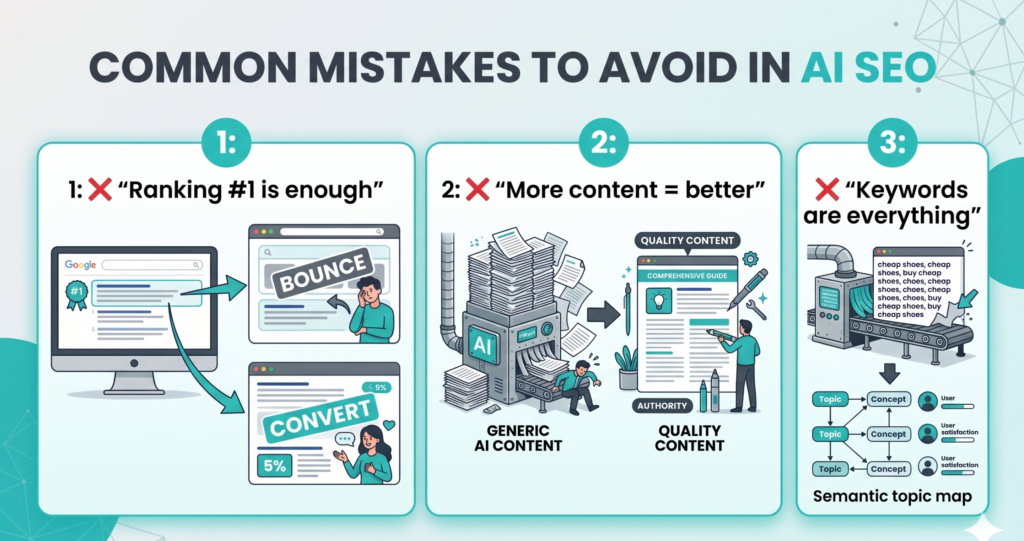
Let’s challenge a few assumptions:
❌ “Ranking #1 is enough”
Not anymore. AI often skips top results.
❌ “More content = better”
Low-quality volume weakens authority.
❌ “Keywords are everything”
They matter — but structure and clarity matter more.
Conclusion
AI search isn’t a future trend, it’s already changing how content gets discovered.
The websites that win aren’t the ones with the most keywords or the longest articles. They’re the ones that are clear, structured, and easy to trust. If your content can answer questions directly, connect ideas across topics, and signal authority consistently, it stands a much higher chance of being selected in AI-generated responses.
At the same time, this doesn’t replace SEO, but it evolves it. The shift toward AI search optimisation strategies simply forces businesses to be more intentional with how content is written, structured, and connected.
If there’s one takeaway:
Don’t just create content to rank — create content that deserves to be quoted.
Because in 2026, visibility doesn’t come from being first.
It comes from being the answer.
FAQ
What does it mean to optimise a website for AI search?
It means structuring your content so AI systems can easily extract, understand, and cite it when generating answers, rather than relying only on traditional search rankings.
How do AI search systems choose which content to show?
They prioritise content that is clear, well-structured, and directly answers user intent, especially when it demonstrates topical authority and trustworthiness.
What are the most important steps for AI search optimisation?
Key steps include answer-first writing, strong content structure, entity clarity, internal linking, and building topical authority across related pages.
Why is content structure so important for AI search?
Because AI systems break content into sections and evaluate them individually, meaning well-structured pages are more likely to be extracted and cited accurately.
Do I need backlinks for AI search visibility?
Yes. While structure and clarity matter more, backlinks still help build authority and trust signals that influence whether AI systems consider your content reliable.
How can businesses improve their AI search performance quickly?
By improving content clarity, rewriting pages into question-answer formats, and connecting related topics through internal linking to strengthen overall authority.