
- Google has confirmed an "early-stage learning pilot" that pays publishers when their content significantly contributes to AI-generated answers in AI Overviews, AI Mode, and Gemini, the first direct compensation model of its kind from Google Search.
- So far, the pilot programme involves around 100 publishers. Payments vary from less than $1,000 over a period of months for small publications to over $1 million per year for the biggest earner, with one medium publisher receiving $50,000 to $60,000. Specialised sites with dedicated audiences usually make more.
- The click loss factor is relevant too: Pew Research discovered that in searches with an AI summary, only 8% of users clicked a traditional result (as opposed to 15% with no summary), while Ahrefs reported a 58% decrease in CTR associated with AI Overviews in position one.
- Publishers participating in the project get a Contribution tab in Search Console with information on monthly payments, but cannot yet see their payments per article.
- Currently, GEO signals (the density of the Answer Capsules, coverage of the topical clusters, authors' authority and accuracy of structured data) are the best application for this pilot programme.
Google is testing payments to publishers for the content used to power AI answers. The Google AI contribution pilot, first reported in mid-September 2026 and confirmed by Google as an "early-stage learning pilot," is the first formal mechanism through which publishers can earn revenue directly from their content appearing inside AI Overviews, AI Mode, and Gemini-powered search features. For anyone building a GEO strategy, this is the development that turns AI citation from a visibility metric into a potential income stream.
Until now, when a user searched Google and received an AI-generated answer built from your content, you got nothing from that interaction. Your article was the source material. Google's AI was the distributor. The user got the answer without clicking through to your site. The scale of this shift is not trivial: research by Pew Research (March 2025, 900 U.S. adults, 68,879 searches) found users clicked a traditional result in only 8% of searches that showed an AI summary, compared with 15% in searches without one. Ahrefs separately found that AI Overviews correlated with a 58% reduction in click-through rate for top-ranking pages. The contribution pilot is Google's direct response to the revenue impact of those numbers.
This post breaks down exactly what the pilot is, how the payment calculation works, what it means for your AI search optimisation strategy, and the specific steps you need to take right now to qualify and maximise your earnings.
What Is the Google AI Contribution Pilot?
The Google AI contribution pilot is a usage-based payment programme. When a user receives an answer generated by AI Overviews or AI Mode, that answer is built from content Google has indexed. The contribution pilot changes this by attaching a payment to instances where Google determines your content contributed "significantly" to the AI-generated response, making it the first direct compensation model of its kind from Google Search.
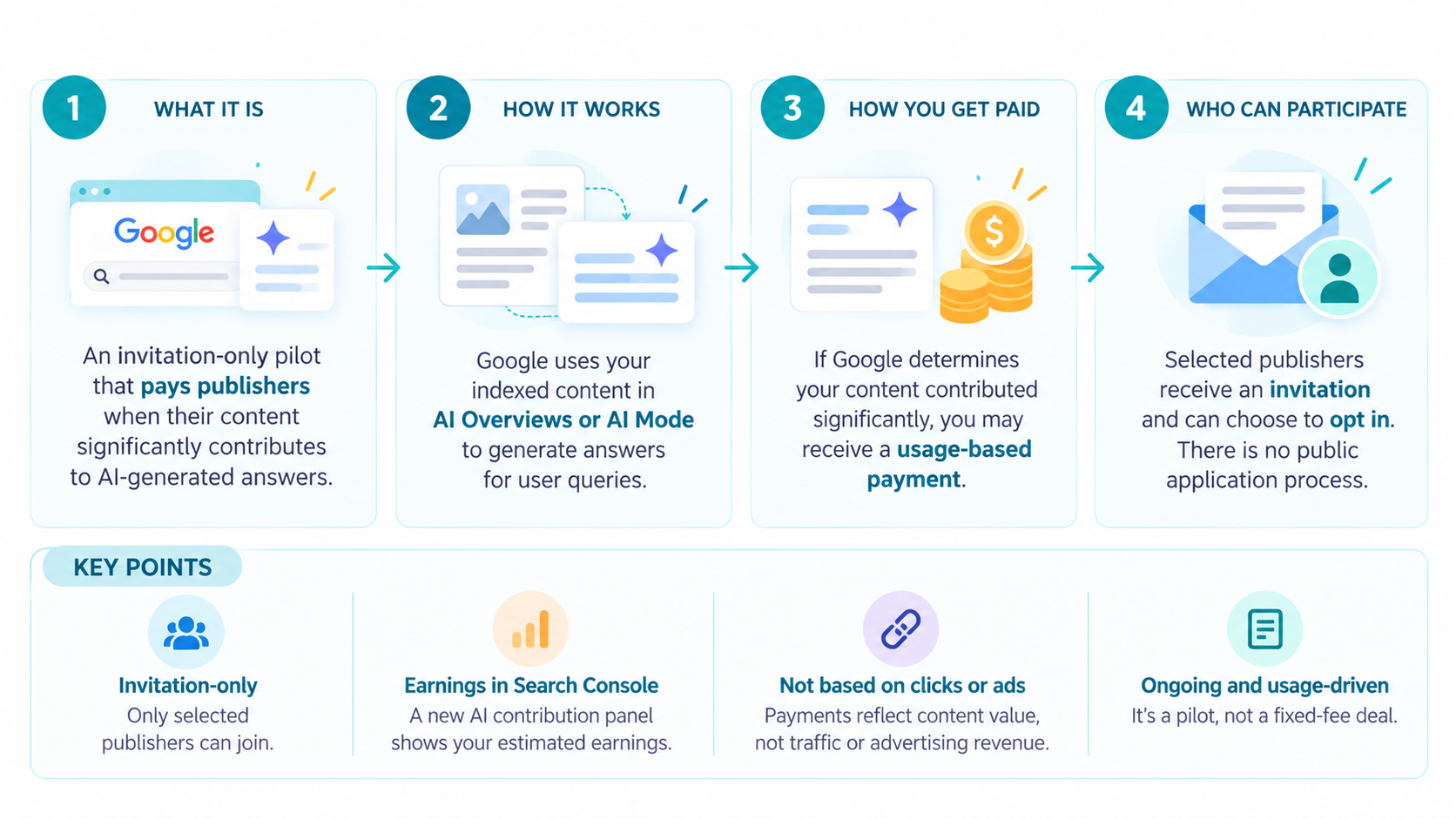
Based on reports from Digiday and Google itself, the initiative was announced in mid-September 2026. After a publisher is invited and opts in, an AI contribution panel appears inside Search Console showing a monthly earnings figure. Payment depends on Google's assessment of the value contributed, not raw clicks. Publishers can opt out at any time with no upfront fee or partnership required. Unlike fixed-fee licensing, payments are ongoing and usage-driven.
As per the company's own explanation, the goal is to reward high-quality content that forms the basis of generative answers and maintains their accuracy and freshness. It is supposed to be a supplement to traffic and tools already offered to publishers rather than the substitute for either. This should be kept in mind when assessing the programme: initial income is reported to be rather low in comparison to ad income earned by most participants and Google has not released any information about how the payment scheme works.
Google AI Contribution Payment Model Explained
The Google AI contribution pilot compensates publishers for each AI impression, rather than clicks, page views, or ad revenue share. This is a very different model from anything else currently available for digital publishers to earn money from. You need to understand the mechanism before you start working with it.
What Counts as an AI Impression
An AI impression is recorded each time your content is cited as a source in an AI-generated answer that is served to a user. If a user searches "how do I improve my website's AI search visibility" and Google serves an AI Overview that draws from your article on that topic, that is one AI impression for your property. If the same query is searched 10,000 times in a month and your article is cited in the AI Overview each time, that is 10,000 AI impressions. The AI Search Earnings panel inside Search Console shows you this count broken down by page, so you can see exactly which pieces of content are generating the most citation events.
How the Payment Value Is Determined
Google has confirmed that compensation reflects its "assessment of value," though it has not published the specific formula. What is clear from Google's own statements is that the model is not based on raw usage counts or clicks. Publishers currently cannot see how individual articles affected their overall payout, which means you are working with a total monthly figure rather than granular per-page rate data at this stage. Based on the content signals Google has described as important for AI citation quality, the most influential factors are likely citation consistency on a specific query (how reliably your content is selected when that query fires) and the informational significance of the query itself. The practical implication is that being a go-to source on a focused topic is more valuable than being occasionally mentioned across many broad ones.
The Shift From Traffic to Citation as a Revenue Event
The most important conceptual shift the pilot introduces is decoupling revenue from traffic. Under every previous digital revenue model, earning money required a user to arrive at your site. Ad impressions, affiliate clicks, product sales, newsletter sign-ups: all of these require the user to take the journey from the search results page to your domain. AI Overviews and AI Mode have been reducing that journey for millions of queries because users receive the answer directly inside the results page and never need to click.
This click reduction has been one of the most discussed tensions in the publisher-Google relationship since AI search features launched. The contribution pilot is Google's direct response: if the AI answer reduces the click, the citation that powered that answer now generates a payment instead. It does not fully replace lost traffic revenue, but it creates a parallel income stream that grows in proportion to how frequently your content is cited, regardless of whether those citations generate visits.
Reported payment figures from The Information via Search Engine Journal (October 2026) give the clearest picture of what publishers are actually earning at this stage:
The spread is significant: the top earner brings in over a million dollars annually while some smaller participants have received less than a thousand dollars across several months. Google has not published rates or a formula, and participants report that monthly figures change without explanation. Niche sites with committed audiences, such as those covering anime or gaming, reportedly earn more than broad general-interest publishers. Actual transfers may also differ from the displayed estimate due to tax deductions and local payment thresholds.
The honest framing for this pilot at its current stage: it is not a revenue replacement for lost clicks. For most publishers it is a small supplement. For a niche site that happens to be highly cited in AI answers on its subject, it can be meaningful. The strategic value of building for AI citation is real regardless of payment scale, because citation frequency is the signal that determines both your earnings today and your positioning as the programme scales. Per FluxGrowth's analysis, some publishers have even declined participation out of concern it could weaken their leverage in separate licensing negotiations with Google.
What the Pilot Changes for Your GEO Strategy
Before the AI contribution pilot, the business case for investing in GEO relied on a medium-term argument: build AI citation authority now so your brand is established when AI-driven search behaviour fully matures and the traffic eventually flows. That argument was sound, but it required patience and a tolerance for unmeasured returns. The pilot eliminates that tolerance requirement. Being cited by Google AI is now a measurable revenue event that compounds month over month.
Citation Frequency Is Now Your Primary Revenue Driver
The single most important metric in your AI SEO performance dashboard has changed. It is no longer organic rank, not domain authority, and not click-through rate. Under the pilot model, the metric that directly drives revenue is AI citation frequency per page, which is visible as AI impression count inside the Generative AI performance report in Search Console. The pages on your site that generate the most AI impressions are your highest-earning assets, and the gap between your top-performing and lowest-performing pages in citation frequency is now a gap in revenue, not just visibility.
To find this data, go to Search Console, open Performance, select Search results, and switch the Search type filter to Generative AI. Sort by Impressions descending. The pages at the top of that list are your current contribution earners. The pages with zero or near-zero impressions are your optimisation targets.
Answer Capsule Density Determines How Many Pages Qualify
Google's AI systems have a tendency to cite content that answers the questions being asked in a direct way. The key structural component that seems to have the most relation to the AI citations Google uses is the Answer Capsule. This refers to the capsule of information that explicitly answers the query that the section addresses in the first 100 words of the section itself. The AI is looking for the information that best fills the gap between the query and the answer.
A page that leads into its answers with some background paragraphs is much less likely to be cited by Google than pages where the answer is stated right away and then expanded upon later on. This is not a new concept in GEO but is certainly given concrete meaning through the new programme. The fact is that every page on your site that does not contain the Answer Capsule structure will be unable to earn any payment through the AI's work.
The Authority of Your Topicality Across the Cluster Amplifies Your Monetisation Opportunities
A page with high citation earns from all the searches it deals with. In case you have the entire topic cluster with pages that have information about the main topic, the subtopics, the comparison searches, and the how-to queries, you earn from all the queries related to that topic. This is because each page in the cluster acts as an individual citation point, meaning that the total number of impressions for that cluster becomes much larger than a single page would earn on its own. In terms of Malaysian brands, this means that you have to find one or two topics in which your company is a true expert.
Gemini Citations in AI Mode Carry the Highest Rate Weight
The pilot covers three AI surfaces: AI Overviews (the summary boxes at the top of standard search results), AI Mode (Google's conversational multi-turn search experience), and Gemini-generated answers. Of these, citations that occur inside AI Mode carry the strongest quality signal because they appear in response to higher-intent, more specific queries from users who are actively researching a topic rather than doing a quick lookup. Content that earns consistent citations in AI Mode is being used to answer the most engaged users in Google Search, and the quality weighting on those impressions reflects this.
To earn AI Mode citations, your content needs to handle follow-up query logic: it should not only answer the primary question but also address the secondary questions a reader would naturally ask next. This is the same structure that helps content get cited by ChatGPT and other conversational AI systems. The difference is that Google AI Mode citations now carry a direct payment attached to them.
How to Position Your Content for the Pilot
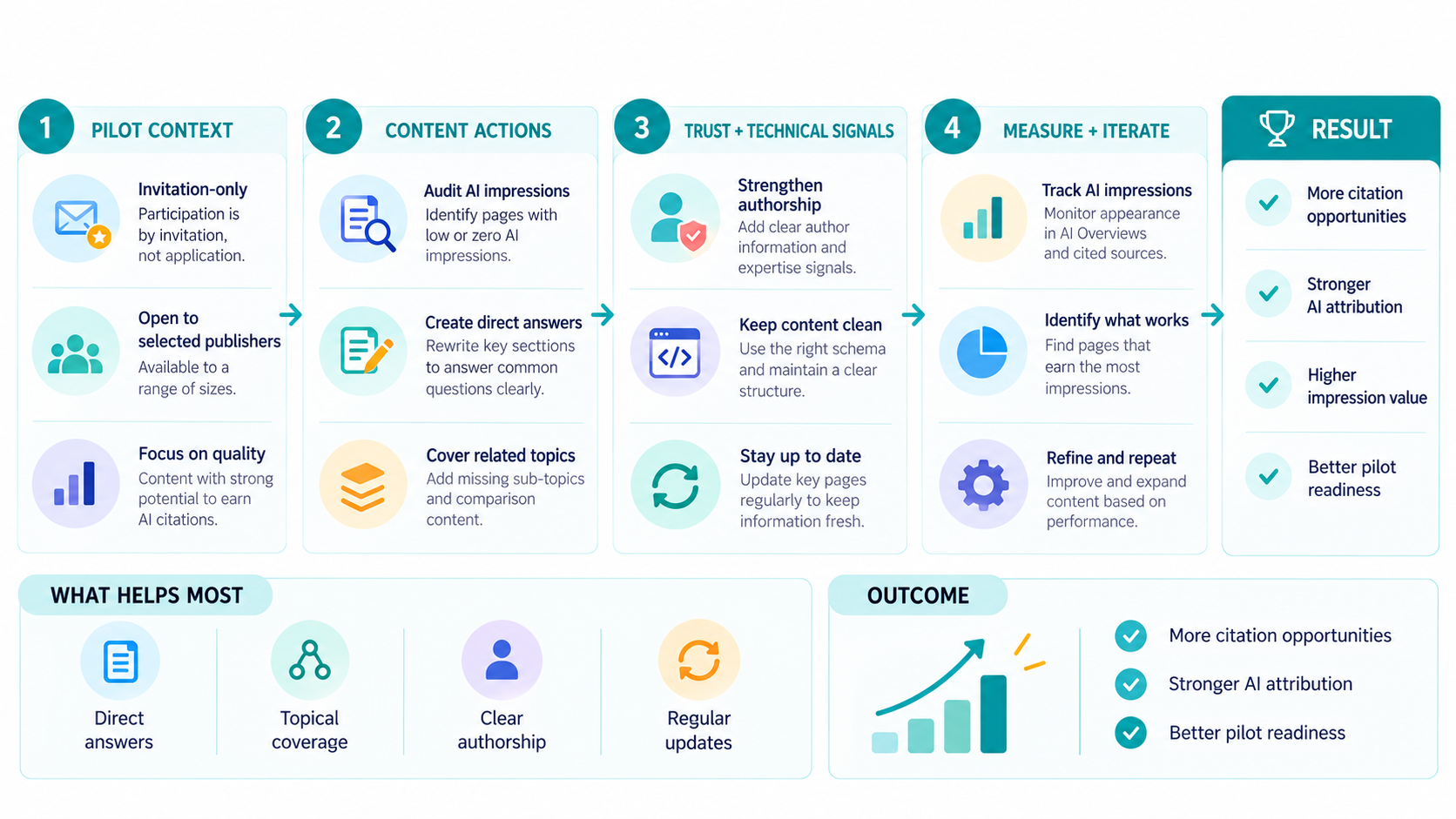
The pilot is currently invitation-only, and Google has not published eligibility criteria. What has been reported is that Google has approached at least dozens of publishers spanning news, informational, and niche content sites, and that the programme is not limited to large media organisations. Small and mid-sized publishers are among those invited. The most reliable inference is that high AI citation volume, content quality, and active Search Console presence are the factors Google is using to identify candidates. You do not apply. You build content that earns AI citations and position your property to receive an invitation. Here is the process.
-
1
Audit your Generative AI impression data in Search Console. Go to Performance, switch to the Generative AI search type, and export the page-level impression data. This is your baseline. Any page with more than zero AI impressions is already participating in the citation economy. Your job is to increase the impression count on those pages and bring the zero-impression pages into citation range.
-
2
Rewrite section openings on your top-traffic pages. For every page that ranks in standard organic search but shows low or zero AI impressions, review the first 100 words of each section. Replace introductory or context-setting language with a direct statement that answers the implied query of that section. Test the rewritten version against the AI Overview that appears for your target query: if your page is still not cited after 4 to 6 weeks, the opening is still not direct enough.
-
3
Map your topic clusters and identify coverage gaps. For each subject area your site covers, list the sub-topics, comparison questions, and how-to variants that a reader researching that subject would want answered. Each gap is a page you have not yet published. Each unpublished page is a citation opportunity you are not capturing. Build the missing pages to complete the cluster, using the same Answer Capsule structure in every section.
-
4
Strengthen your entity and authorship signals across all content. AI systems use entity signals to determine citation quality. This means your author bios should include verifiable credentials and links to professional profiles. Your brand name should appear consistently across your content, your About page, and your structured data. Your key topics should be covered by named authors who have a visible track record on those subjects. These signals tell the AI system that your content is authored by a credible source, which increases the quality weight applied to your citations.
-
5
Keep your structured data markup current and error-free. Structured data helps Google's systems parse and attribute your content accurately. An Article schema with accurate datePublished and dateModified values tells the AI system that your content is current. A correct author entity linked to a credible Person or Organization schema increases your attribution confidence score. Run your key pages through Google's Rich Results Test every quarter and fix any errors immediately.
-
6
Monitor the AI Search Earnings panel as soon as it appears in your account. Once you reach the eligibility threshold, the panel becomes your primary optimisation dashboard. Use the per-page breakdown to identify which pages earn the most per impression. Study those pages for structural patterns they share. Apply those patterns to your lower-earning pages. This is an iterative loop: more structured content produces more citations, more citations produce higher earnings, and higher earnings data tells you exactly which structure is working.
| GEO Signal | What It Does | Effect on Pilot Earnings |
|---|---|---|
| Answer Capsule in first 100 words of each section | Makes your content immediately parseable and attributable by Google AI systems | Direct: sections without this structure are rarely cited; no citation means no payment |
| Topical cluster coverage across sub-topics and variants | Creates multiple citation entry points across the full range of queries in a subject area | Multiplies your total impression volume; more pages earning citations compounds monthly |
| Named authorship with verifiable credentials | Signals citation trustworthiness to AI systems; increases quality weighting on attributed impressions | Raises the per-impression rate by improving citation quality classification |
| Article schema with current datePublished and dateModified | Confirms content freshness and accurate attribution to Google's structured data parser | Ensures impressions are logged under the correct property and page; prevents misattribution |
| Content freshness via regular updates | Keeps pages eligible for AI citation on fast-moving or time-sensitive query categories | Maintains citation volume on topics where stale content loses citation eligibility over time |
| Internal linking across the topic cluster | Signals topical depth and authority to Google's crawl and indexing systems | Supports cluster-wide citation eligibility by reinforcing the authority of each page in the group |
The brands that will earn the most from the AI contribution pilot are not the ones that react to the pilot announcement by rushing out thin content. They are the ones that have been doing consistent, structured GEO work for the past six to twelve months and already have a library of well-cited pages. If that describes your site, check your Search Console account now. If it does not, the audit and optimisation process above is where to start. The AI SEO performance metrics you need to track are already available inside Search Console. The difference is that they now carry a direct revenue value.
Frequently Asked Questions
Ready to Earn From AI Search?
Let AI SEO Agency build the GEO content strategy that positions your brand for Google AI contribution pilot payments and every AI search feature that follows it.
Get a Free AI SEO Audit