- ChatGPT Ads appear below the AI's response they do not influence which brands or sources ChatGPT cites inside the answer; organic citations remain determined entirely by GEO and AEO signals
- Paid ads only reach free-tier users; paid subscribers the higher-intent, higher spending segment never see them, making organic citation the only path to that audience
- Around 40% of consumers report trusting AI-generated answers more than paid ads which means the organic recommendation inside the answer carries more commercial weight than the sponsored card below it
- ChatGPT Ads create a new risk: a brand with weak organic GEO but active paid ads is funding exposure beneath answers that recommend competitors paid amplifies the organic gap, it does not close it
- The correct sequencing is organic GEO and AEO first, paid amplification second ads on top of an organic foundation work; ads instead of one do not
When ChatGPT Ads launched in February 2026, the immediate reaction from many marketers was some version of: does this mean GEO is over? If you can just buy your way into AI answers, why spend months building organic authority?
The answer is no and understanding exactly why requires understanding one structural fact that most early coverage of ChatGPT Ads buried in paragraph six.
ChatGPT Ads appear below the AI's response. They do not appear inside it.
That single distinction changes the entire strategic calculus. The sponsored cards appear after ChatGPT has finished answering they do not influence which sources ChatGPT cites in its organic response. When ChatGPT names a brand inside its answer, that is still organic earned through GEO and AEO signals, not purchased. Paid ads and organic citations are operating in two different parts of the same interface, serving two different purposes, and reaching two different audiences.
This blog is our perspective on what that means for how you should be thinking about AI visibility strategy in 2026 and where we think most businesses are about to make a costly mistake.
The Structural Fact Most Coverage Is Missing
The analogy that helps most: think about how Google's search results page is structured. The top has paid ads. Below them are organic results. The ads did not kill organic SEO they added a paid layer on top of it. Anyone who has run Google Ads for more than a year knows that ads and organic rankings serve different purposes at different moments in the funnel, and that the best performing brands invest in both rather than substituting one for the other.
ChatGPT is following the same structural model. OpenAI has been explicit that ads do not influence the answers ChatGPT gives answers are optimised based on what is most helpful to the user. The paid layer and the organic layer are separated by design. That separation is intentional it is the foundation of user trust in the product, and OpenAI would be undermining its own core value proposition if it allowed ad spend to influence what the AI recommends.
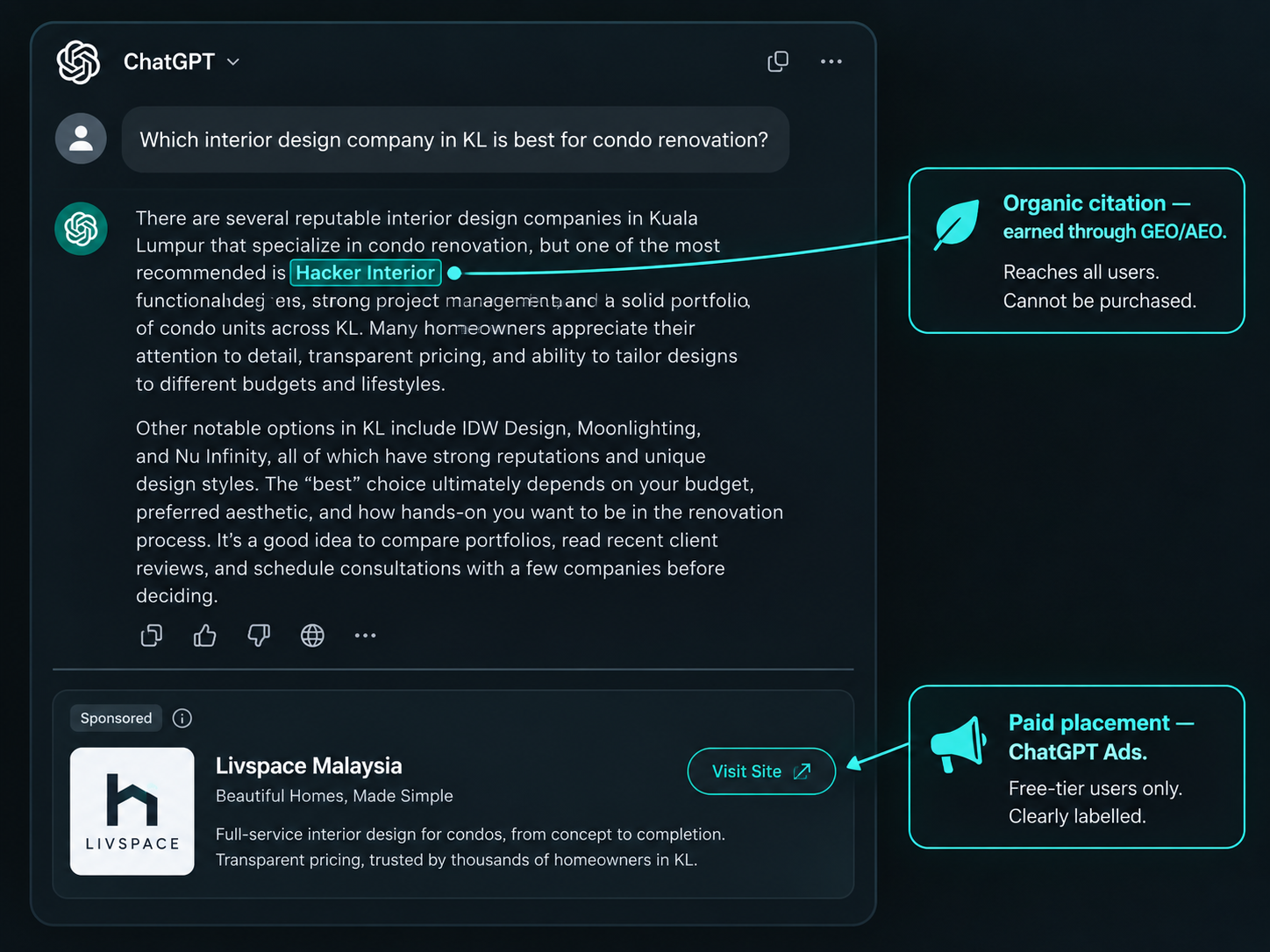
- Appears inside the AI's response
- Reaches all users — free and paid
- Cannot be purchased
- Driven by content structure, entity recognition, topical authority, off-site mentions
- Trusted by users as the AI's genuine recommendation
- Appears below the AI's response
- Reaches free-tier users only
- Purchased via OpenAI Ads Manager
- Driven by context hints, bid, and creative relevance
- Clearly labelled as sponsored
The Google Ads analogy is useful but has one important difference. In Google Search, a paid ad at the top of the page can effectively substitute for an organic ranking many users click the first result regardless of whether it is labelled sponsored. In ChatGPT, the answer is the product. The AI's response is what the user came for. The sponsored card below it is an afterthought. Users who came to ChatGPT for an authoritative recommendation are not going to override that recommendation because a sponsored card appeared beneath it. This makes the trust asymmetry between organic and paid significantly more pronounced in AI interfaces than in traditional search.
The Audience Gap That Changes Everything
There is a second structural fact that further widens the gap between paid and organic in ChatGPT one that has implications for how you think about budget allocation.
Organic citations reach every ChatGPT user regardless of subscription tier. Paid ads only reach free-tier users. ChatGPT's paid subscribers Plus, Pro, Business, Enterprise never see ads. That segment is, by definition, the more engaged, higher-spending, and typically higher-intent portion of ChatGPT's user base. The only way your brand reaches them is through organic citations.
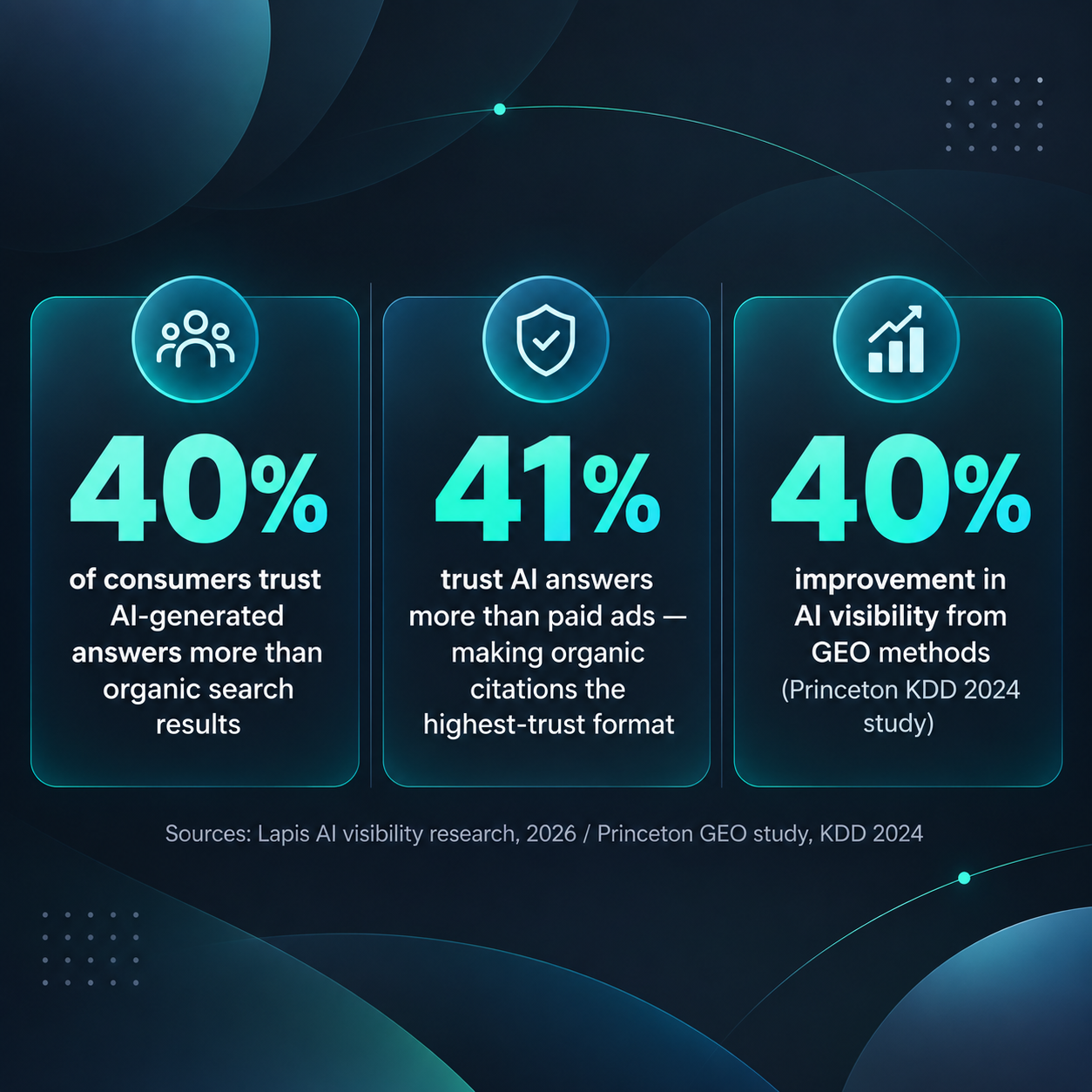
What these numbers mean together: users trust what the AI says more than what an advertiser pays to show them and that trust gap is widest for the paid-subscriber segment that never sees ads at all. The 40% GEO improvement figure from the Princeton study means that organic visibility is not only the more trusted format, it is also a measurable, improvable one. Sources: Lapis AI visibility research, 2026; Princeton GEO study, KDD 2024.
The 41% trust figure is the one that matters most for B2B and professional service businesses the same segment that has the highest ChatGPT paid subscription rates. If you are marketing to procurement teams, senior decision-makers, or professional buyers, that audience is disproportionately represented among ChatGPT's paid subscribers. They will never see your ChatGPT Ads. The only impression your brand makes on them inside ChatGPT is the one made by organic citation. This is not a theoretical future state it is the reality of how the platform is structured today.
What ChatGPT Ads Actually Change And What They Do Not
Contrary to the panic that accompanied the launch, ChatGPT Ads do not change the fundamentals of GEO or AEO. What they do change is the completeness required of an AI visibility strategy and the competitive stakes for brands that have neglected organic AI visibility.
What Does Not Change
- The signals that determine organic citations. Content structure, answer-first formatting, entity recognition, topical authority, schema markup, and off-site brand mentions all remain the levers that determine whether ChatGPT cites your brand inside its response. None of these are affected by the addition of a paid layer.
- The value of being cited organically. By late 2026, ChatGPT ads will be widely adopted, but organic citations will still make up the majority of brand mentions in AI responses. The organic layer is where the conversation happens. The paid layer is where the footnote sits.
- The compounding nature of GEO investment. Organic citations compound; ads rent attention. GEO work done today builds entity recognition and topical authority that persists and accumulates. Ad spend stops the moment the budget does.
What Does Change
- The risk for brands with weak organic presence. A brand that has invested in ChatGPT Ads but not in GEO is paying to put a sponsored card beneath answers that recommend competitors. The ad increases exposure to a response that is working against it. A brand that has earned no organic visibility but spends heavily on ChatGPT Ads gets surface-level exposure beneath the answer, but the answer itself still recommends competitors.
- The emergence of prompt conquesting. Just as advertisers bid on competitor keywords in Google Ads, marketers can now write context hints that target competitor brand queries on ChatGPT placing their sponsored card beneath responses where a competitor is cited organically. This is a legitimate tactic, but it only works if your organic foundation is strong enough to convert the traffic that clicks through.
- The intelligence value of ad data. ChatGPT Ads provide something GEO cannot easily produce on its own: data on which conversation contexts drive clicks and conversions. That data can directly inform your organic content strategy which context hints drive engagement tells you which prompts your audience is actually using.
The Right Sequencing And Where Most Businesses Are Getting It Wrong
The most common mistake we are seeing as ChatGPT Ads gain visibility as a marketing channel: brands treating it as a faster alternative to GEO rather than a complement to it.
The sequencing that works is clear. A 2026 MarketingDive benchmark of more than 350 brands found that teams allocating roughly 62% of budgets to lower-funnel search and early ChatGPT ads, while underfunding GEO and other upper-funnel authority plays, improved blended CPA by 12% when they shifted 10–15% of that spend into organic programmes. Even modest reallocation toward GEO produced measurable commercial improvement.
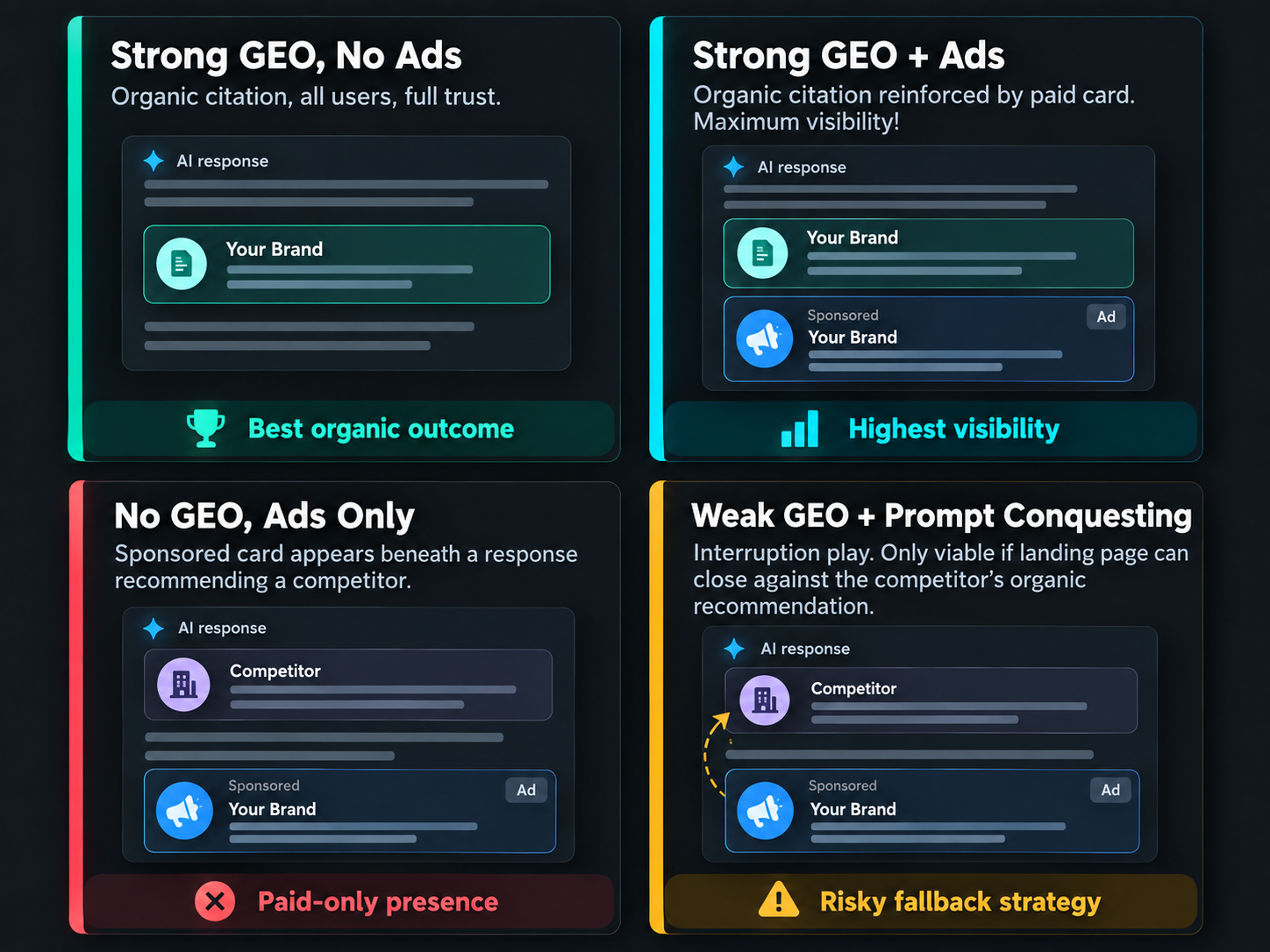
| Scenario | ChatGPT Answer Says | Sponsored Card Shows | Net Result |
|---|---|---|---|
| Strong GEO, no ads | Recommends your brand organically | No sponsored card | Organic citation full trust, all users including paid tier |
| Strong GEO + ads | Recommends your brand organically | Your sponsored card reinforces the organic mention | Maximum visibility organic credibility plus paid reinforcement |
| No GEO, ads only | Recommends a competitor | Your sponsored card appears beneath competitor recommendation | Funded exposure beneath a response that works against you |
| Weak GEO, ads as prompt conquesting | Recommends a competitor | Your sponsored card targets that competitor's queries | Interruption play only viable if your landing page can overcome the organic recommendation |
The scenario we see most often with Malaysian businesses considering ChatGPT Ads is the third row no meaningful organic GEO foundation, enthusiasm for the new paid channel. The appeal is understandable: ads feel faster and more controllable than months of content and entity work. But the structural reality of how ChatGPT surfaces content means that paid spend in this scenario is funding exposure to a conversation where a competitor is being recommended. That is not a media buy it is a subsidy for your competitor's organic presence. The right move is to use the period before ChatGPT Ads opens to Malaysian advertisers to build the organic foundation, so that when the paid channel becomes accessible, you are using it to amplify a position you have already earned rather than compensating for one you have not.
What This Means for Your AI Visibility Strategy Right Now
For Malaysian businesses, ChatGPT Ads is not yet a live channel the platform remains US and UK only as of October 2026. That is not a reason to ignore it. It is a window to get the organic foundation right before the paid competitive pressure arrives.
- Audit your current organic AI citation position. Before thinking about paid, know where you stand organically. Run your key category queries across ChatGPT, Perplexity, and Gemini. Is your brand cited? Accurately described? Or is a competitor appearing in your place? Use our AI SEO audit checklist as the starting point.
- Invest in GEO and AEO now, before paid competition intensifies. When ChatGPT Ads opens to more markets, the brands that will use it most effectively will be those that already have strong organic foundations. The organic work you do in the next six months will be more valuable and harder to replicate once the paid layer becomes competitive.
- Think about prompt conquesting as a future tactic, not a current one. If you have strong organic GEO and a competitor is being cited in AI responses for your key queries, prompt conquesting targeting those queries with paid ads becomes a legitimate competitive play. Without the organic foundation, it is an expensive way to be present beneath someone else's recommendation.
- Use paid ad data to inform organic strategy. When ChatGPT Ads does become available to you, the context hint performance data it generates which scenarios drive clicks, which do not is direct intelligence about how your audience is prompting AI tools. Feed that data back into your GEO content strategy.
Final Thoughts
ChatGPT Ads are a meaningful development not because they change how organic AI citations work, but because they make the stakes of organic visibility clearer. The interface now has two layers: an organic recommendation that every user sees and most trust, and a paid card beneath it that only free-tier users see and that is clearly labelled as advertising.
Which layer would you rather your brand be in?
The brands that will win in AI search over the next two to three years are the ones building the organic foundation now the entity recognition, topical authority, and content structure that makes them the natural answer to the questions their customers are asking AI tools. Paid ads can amplify that foundation. They cannot substitute for it.
Stay current with how AI search is evolving by following our AI SEO updates. For our complete guide to ChatGPT Ads mechanics, pricing, and campaign setup, read ChatGPT Ads: The Complete 2026 Guide for Marketers.
Before you consider ChatGPT Ads, find out whether your brand is being cited organically and which competitors are being recommended instead. Our free AI citation visibility audit shows you exactly where you stand across ChatGPT, Gemini, Perplexity, and Claude.
Request Your Free AI SEO Audit →