- AI visibility is not a single metric — it is a seven-layer stack where each layer compounds the one below it, from Technical SEO at the foundation to Measurement at the top
- Gartner predicted traditional search engine volume would drop 25% by 2026, and that projection has become a reality for many brands that only track Google rankings
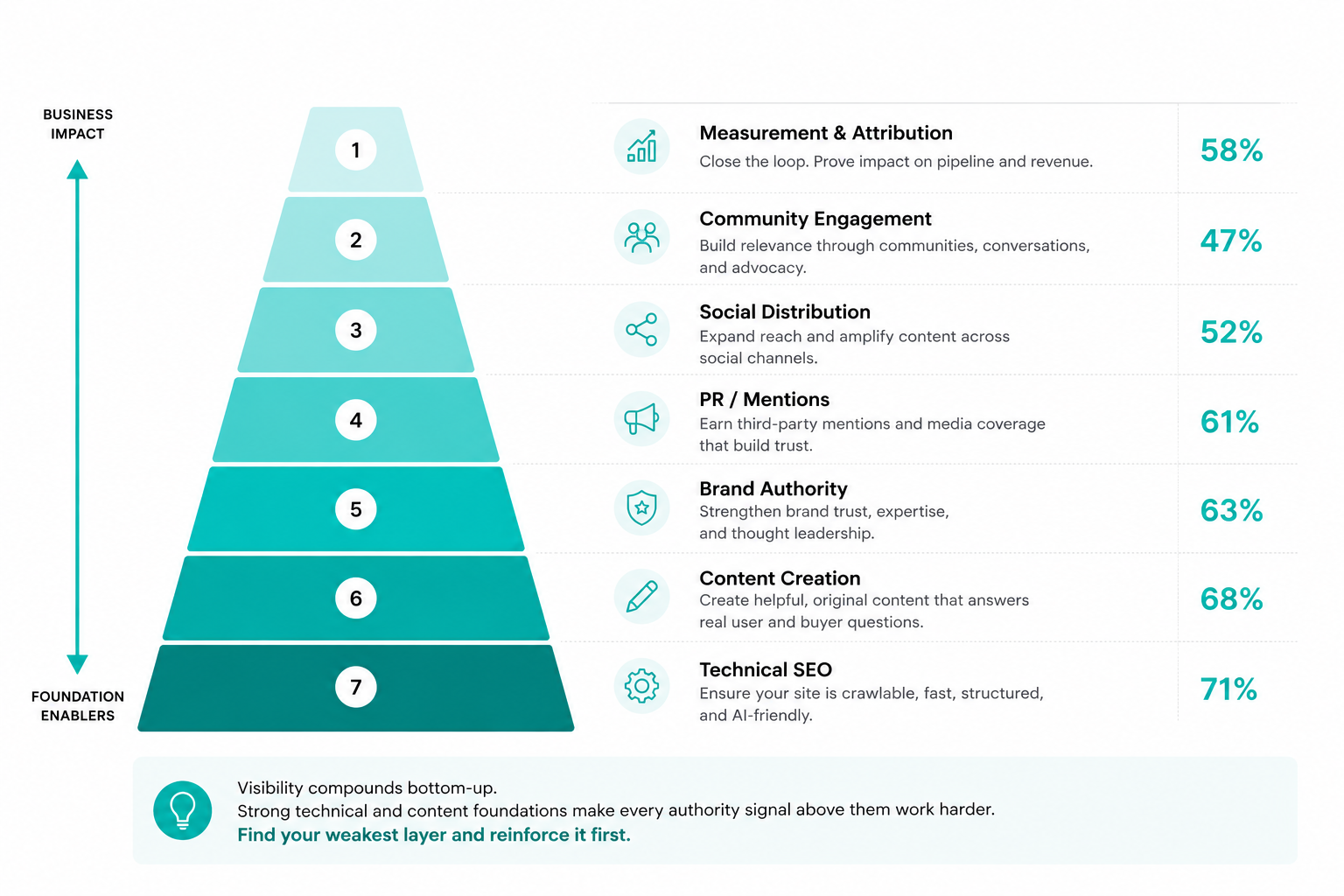
- NP Digital's research found Technical SEO (71% adoption) and Content Creation (68%) are the most commonly invested layers — but Brand Authority (63%), PR and Mentions (61%), and Measurement (58%) remain underdeveloped for most teams
- AI visibility operates as a compounding system: strong technical foundations make content accessible, strong content makes brand authority credible, and strong authority makes PR mentions generate citations instead of just traffic
- The weakest layer limits the whole stack — a brand with excellent content but poor technical SEO will not be crawled; a brand with excellent content and technical SEO but no off-site mentions will lose citation share to brands that have all three
For the past two decades, "visibility" in search had a clear definition: where your page ranks on Google. Rank #1, get traffic. Rank #10, get much less. Rank #50, get almost nothing. It was a single number, tracked by a single tool, and optimised with a well-established set of tactics.
That definition is no longer sufficient. As Writer's enterprise GEO guide notes, Gartner predicted that traditional search engine volume would drop 25% by 2026 — and that projection has become a reality. A growing share of discovery now happens inside AI-generated answers: ChatGPT, Perplexity, Google AI Overviews, Gemini, and Claude are answering questions that used to produce ten blue links. In those answers, there are no ranking positions, no click-through rates, and no impression logs that your current analytics stack was built to capture.
This creates a visibility blind spot. A brand can rank #1 for its core keywords on Google and be completely absent from the AI answers its potential customers are reading. And the inverse is also true: a brand outside the top 10 on Google can appear consistently in AI answers if it has built the right signals.
The AI Visibility Stack is a framework for understanding what those signals are, how they relate to each other, and where your brand most likely has gaps.
Why Rankings No Longer Tell the Whole Story
The shift is structural, not just a trend. When a user asks ChatGPT "what is the best interior design company in Malaysia?" — the AI does not produce a ranked list of links. It produces a single answer with named brands and cited sources. If your brand is not in that answer, you are not visible to that user at that moment, regardless of your Google ranking.
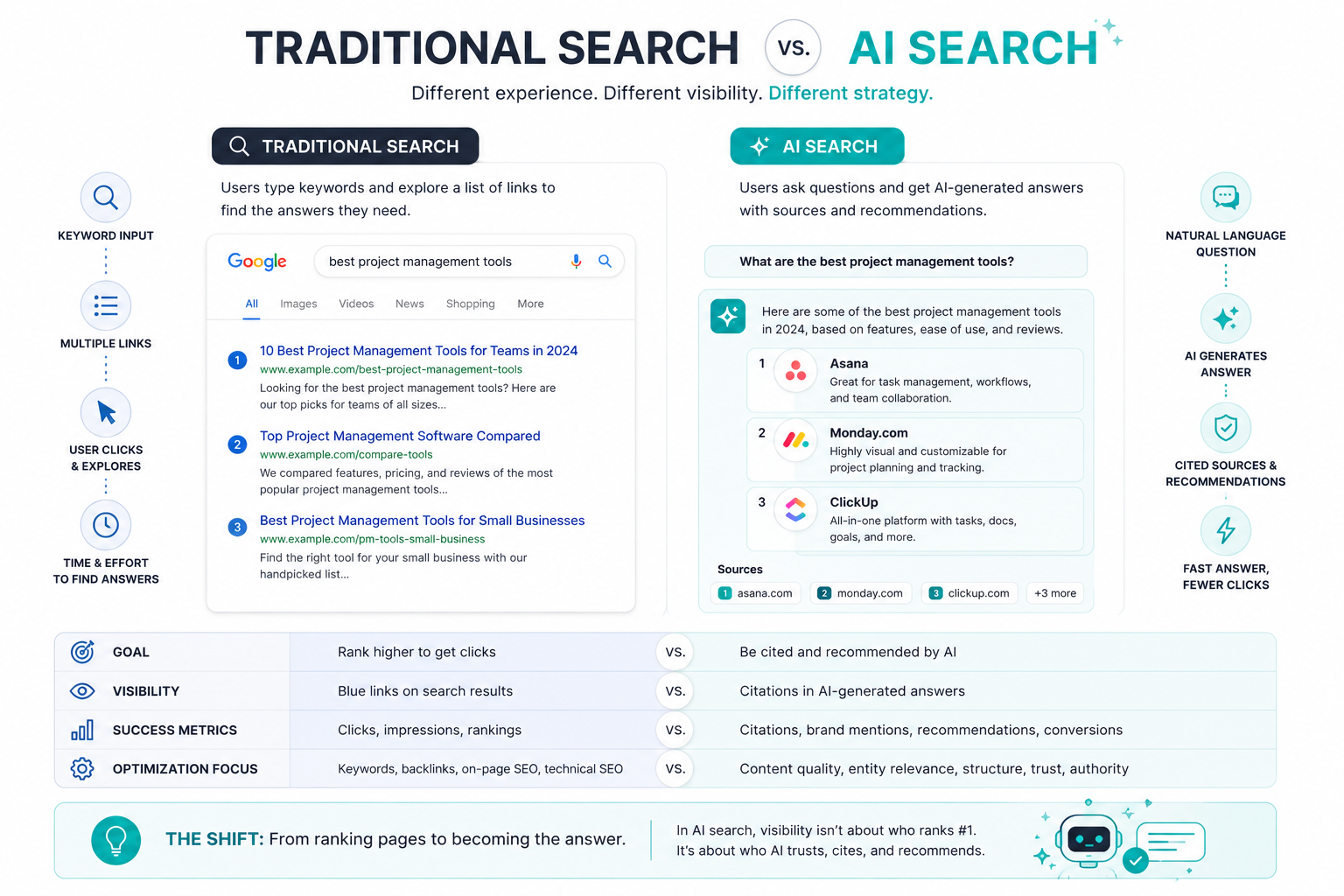
Brandi AI's GEO framework, launched in February 2026, captures this precisely: "Content is no longer simply ranked — it is retrieved, interpreted, synthesised, and returned." That four-word shift — from ranked to retrieved, interpreted, synthesised, returned — describes the entire change in how discovery works. SEO optimised for the first word. The AI Visibility Stack addresses all four.
The most dangerous position for a brand right now is not poor Google rankings — it is false confidence. If you have strong Google rankings, you have a working foundation. But if you are measuring only those rankings and not monitoring what AI tools say about your brand, you are operating with an incomplete picture. We have seen clients with strong organic traffic and strong rankings who were being described inaccurately — or not described at all — in AI answers to questions their customers were actively asking. That gap is invisible to traditional SEO reporting.
The 7-Layer AI Visibility Stack
The framework below draws on NP Digital's AI visibility research across 500 marketing teams, Wild Coffee Marketing's four-layer visibility framework, AuthorityTech's Machine Relations stack, and Brandi AI's SEO→AEO→GEO sequential model. The percentages shown represent the share of high-performing marketing teams actively investing in each layer, per NP Digital's June 2026 research.
The key principle: visibility compounds bottom-up. Fixing a higher layer without fixing the layers below it produces diminishing returns. Find your weakest layer and reinforce it first.
How the Layers Compound — And Where Most Brands Break Down
The percentage figures above reveal something important: the most foundational layers (Technical SEO and Content Creation) have the highest adoption rates, while the layers that directly determine AI citation outcomes (PR and Mentions, Community Engagement, and Measurement) have the lowest. This is not because teams do not recognise their importance — it is because those layers require skills and workflows that most SEO teams were not built to execute.
The practical consequence: a brand can have excellent technical foundations and strong content but still lose AI citation share to competitors that have weaker content but stronger off-site presence. AuthorityTech's GEO research puts this directly: distributing content across a wider range of publications increases AI citations by up to 325% compared to publishing only on your own site.
The Three Most Common Breakdown Points
| Breakdown Point | What It Looks Like | What It Costs You |
|---|---|---|
| Strong content, weak technical SEO | Well-written pages that AI crawlers cannot access due to robots.txt blocks or indexing issues | Your content never enters the retrieval pipeline regardless of quality |
| Strong content, weak off-site presence | High-quality articles on your own domain but minimal third-party mentions or citations | AI systems may retrieve your content but discount it against competitors with stronger external validation |
| Strong everything, no measurement | No systematic tracking of AI mention rate, sentiment, or competitive citation share | You cannot identify which layer is failing or where you are losing ground to competitors |
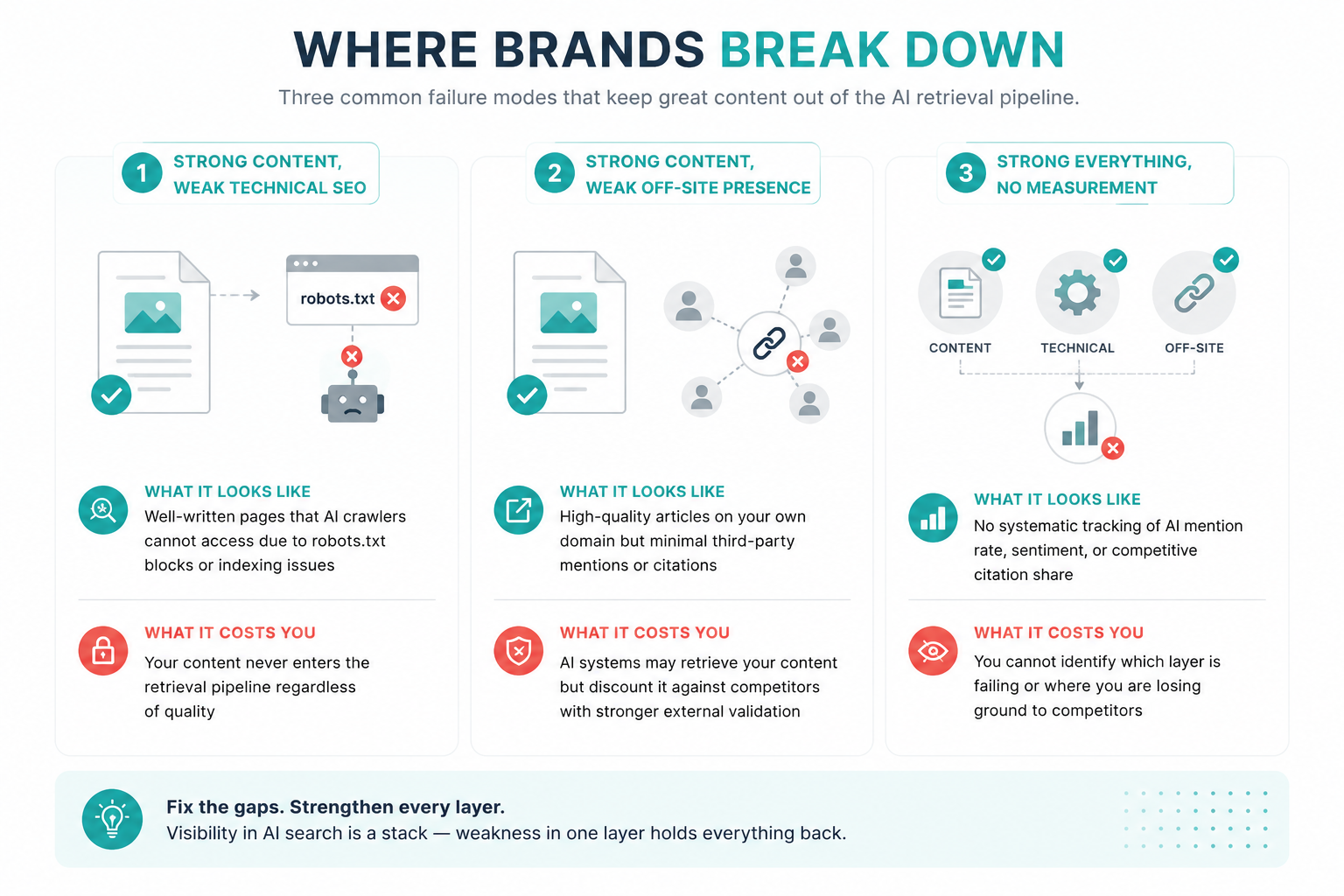
The breakdown point we encounter most often with Malaysian SMEs is the second one — strong content on their own website, almost no off-site presence. This is partly a resources issue (PR and earned media require time and relationships) and partly a framing issue (many SMEs still think of PR as traditional media coverage rather than as the citation-building activity it has become in AI search). The reframe we find useful: every third-party mention of your business — a review, a directory listing, a blog that references your service, a quote in an industry article — is a potential AI citation signal. Building that footprint does not require a PR agency. It requires a systematic approach to ensuring your brand appears in the places AI systems are trained to trust.
SEO, AEO, and GEO — The Three Phases Within the Stack
The seven layers map onto three sequential phases that describe how AI systems process and surface content. Brandi AI's unified framework describes these as interdependent, not competing:
| Phase | What It Does | Stack Layers | Without It |
|---|---|---|---|
| SEO | Makes your content crawlable, indexed, and retrievable by AI systems | Layer 1 (Technical SEO) | AI cannot access your content at all |
| AEO (Answer Engine Optimisation) | Structures content so AI systems can extract and reuse it to answer specific questions | Layer 2 (Content Creation) | AI accesses your content but cannot cite it cleanly |
| GEO (Generative Engine Optimisation) | Builds the authority, reputation, and distribution signals that make AI systems choose your content over competitors | Layers 3–7 | AI can access and extract your content but prefers competitors with stronger external signals |
The important nuance in this framing, which Wild Coffee Marketing's 2026 visibility guide is correct to emphasise: "The most common mistake in approaching this framework is treating each layer as a separate project. They are not. They are interdependent." A brand that executes well on all three phases does not need to game any individual signal — the combined signal is strong enough that AI systems surface it naturally.
We would add a practical sequencing point that the academic framing tends to gloss over. For most businesses starting from a baseline of decent SEO but limited AI visibility work, the priority order is: fix technical access first (Layer 1), then ensure content is answer-formatted (Layer 2), then build one off-site citation channel consistently (Layer 4 — whether that is a review platform, an industry directory, or a publication). Trying to build all seven layers simultaneously is how most AI visibility initiatives fail. It produces activity across every layer but depth in none of them. One well-executed PR placement in an AI-trusted source is worth more than a scattershot presence across twenty platforms.
Why Measurement Is the Most Underinvested Layer
At 58% adoption, Measurement and Attribution is the layer where the gap between knowing it matters and having a system to do it is widest. The reason is structural: AI answers do not generate rankings, clicks, or impression logs. As the 2026 AI visibility platform rankings note, traditional SEO metrics like CTR and impressions simply do not apply in zero-click AI answers. You cannot measure AI visibility passively — you have to actively test it.
What AI Visibility Measurement Actually Looks Like
The baseline methodology, drawn from Ewan Mak's 2026 GEO and AEO survival guide and NP Digital's monitoring framework:
- Define 20–50 prompts relevant to your business category — the questions your customers are asking AI tools right now
- Run them across ChatGPT, Perplexity, Gemini, and Claude — each platform has different citation behaviours and different training data weightings
- Record four metrics per prompt: brand mention rate (were you mentioned?), citation rate (were you cited as a source?), sentiment (how were you described?), and competitive positioning (which competitors appeared?)
- Repeat monthly — AI visibility changes as models update, new content is indexed, and competitor activity shifts
Tools that can scale this process include Profound, Otterly.AI, and Semrush's AI Overview tracking. For teams without dedicated tooling, a manual spreadsheet tracking the four metrics above across 20 prompts per month is a meaningful starting point. For a full measurement framework, read our guide on how to measure AI SEO performance.
Where to Start: Diagnosing Your Weakest Layer
The fastest way to use this framework is as a diagnostic rather than a build-from-scratch plan. Most brands already have something in each layer — the question is which layer is creating the biggest constraint on the layers above it.
- ✓ Layer 1 check: Can AI crawlers access your site? Visit yoursite.com/robots.txt and check for GPTBot, PerplexityBot, or ClaudeBot blocks. Run a Lighthouse Agentic Browsing audit in Chrome DevTools.
- ✓ Layer 2 check: Does your content lead with direct answers? Run one of your key service pages through an AI readiness scanner. Check whether key pages have answer capsules, FAQ sections, and schema markup.
- ✓ Layer 3 check: Does AI know who you are? Ask ChatGPT to describe your brand. Note whether the description is accurate, missing, or characterised by a competitor.
- ✓ Layer 4 check: Where are you mentioned off-site? Search "[your brand name]" on Google and count how many results are from third-party sites versus your own domain. Less than 30% third-party is a signal of weak off-site presence.
- ✓ Layer 5 check: Is your content being shared and referenced? Check your top content pieces for social shares, reposts, and external references.
- ✓ Layer 6 check: Is your brand present in industry conversations? Search your category on Reddit, LinkedIn groups, and relevant forums. Are you being mentioned organically?
- ✓ Layer 7 check: Do you have a measurement system? If you cannot currently answer "what percentage of relevant AI queries mention our brand?", Layer 7 is your priority.
Final Thoughts
The shift from rankings to AI visibility is not a replacement of SEO — it is an expansion of what visibility requires. Technical SEO remains the foundation without which nothing else works. But a brand that has only technical SEO and content, without the authority, distribution, and measurement layers above them, is increasingly competing with one hand tied behind its back.
The AI Visibility Stack is not a project to complete. It is a system to maintain. Each layer needs ongoing investment, and the balance between layers will shift as AI platforms evolve, update their training data, and adjust their citation behaviours. The brands that build monitoring into their regular workflow — checking their AI mention rate alongside their Google rankings — will be the ones that catch shifts early and adapt before the gap compounds.
Stay current with how AI search and visibility signals are evolving by following our AI SEO updates.