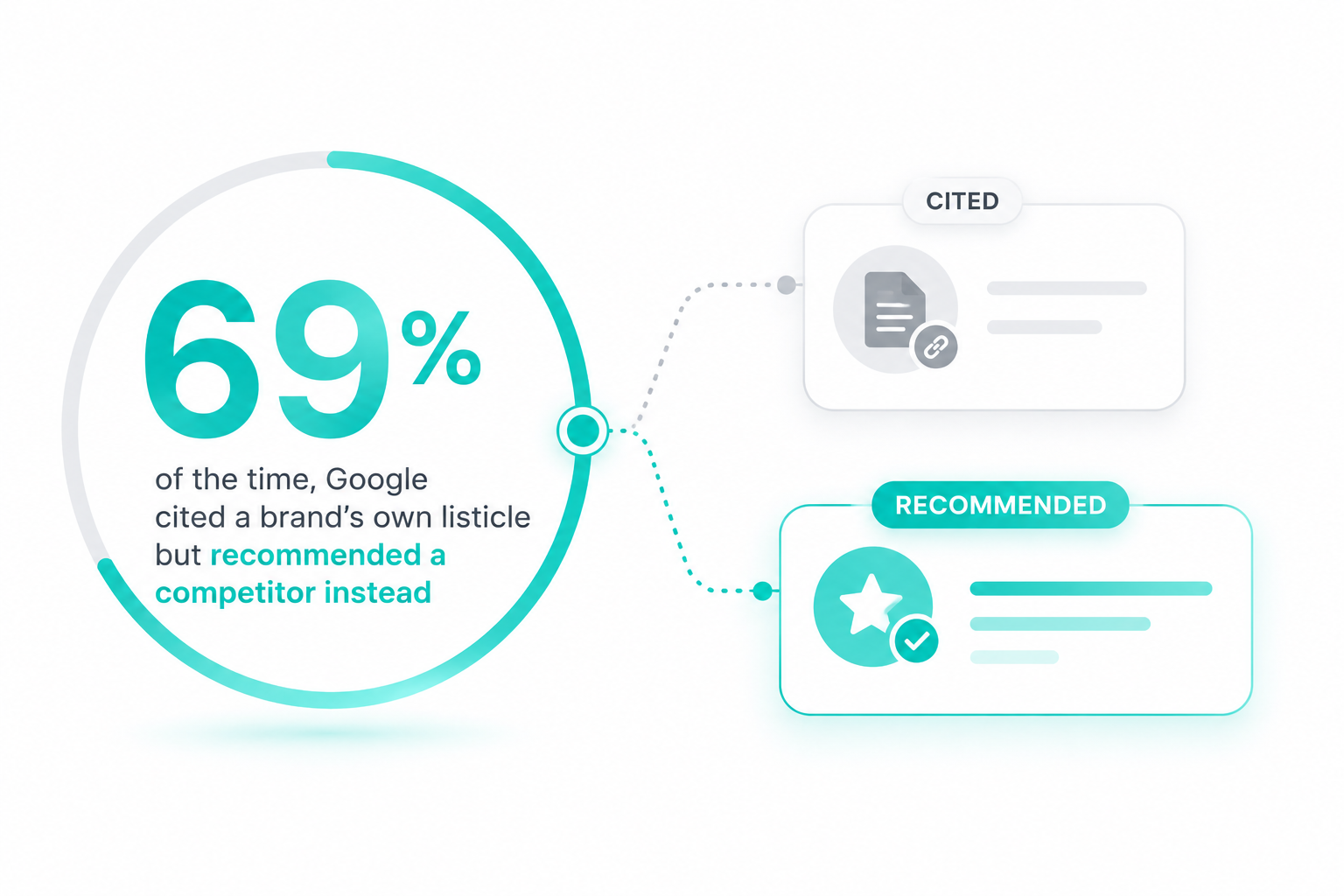
- Google AI Overviews cited brands' own "best" listicles but recommended a competitor instead in 69% of cases, according to a Search Engine Land analysis of 100 B2B software queries.
- A citation only proves an AI engine could find and read your page — a recommendation proves it trusted your brand enough to name you as the answer.
- Brands with stronger third-party mentions, category leadership, and link profiles were far more likely to be recommended, not just cited, in the same study.
- Self-promotional "best of" content that ranks a brand's own product first is a strong predictor of being cited without being recommended.
- Closing the gap between citation and recommendation means earning outside validation, not publishing more content that only cites itself.
If your brand shows up in a ChatGPT or Google AI Overview answer, that feels like a win. But an AI citation vs recommendation is not the same thing, and mistaking one for the other can quietly cost you the sale. A new analysis of B2B software queries found that Google's AI Overviews cited brands' own "best of" listicles constantly — then turned around and recommended a competitor anyway, in 69% of those cases. This piece unpacks why that gap exists, what it means for your AI visibility strategy, and what we tell clients when "we got cited" isn't actually the metric that matters.
What's the Difference Between an AI Citation and a Recommendation?
A citation is when an AI engine names or links to your page as a source behind its answer. It tells you the content was crawlable, relevant, and readable enough to reference. It does not tell you the AI engine actually believes your brand is the right choice for the person asking.
A recommendation is different. It's the moment the AI engine tells the user "use this," "buy this," or "here are your best options" — and your brand is on that shortlist. As Search Engine Land has explained, brands can appear in AI systems through usage (the model draws on your information) and citation (it names you as a source) — but neither guarantees the model treats you as the answer it wants to give.
That distinction is the whole story in this piece. Being retrievable is table stakes. Being recommended is the actual goal of AI search optimisation strategies.
The Study: Cited by Google, Then Recommended a Competitor
SEO researcher Lily Ray analysed 100 B2B "best [category] software" queries in Google AI Overviews across three checkpoints — April 15, May 15, and June 8, 2026 — using Ahrefs Brand Radar to pull the answer text and cited sources.
Of the 80 prompts that actually triggered an AI Overview, self-promotional listicles were cited 323 times. In 224 of those cases, Google referenced the brand's own "best" page as a source and then named a different company as the recommendation.
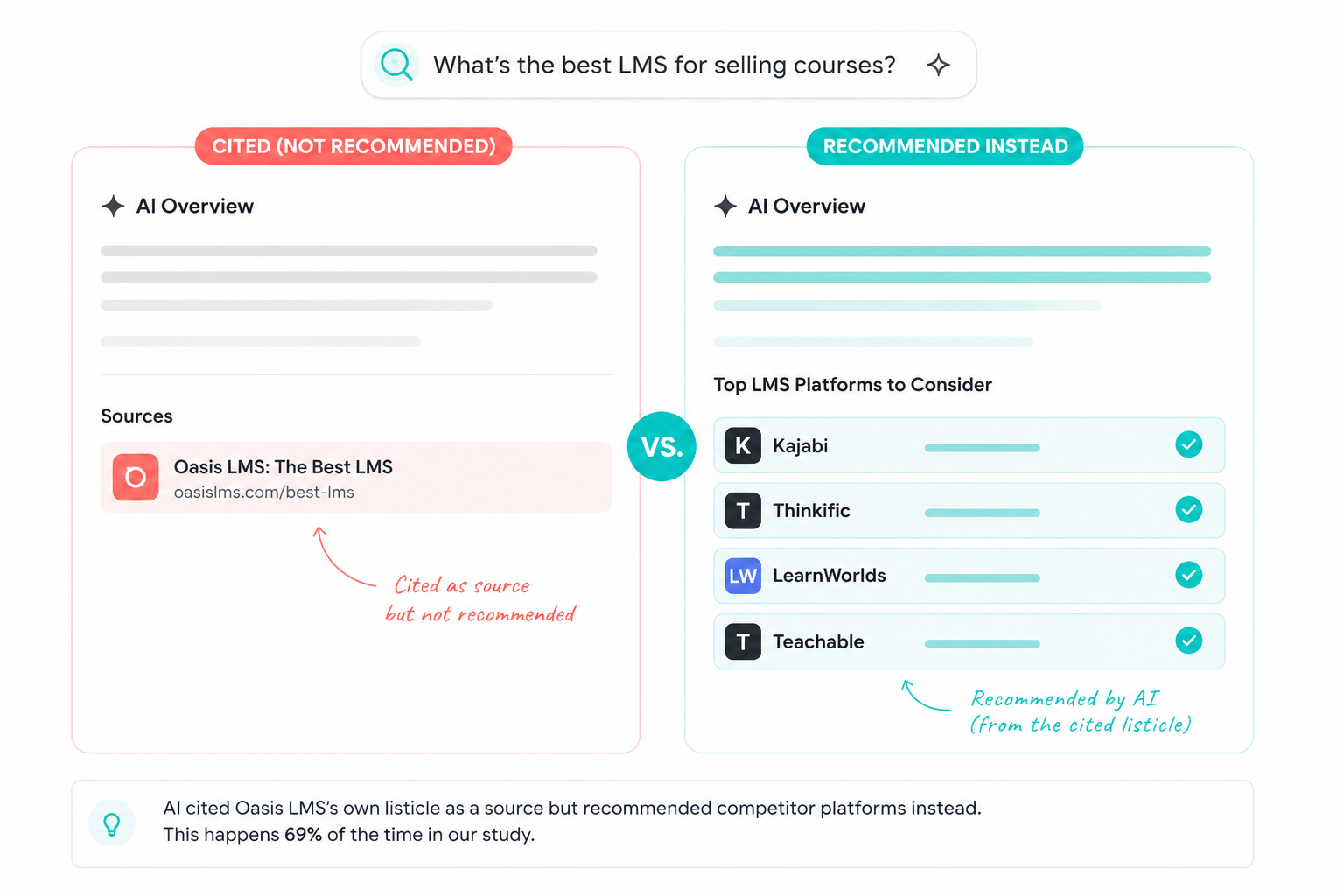
Ray documented the same pattern across help desk, task management, survey, CRM, and SEO software queries. The brands that got recommended were consistently the ones with stronger category leadership, broader third-party mentions, and more established link profiles — not necessarily the ones whose own page Google happened to cite.
Why AI Engines Cite Without Recommending
This isn't a glitch. It's how these systems are designed to weigh evidence. A citation answers "can I find something relevant here?" A recommendation answers "do independent signals agree this is a good choice?" Those are different questions, and AI engines increasingly answer them from different sources.
The Business Cost of Being Cited but Not Recommended
For Malaysian businesses tracking AI visibility, this matters because the temptation is to chase citation volume — publish more "best of," "top 10," and comparison pages that rank your own brand first. The Ray study suggests that approach can backfire twice: it fails to earn the recommendation, and it can drag down the organic rankings the AI engine leans on in the first place.
What Actually Earns a Recommendation
If citation is the floor and recommendation is the goal, the levers that move you from one to the other are mostly about how to get cited by ChatGPT and other engines with evidence they can't dismiss as self-interested:
- ✓ Third-party mentions across review sites, forums, and trade press — not just your own blog
- ✓ A visible track record other sources independently confirm, such as case studies, press coverage, and verified testimonials
- ✓ Category-relevant backlinks and brand mentions that build topical authority over time
- ✓ Original data or a distinct point of view AI engines can't lift from a competitor's page
- ✓ Content structured for direct extraction — clear, specific answers rather than self-praise
Our Perspective
At AI SEO Agency, we treat citation tracking as an incomplete metric on its own. Knowing you were mentioned tells a client half the story; knowing whether AI engines actually recommended you is the half that affects revenue. The Ray study is useful precisely because it separates the two and shows, with real numbers, how often they diverge.
Our read: the brands winning recommendations in 2026 are the ones investing in AI SEO performance metrics that go beyond citation counts — tracking whether they're named as the answer, not just referenced as a source. Self-promotional listicles still have a place in a content mix, but they cannot be the whole strategy. The gap this study exposes is exactly where third-party validation, digital PR, and genuine category authority earn their keep.
FAQ
Ready to Get Cited by AI?
Let AI SEO Agency build your content strategy for ChatGPT, Gemini, and AI Overviews.
Get a Free AI SEO Audit