

- Fan-out query refers to how the AI search engines will split a user query into several sub-queries aimed at a particular facet of the original question before synthesizing the results for the final answer. Google AI Mode will run between 5 and 11 sub-queries on one prompt while ChatGPT Deep Research ran 420 sub-queries on one query.
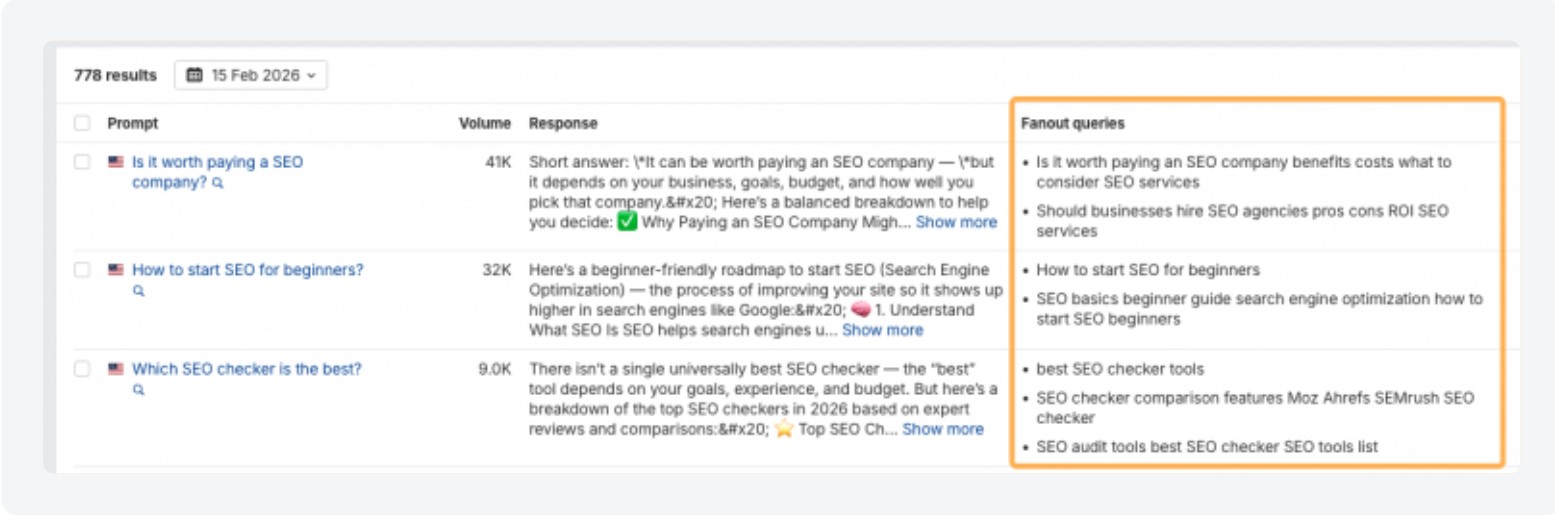
- Over 95% of fan-out sub-queries do not recur in any other searches. This implies that keyword research tools will never identify them and optimizing for the keywords will only cover less than half of the search surface used by the AI.
- The AI does not look for the exact phrase typed by the user. Rather, the AI creates sub-queries synthetically depending on the inferred meaning of the query and other possible follow-up queries. The ranking of the original keyword is simply the start of citation eligibility.
- Research found that ranking for several fan-out sub-queries increased the chances of citation significantly. Coverage of a topic cluster is now more effective than optimizing a single page for a single head keyword.
- The practical response is to map your topic's fan-out patterns, audit your cluster for coverage gaps, close those gaps with content and structured data, and measure citation performance separately from organic rankings.
You built the content. You earned the ranking. You hit position one. Then Google AI Mode answered the question without naming your page once. The reason is query fan-out: the mechanism that turns one user query into 5, 10, or even hundreds of parallel searches before an AI answer is generated. Understanding it is now the most important concept in AI search optimisation. This post explains exactly how it works, what sub-queries look like in practice, and how to audit your content to compete across the full retrieval surface.
While traditional SEO was one to one: one query, one intent, one top-ranking content piece, AI Mode is a one-to-many SEO strategy. After the user submits their question, multiple sub-queries are launched to explore all the sides of the initial query. Then, Gemini combines the results from each of the queries into one output. While the site ranking for the head keyword wins just one spot out of many, the sites answering the adjacent sub-queries win the rest. When you have optimised your site for just the head keyword, you are only fighting for the smaller part of the citation surface.
What Is Query Fan-Out?
The query fan-out is the process used by the artificial intelligence search engines to break down one user's query into multiple sub-queries, find answers to each of them separately and synthesise the final result. The process was explained in the patent documents of Google and became the basis of how AI Mode, AI Overviews, ChatGPT and Perplexity work now. Instead of trying to find the answer to the exact query the user asked, the artificial intelligence produces synthetic sub-queries based on what an informed person would need to know to fully answer the original question.
Research found that Google AI Mode runs an average of 9 to 11 sub-queries per prompt, with 59% of prompts triggering between 5 and 11 searches and 24% triggering 12 to 19. The maximum observed was 28. ChatGPT's Deep Research feature ran 420 sub-queries for a single prompt and cited 30 sources, running over 200 of those searches in its first step alone just to resolve the user's phone model and case-type assumptions before it could even begin answering. The scale varies by platform and query complexity, but the underlying logic is consistent: the AI is not searching once. It is searching many times, from many angles, simultaneously.
The 95% zero-volume point is the biggest takeaway from the implications above for content strategy. The sub-queries created by the AI Mode are synthetic: made based on the inference of the intended meaning, context and potential follow-ups, not based on the history of the searches done by the actual users. This means they are completely invisible to any existing keyword tool. If your keyword strategy is geared towards finding keywords with measurable search volume, you are focusing only on a tiny fraction of queries while overlooking a much bigger surface of synthetic queries created by the AI on the spot to formulate its answer.
How Sub-Queries Are Generated
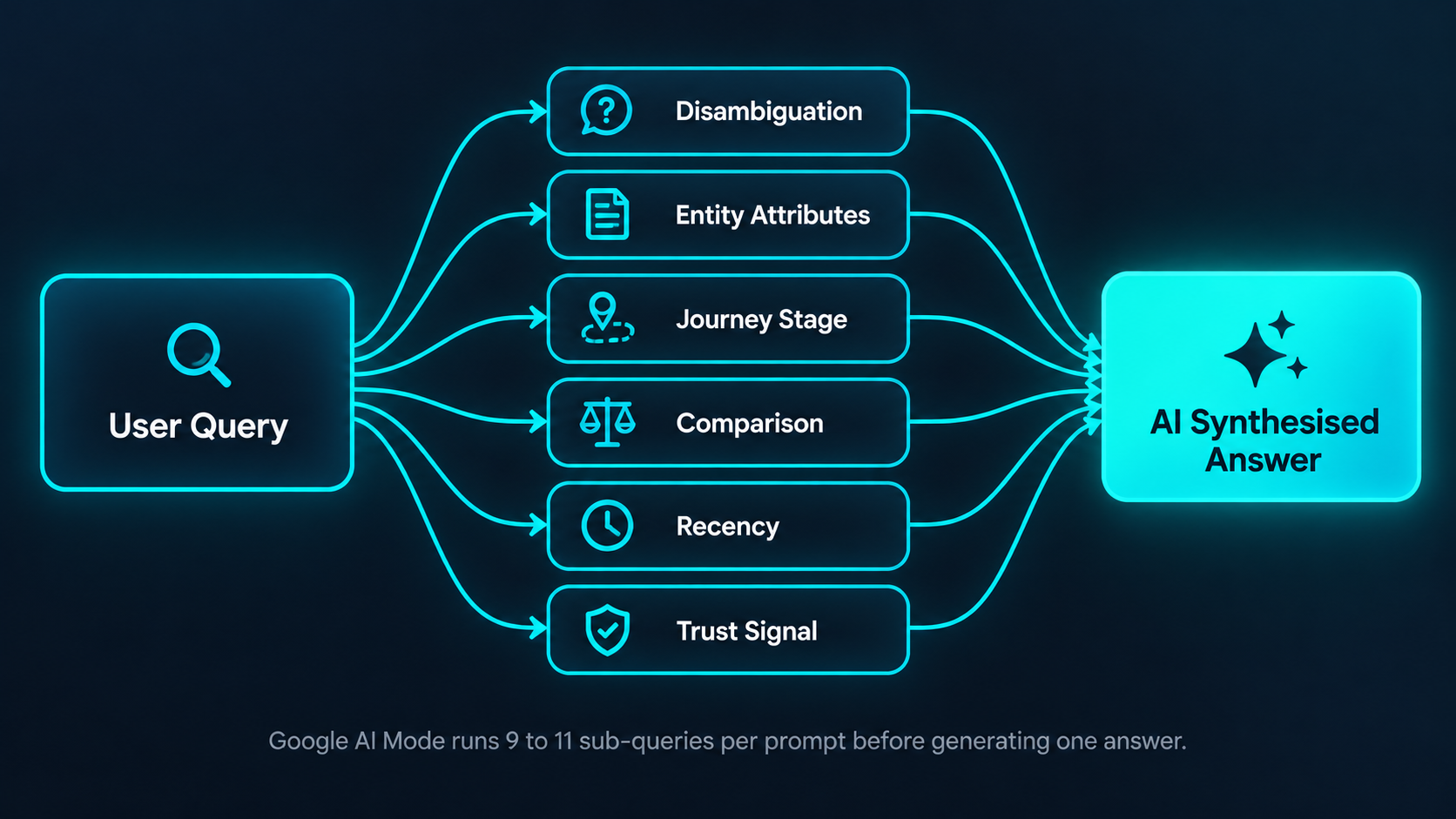
Based on analysis of Google's patents, fan-out sub-queries obey certain patterns. They are predictable, not random. The depth of the fan-out is driven by how much context is missing from the original query: the more dimensions left unresolved, the more sub-queries the AI generates to fill in the gaps before it can construct a confident answer. A query like "best CRM for Malaysian SME" is underspecified across at least four dimensions simultaneously: what size of SME, what industry, what budget, and what features matter most. Each unresolved dimension can trigger its own sub-query. Understanding those patterns is what makes it possible to audit and close coverage gaps systematically.
The effect on the practical application level is that two queries that may appear similar can lead to entirely different fan-outs. A query on "best noise-cancelling headphones" will result in sub-queries related to attributes and comparisons. A query on "how to choose noise-cancelling headphones" will result in sub-queries related to journey stage and trust signals. The same page cannot win a citation slot in both cases unless it has been prepared to address the entire topic cluster.
How AI Mode Selects What to Cite
Once sub-queries have retrieved results, Gemini uses a process called reciprocal rank fusion (RRF) to combine and score sources across multiple retrieval lists. Each source earns a score based on its ranking position across the sub-queries it appeared in. A source ranked second in one sub-query and fifth in another earns a combined score of 1/2 + 1/5 = 0.7. The final citation selection is a re-ranking of these combined scores.
This has one critical implication: a page that ranks moderately across several related sub-queries can outscore a page that ranks first for only one of them. The maths rewards coverage over dominance. A page at position 3 across four sub-queries (combined RRF score of 4 x 0.33 = 1.33) outscores a page at position 1 for a single sub-query (RRF score of 1.0). Breadth of sub-query coverage is not just a nice-to-have. It is a scoring input that directly affects whether your content gets cited.
Studies found that ranking for multiple fan-out sub-queries raises citation probability significantly. The implication is not that ranking first no longer matters. It is that ranking first for a single keyword while ignoring the surrounding sub-query landscape is now a structurally losing strategy in AI search.
Four Steps to Optimise for Query Fan-Out
The fan-out optimisation framework follows four stages. Each builds on the previous one, and skipping any of them leaves identifiable gaps in your citation coverage.
-
01 🗺️Discover
Map Your Fan-Out Patterns
Submit your target query to AI Mode and read the response section by section. Each section corresponds to a sub-query that fired. Note the heading, the source cited, and what type of question that section answers. A query about "how to start a podcast" fires sub-queries like "podcast recording equipment" and "best podcast hosting and distribution 2025", alongside branding, guest outreach, content planning, and promotion, all in parallel before any answer is produced. Each section heading is effectively the sub-query the AI ran. List them, then categorise each one against the six pattern types: disambiguation, entity attributes, journey stages, comparisons, recency, and trust signals. The result is your fan-out map for that topic.
-
02 🔍Audit
Audit Your Cluster Coverage Against These Patterns
Chart all pages and sections of your existing content against the fan-out patterns you identified. Mark each sub-query as covered, partially covered, or missing. "Covered" means a section with a heading and a direct answering statement. "Partially covered" means the information exists but is buried or unclear. "Missing" means neither your site nor any page you link to addresses that sub-query. The missing slots are exactly where competitors are earning citations you are not.
-
03 🛠️Execute
Fill Coverage Gaps On-Site and Off-Site
On-site: write sections for partially covered sub-queries, build cluster pages for distinct missing intents, and complete your schema markup for entity-heavy patterns. Off-site: identify which third-party sources AI Mode is citing for the sub-queries you are not covering (review sites, listicles, comparison pages) and pursue those as link and mention targets.
-
04 📊Measure
Measure Citation Performance Separately from Organic Rankings
Employ AI SEO performance metrics that are separate from standard rank tracking. Use the Generative AI search type filter in the Performance tab of Google Search Console to see which pages generate AI impressions. Track topic clusters in aggregate with tagged rank tracking rather than monitoring individual keywords. Monitor brand citations across AI platforms to identify which sub-query patterns name you and which name competitors. Shift your success metric from per-keyword position toward topic-level visibility and citation frequency. Your standard organic rank report will not capture any of this.
Fan-Out Pattern Types and How to Cover Them
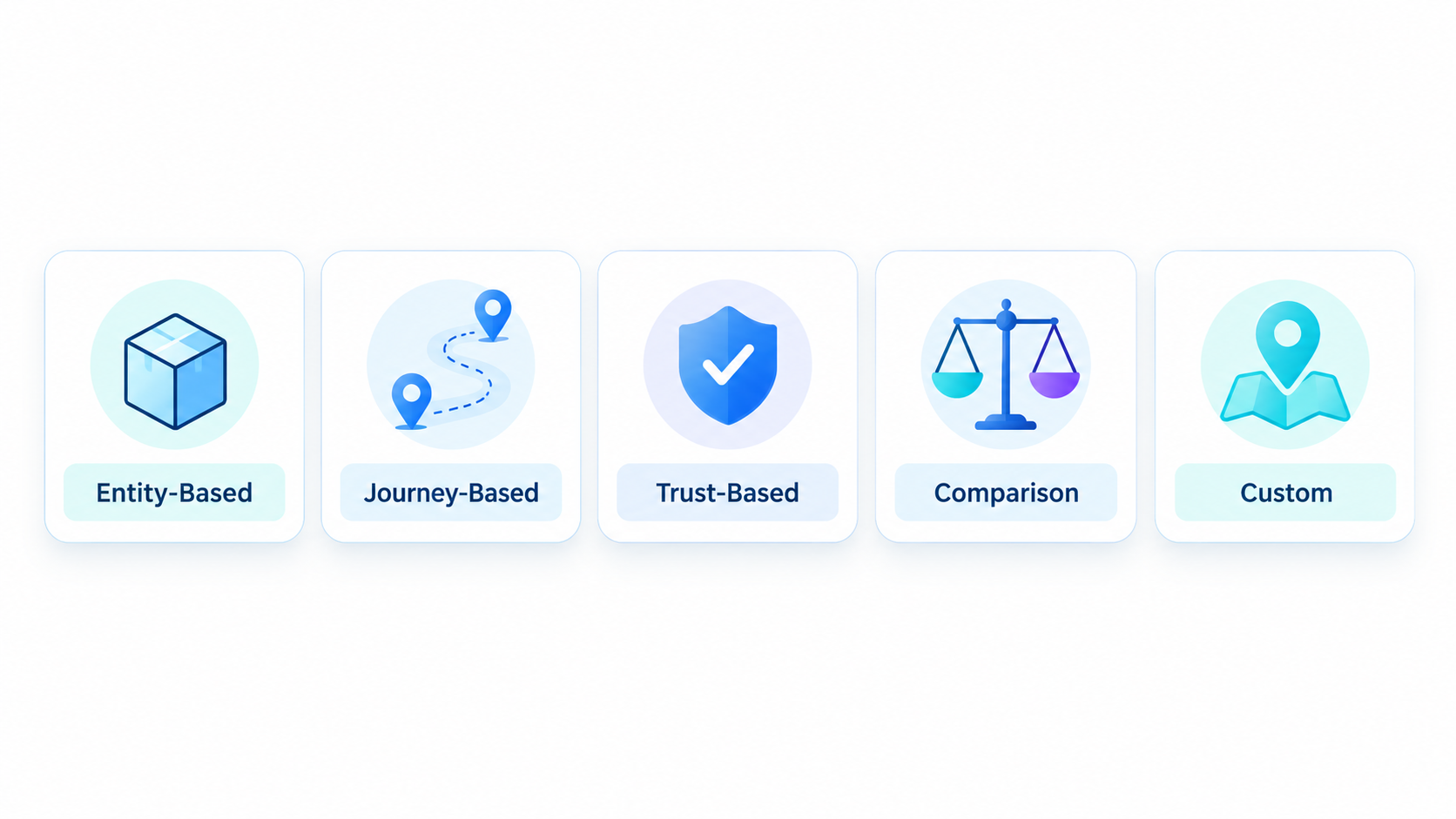
Before mapping your coverage, it helps to understand how fan-out sub-queries are formatted. Research identifies seven common sub-query formats the AI generates from a single prompt: related topics (expanding the core topic into adjacent areas), implicit questions (answering what the user implied but did not ask), comparative (evaluating options side by side), recency (filtering for the most current information), reformulations (rephrasing the same intent differently), contextual variations (location-based or behavioural variants), and next-step queries (what the user will need to know after this answer). A single prompt can trigger all seven formats simultaneously. The six function patterns below describe what the AI is trying to accomplish with those sub-queries.
- Entity Attributes: AI searches for the specific attributes of a named product, brand, or concept: colour, material, features, compatibility, specifications, price range, and availability. Cover this with complete attribute data on product and service pages, descriptive image filenames and alt text, collection pages for key attribute combinations, and complete product schema markup.
- Journey Stages: AI searches for information at every stage of the buying process from awareness to decision. Cover this with a topic cluster that has a dedicated page or section per stage: awareness, education, comparison, decision, and implementation, all connected through internal linking.
- Trust Signals: AI searches for credibility signals, expert opinion, compliance, and validation, particularly for YMYL and high-cost decisions. Cover this with visible author credentials, third-party citations, published policies, reviews, awards, and case studies.
- Comparison Criteria: AI searches for comparisons of similar products or services and identifies which attributes drive decisions. Cover this with dedicated comparison pages or sections that evaluate options side by side against the criteria your audience actually uses.
- Action and Risk: AI searches for post-decision details including availability, shipping, returns, warranties, and refunds. Cover this with clear policy pages and product-level logistics information that answers what happens after the purchase decision is made.
- Recency: AI searches for the newest available information on time-sensitive topics such as pricing, regulations, and product launches. Cover this with regularly refreshed content and a visible last-updated timestamp in both on-page text and structured data.
Frequently Asked Questions
Ready to Get Cited by AI?
Let AI SEO Agency map your query fan-out patterns, identify your sub-query coverage gaps, and build the content cluster that earns citations across AI Mode, AI Overviews, and Gemini.
Get a Free AI SEO Audit