
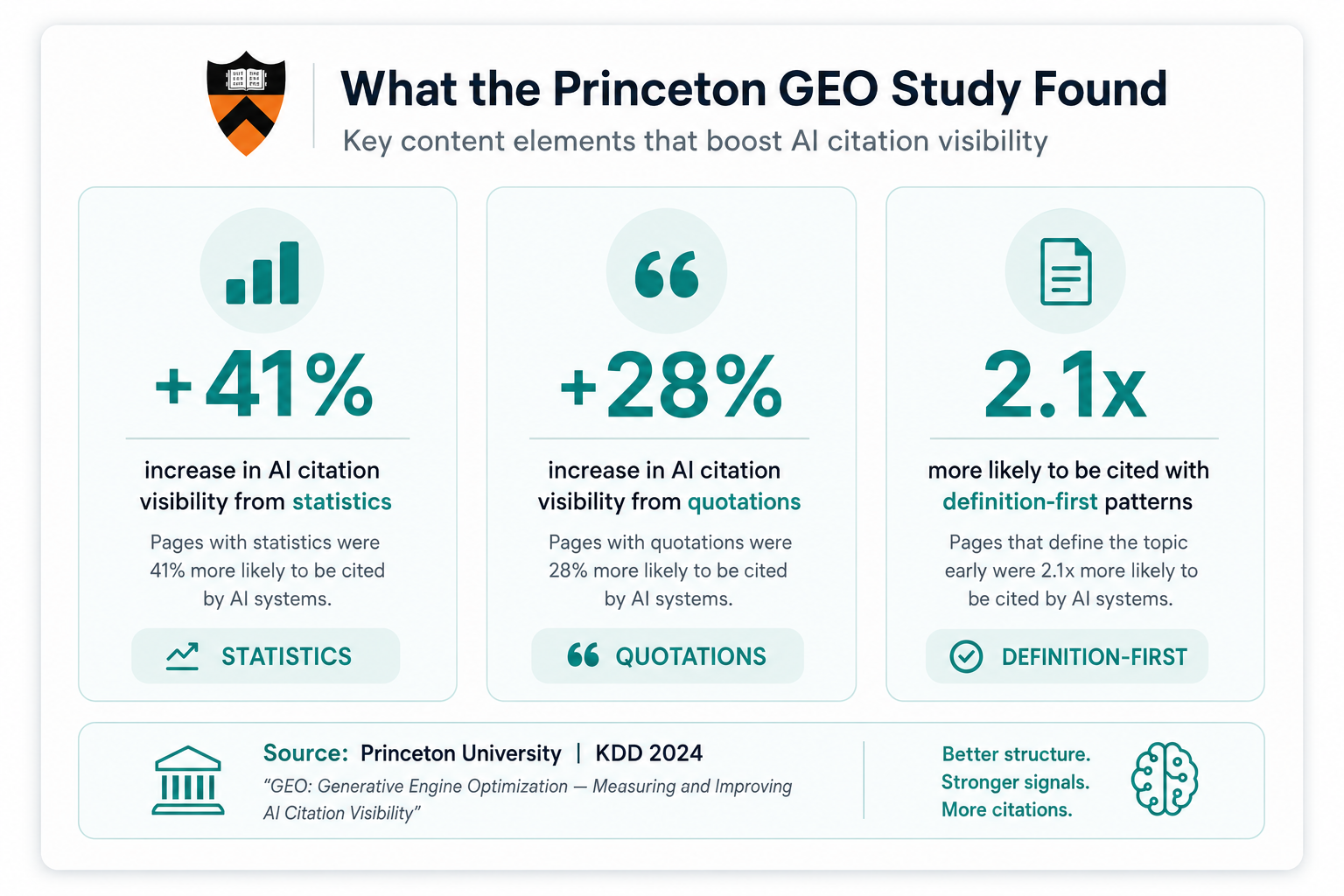
- The Princeton GEO study (KDD 2024) found that adding statistics to content improved AI citation visibility by up to 41% — the single most effective structural tactic tested across 10,000 queries
- AI answer engines do not read content linearly — they chunk, embed, and rank extractable passages independently, which means every H2 section needs to stand alone as a citable answer block
- Definition-first sentence patterns ("X is..." or "X refers to...") increase AI citation rates by 2.1x — making how you open each section as important as what the section covers
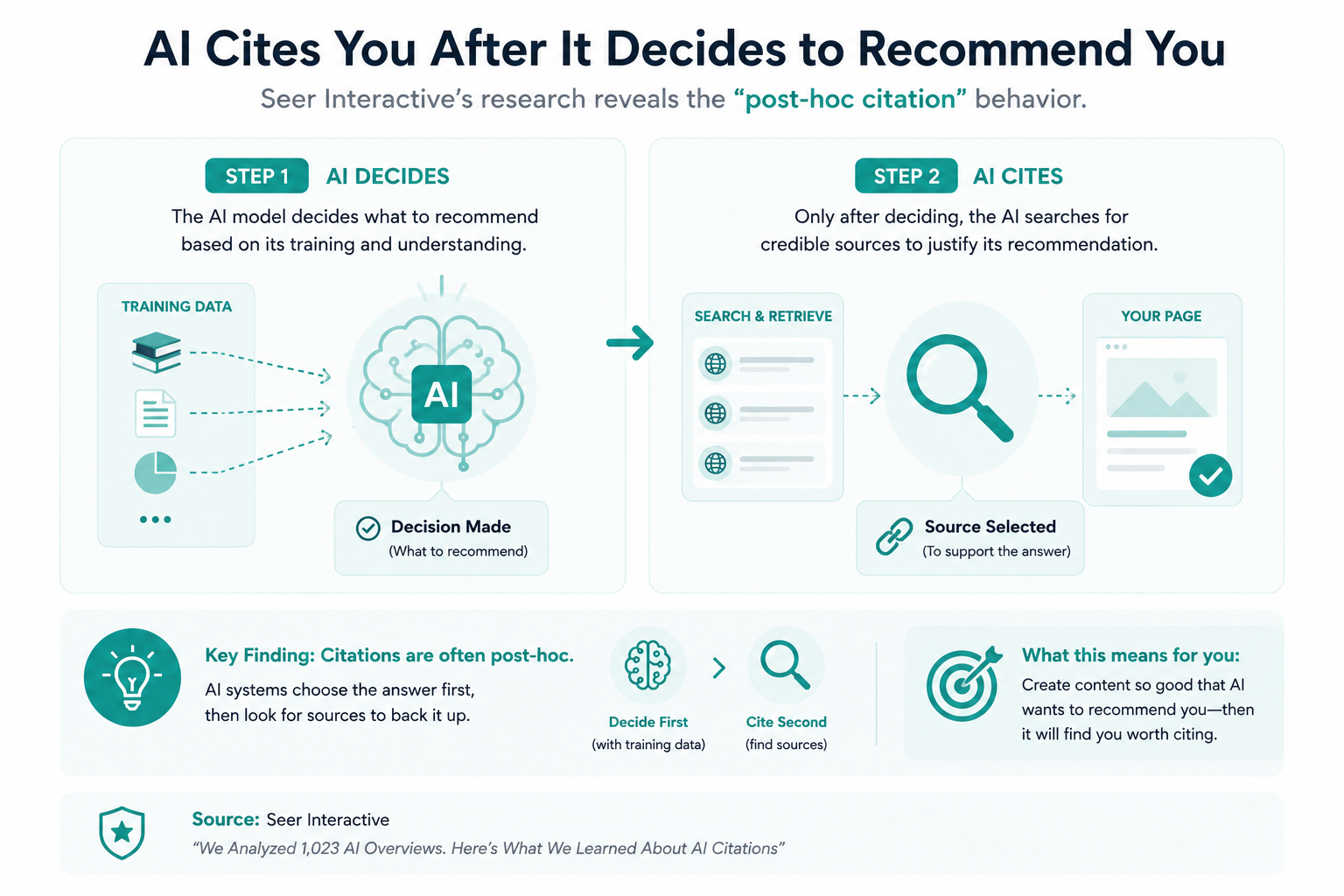
- Seer Interactive's research across 362,388 AI responses suggests citations may be post-hoc — the AI often decides what to recommend from training data first, then searches for sources to support it
- Structural optimisation produces 17.3% citation improvement independently of content quality — meaning structure is a separate lever you can pull on existing content, not just new articles
Most content advice for AI search is built on intuition. "Write clearly." "Be helpful." "Use headings." These are not wrong — but they are not precise enough to be actionable, and they do not explain why some well-written pages get cited regularly while others, equally well-written, never appear in an AI answer at all.
The reason is that AI answer engines do not read the way humans do. They do not start at your headline and scroll through your page. They run a scanning and ranking process on your content before a single sentence of a response is written — think of it like a hiring manager who has 500 CVs to review in 10 minutes. They are not reading every word. They are skimming for the right signals in the right places, and anything that does not immediately signal relevance gets set aside. Technically, AI systems run what researchers call a Retrieval-Augmented Generation (RAG) pipeline — they break your page into small sections (chunks), score each section for relevance to the user's question, and only pass the highest-scoring sections into the answer-generation stage. Structure is not aesthetic — it is functional. The way you arrange information determines whether your content gets selected or discarded at that scoring stage.
This guide covers what the research actually says about which structural signals drive citations, how those signals map to decisions you can make when writing and formatting content, and where our own perspective diverges from what the data shows — because it does diverge in at least one important place.
How AI Answer Engines Actually Read Your Content
GEO — Generative Engine Optimisation, meaning the practice of structuring content so AI tools cite it rather than just rank it — was formally studied by researchers at Princeton University, IIT Delhi, Georgia Tech, and the Allen Institute for AI in a paper published at one of the most respected data science conferences in the world (ACM SIGKDD 2024). They tested nine content optimisation strategies across 10,000 real queries and found that specific structural changes can boost how often AI tools cite a page by up to 40%.
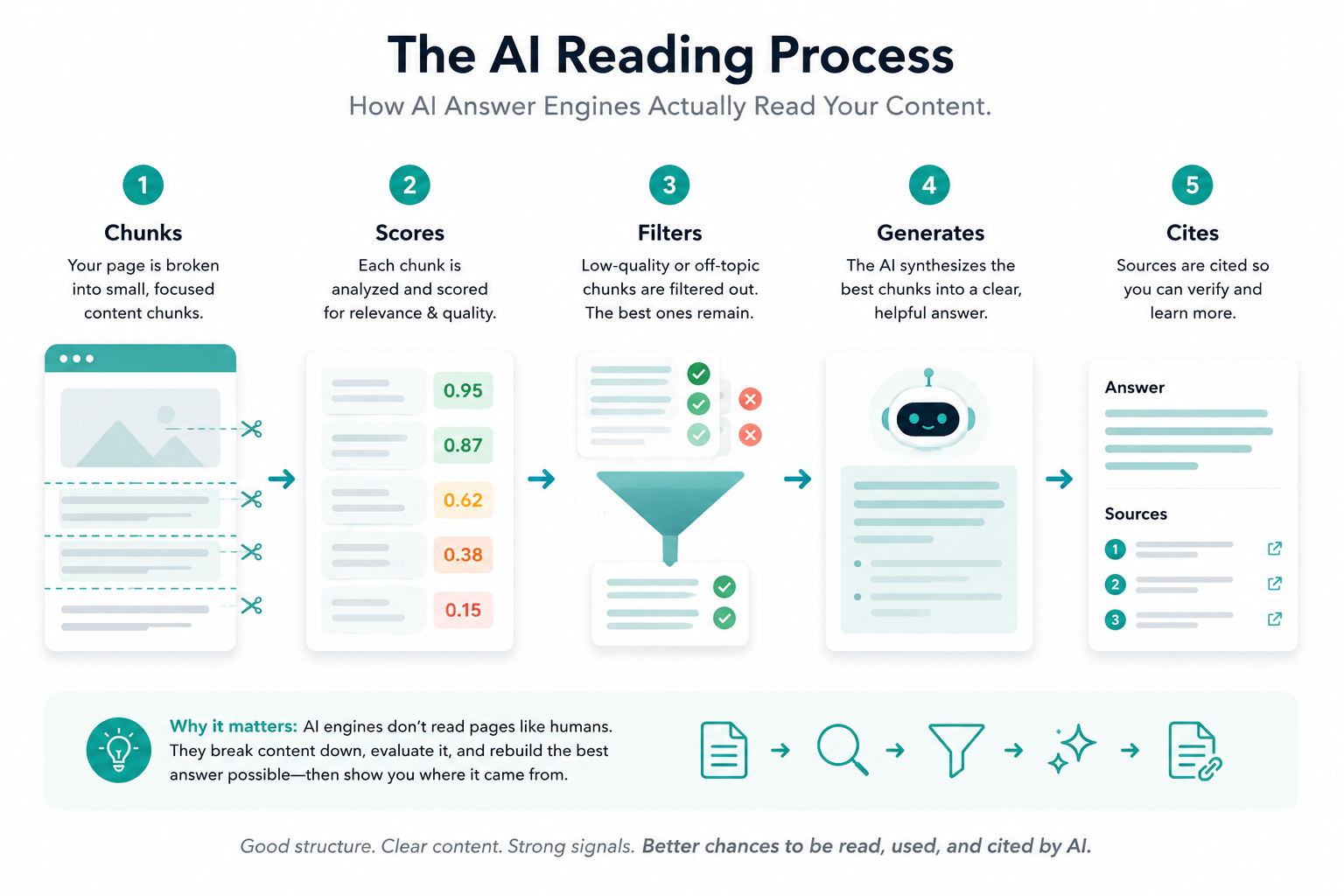
But before the tactics, it helps to understand what is actually happening when you ask ChatGPT or Perplexity a question. The system does not visit your page and read it from top to bottom. It:
- Breaks your page into short sections — usually one paragraph or a heading plus a few sentences (researchers call these "chunks")
- Scores each section on how relevant it is to the user's specific question
- Filters down to only the highest-scoring sections
- Writes its answer using only those selected sections
- Cites the page each selected section came from — which is why your page gets credited as a source
The implication is direct: if your content is not structured into clearly bounded, self-contained chunks, it is less likely to survive the extraction filter — regardless of how good the underlying thinking is. The practical test is simple: could each H2 section be cited on its own, without needing the rest of your article to make sense? If someone saw only that section — no page title, no introduction, no conclusion — would it still contain a complete, useful answer? If not, it will likely be filtered out before the AI even considers citing it.
We would add one thing the academic framing tends to underplay: the chunking pipeline penalises meandering introductions disproportionately. If your first 150 words are scene-setting rather than answer-giving, those words are likely to form their own chunk — one that contains no extractable claim, no statistic, and no definition. That chunk gets discarded. You have lost your highest-attention real estate on the page before the reader or the AI has seen anything useful. The fix is architectural, not cosmetic: answers first, context second, elaboration last.
What the Princeton GEO Study Actually Found
The Princeton GEO paper is the most-cited academic work on AI citation optimisation and worth understanding precisely, because a lot of secondhand summaries get the numbers wrong or overstate the effect sizes.
The study tested nine content modification strategies on a generative engine closely mimicking Bing Chat, then validated the strongest findings on Perplexity as a real-world deployment check. The results: statistics addition improved visibility by 41%, quotation addition improved visibility by 28%, and citing external sources improved visibility by 115% for lower-ranked content.
That last number — 115% — is the one most often misquoted. It is not a universal figure. It applies specifically to content that was not already ranking in the top positions. Pages ranked around position 5 experienced a 115% visibility increase after GEO optimisation, while pages already ranking in position 1 saw more modest gains. The structural improvements matter most for content that has authority but is losing citation share to better-formatted competitors.
The 41% statistic improvement is real, but it does not mean adding random numbers to your content helps. The mechanism is specificity — a statistic makes a claim verifiable and attributable, which is exactly what AI citation systems are trained to reward. A vague improvement claim ("our clients see significant results") gives an AI system nothing to latch onto. A specific, sourced claim ("our clients reduced content production time by 40% after restructuring to answer-first format, based on a 6-month audit of 23 accounts") gives it a precise, attributable statement it can extract and cite. The stat is not the point. The specificity the stat forces you toward is the point.
The Finding That Changes How You Should Think About Citation
The most important — and most underreported — research finding in this space comes not from an academic paper but from Seer Interactive, a US digital marketing firm that ran six independent behavioural tests across 362,388 AI-generated responses.
Seer Interactive's 2026 research introduced an important nuance: AI citations may be post-hoc. Their hypothesis, supported by six independent tests, suggests the AI decides which brands to recommend first — based on what it already knows from its training — and then searches for sources to back up that choice. In other words: the citation is not what made the AI decide to recommend you. The citation is the AI showing its work after it has already decided.
If this holds up — and it has not yet been independently replicated at the same scale — it means that citation optimisation alone cannot overcome weak brand authority. The AI is not being persuaded by your well-structured content to recommend you for the first time. It is finding your well-structured content when it has already decided to mention you and needs to show its sources.
We find this hypothesis credible, and it matches patterns we observe across client accounts. Brands with no off-site presence — no mentions in industry publications, no reviews on third-party platforms, no presence in industry discussions — tend to see minimal citation gains from content structural work alone, even when the content is technically well-optimised. Brands with some existing off-site presence see much larger citation gains from the same structural improvements. The implication we draw is not "structure does not matter" — structure still determines whether the AI can find and extract a supporting citation once it has decided to mention you. The implication is that brand authority work and content structural work are not alternatives. They are sequential: brand authority gets you into the consideration set, content structure gets your specific pages selected as the citation.
The Researcher's Method: A Content Structure Framework for AI Citation
What follows is the structural framework we apply to content intended for AI citation. It is called the Researcher's Method because it borrows from how academic research is structured — abstract first, evidence second, conclusion last — applied to web content. Every element maps directly to a signal in the AI extraction and ranking pipeline.
The Answer Capsule (First 40–60 Words After Every H2)
An answer capsule is a direct, self-contained response to the implicit question your H2 heading poses, written in the first 40–60 words of each section. It is the single most important structural element for AI citation because it is the text most likely to be selected as a chunk during the extraction phase — positioned immediately after a heading signal, short enough to be its own chunk, specific enough to be citable.
When it comes to selecting the right HR software for your growing business, there are many factors to consider. The landscape of HR technology has changed significantly in recent years...
SMEs should evaluate HR software on four criteria: payroll integration, leave management, mobile accessibility, and pricing per employee. For teams under 50 people, cloud-based systems with flat monthly pricing typically outperform per-employee models.
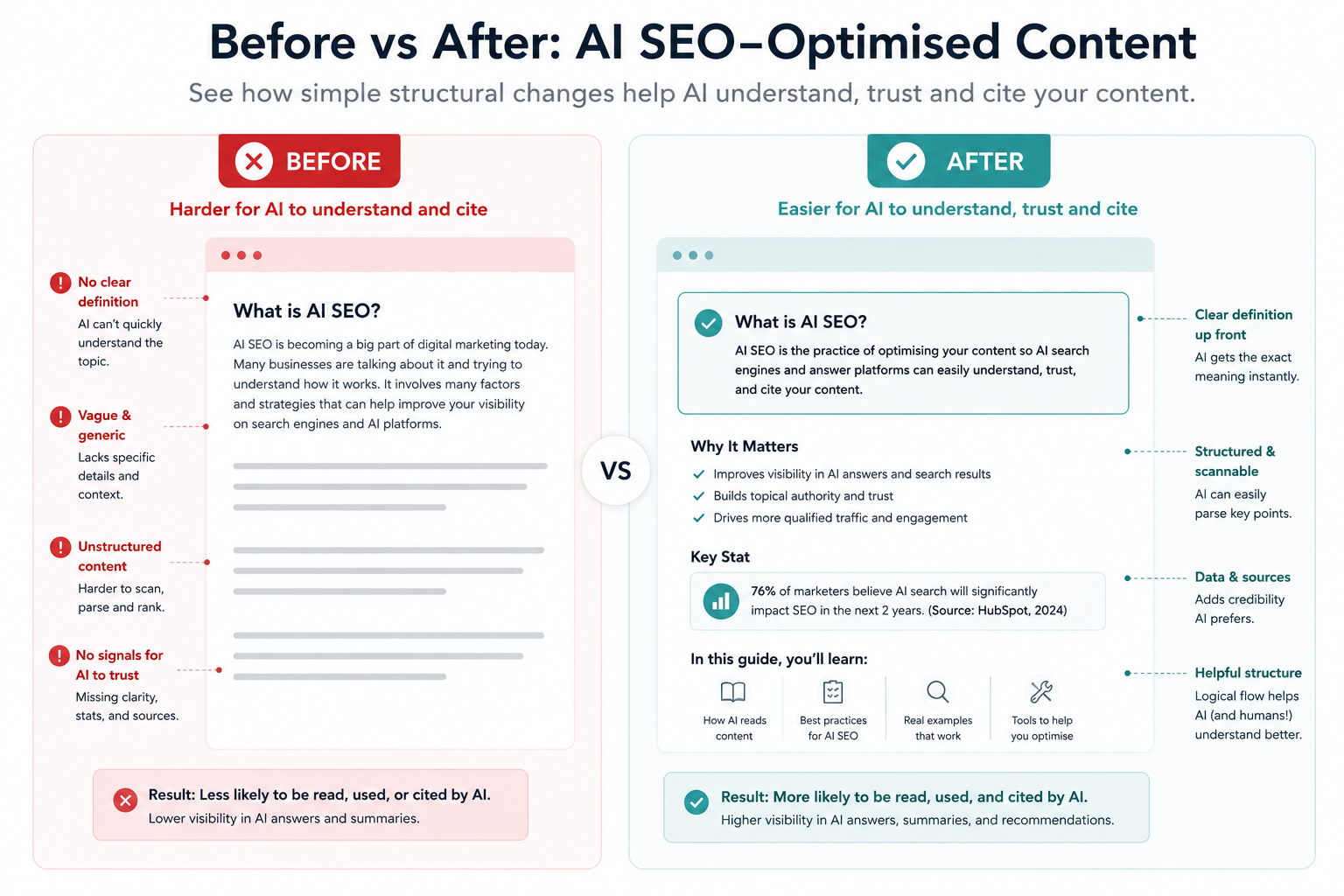
AI systems often cite the first 1–2 sentences after headings — making the answer-first format essential for citations. Siftly's optimisation framework emphasises this inverted pyramid style because it caters directly to how LLMs parse and extract information for responses.
Definition-First Sentence Patterns
Definition-first sentences open with "X is..." or "X refers to..." and immediately state what the subject of the section is before explaining why it matters or how it works. This works because AI systems scan for definitional signals at the start of a section to decide what that section is about. If the first sentence establishes the subject clearly — "Schema markup is..." — the AI can immediately match that section to any user question that involves schema markup. If the first sentence starts with context or background, the AI has to guess what the section is about from what comes later, which reduces how reliably it gets matched and cited.
Research from Georgia Tech found that definition-first sentence patterns increase AI citation rates by 2.1x compared to sections that begin with context or background information.
Sourced Statistics — Placed Within the First 100 Words of Each Section
Statistics make claims verifiable and attributable. A sourced statistic gives the AI system a precise, named claim it can extract and attribute to your page — which is the entire mechanism of citation. Generic claims ("AI search is growing") give the system nothing specific to cite. Sourced statistics ("AI-referred traffic converts at 14.2% compared to 2.8% from traditional search, per SimilarWeb 2025") give it a precise, attributable statement.
We add one constraint that most GEO guides do not mention: the statistic needs a named source adjacent to it — not just a hyperlink. AI extraction layers cannot reliably follow links during the chunking phase. "According to SimilarWeb's 2025 Generative AI Brand Visibility Index" is extractable. A number with only a hyperlink attached loses the attribution in the chunk. Write the source name into the sentence, not just into the anchor text.
The Evidence Layer — Tables and Structured Lists
After the answer capsule and any supporting statistics, the evidence layer provides comparative or categorical information in a format AI extraction layers can parse directly. Structured formats like bullet points and tables make it significantly easier for AI to pull out individual facts and cite them. Research by Siftly found that content with clear heading hierarchy, bullet points, and tables gets cited 65% more frequently by AI tools than the same information written as unbroken paragraphs. The reason: a bullet point or table row is a self-contained unit the AI can extract cleanly. A fact buried inside a paragraph has to be separated from the surrounding sentences first — and that process is less reliable.
The most citation-worthy evidence layer formats, in descending order of extractability:
- Comparison tables — two or three columns comparing entities across consistent criteria. The structure is explicit and the AI can extract individual rows as discrete facts.
- Numbered lists with named items — particularly when each item has a one-sentence description. The list structure signals to the extraction layer that each item is a discrete, independently citable point.
- Definition glossaries — short blocks that define a set of related terms in parallel structure. Highly extractable for informational queries.
- Process steps — numbered sequences where each step is a named action. Maps directly to "how to" query structures that AI tools handle frequently.
The Real-World Example Layer
The example layer follows the evidence layer and provides a concrete case that makes the abstract claim specific. This serves two functions simultaneously: it gives AI systems a citable illustration that distinguishes your content from generic summaries of the same topic, and it demonstrates the firsthand experience signals that Google's E-E-A-T framework and AI trust layers both look for.
This is the layer most AI-optimised content fails to include because it is the hardest to produce quickly. A genuine example from your own practice — a specific client outcome, a specific test you ran, a specific failure and what it taught you — cannot be replicated by a competitor or generated synthetically. Generic content that follows every structural tactic will still lose to specific content that follows the same tactics, because the synthesis layer of generative engines collapses generic content into composite answers regardless of how well-cited it is. The example layer is your defence against that collapse.
FAQ Section — Minimum Five Questions Per Page
FAQ sections are the format AI engines cite most frequently for question-based queries because the structure already matches how users phrase their prompts. A user who asks "how long should each section be for AI to extract it?" will find a page with that exact question-and-answer pair more readily citable than a page that answers the question in flowing prose buried in paragraph seven.
Research in the GEO field confirms that question-and-answer pairs map directly to how AI systems process queries — FAQ sections are listed among the most effective content formats for citation optimisation.
Each FAQ answer should follow the same answer-capsule format as your H2 sections: direct answer first, supporting detail second, no scene-setting. The FAQ is not a customer service section — it is a citation surface area layer for every long-tail query variation your page might match.
The Best Practice AI SEO Blog Structure — Element by Element
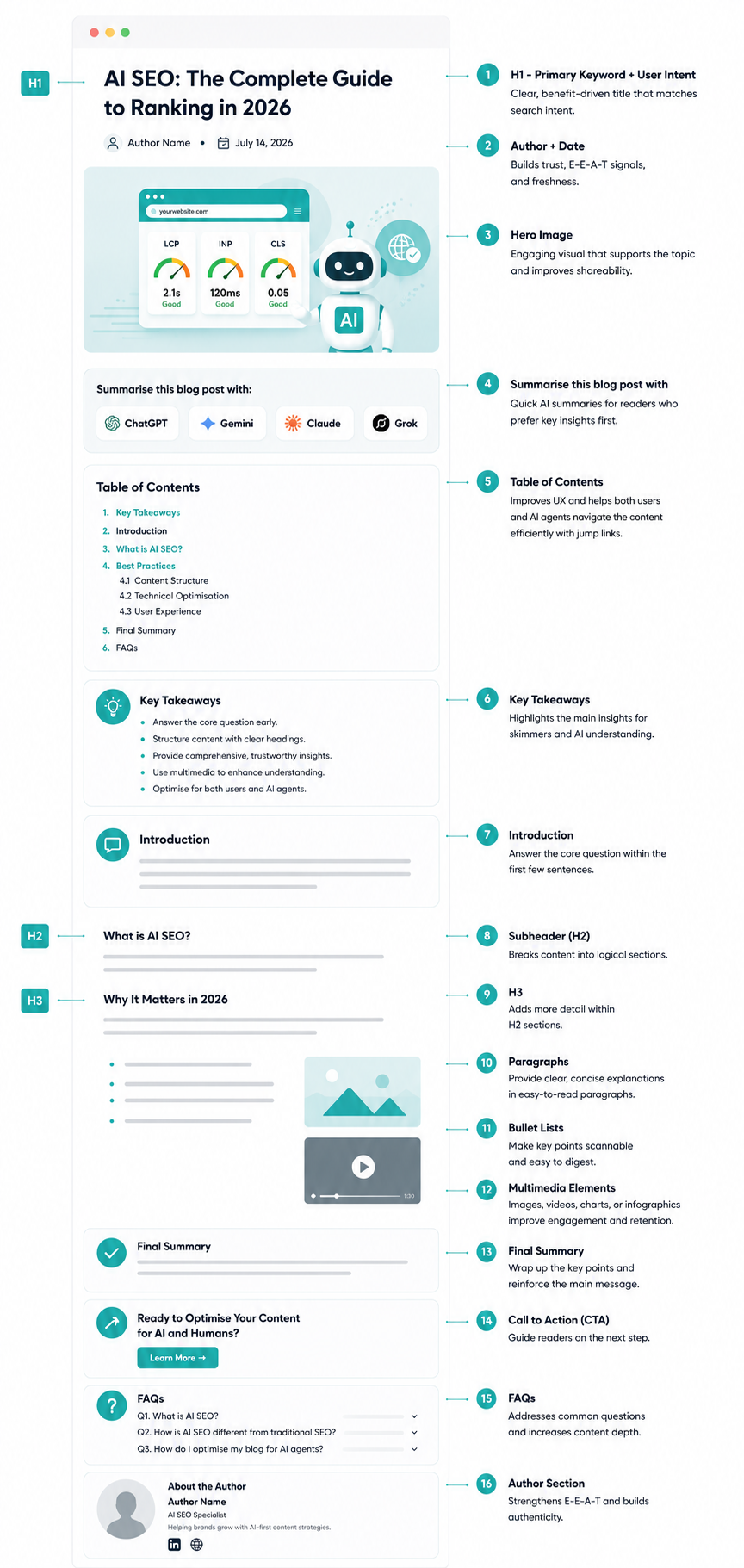
At the page level, applying the Researcher's Method produces a consistent structure that handles both human readability and AI extractability simultaneously. The diagram above shows what a fully optimised AI SEO blog post looks like. Here is what each element does — and why leaving any of them out costs you citation potential.
How Long Should Each Extractable Passage Be?
Passage length for AI extraction is a more precise question than most content guides address. The general advice to "write short paragraphs" is correct but not specific enough to be operationally useful.
Research from Siftly suggests that each extractable passage should be approximately 134 to 167 words — long enough to contain a complete, self-contained argument, but short enough to form a single, coherent chunk rather than being split across multiple embedding windows.
In practice, this maps to:
- An answer capsule of 40–60 words (the primary citable claim)
- A supporting explanation of 60–80 words (context, mechanism, or nuance)
- A statistic or example of 30–40 words (the verifiable anchor)
We treat the 134–167 word range as a heuristic, not a hard rule. The more useful test is self-containment: if someone were to see only the text between two H2 headings — no page title, no introduction, no conclusion — would that section make complete sense and contain a citable claim? If yes, the passage is correctly structured for extraction. If it requires context from elsewhere on the page to be understood, restructure until it does not. This test is faster to apply than counting words and more directly tied to the extraction mechanic you are trying to optimise for.
Common Structural Mistakes That Reduce AI Citation Rates
The inverse of the Researcher's Method is worth naming explicitly, because several common content habits directly interfere with AI extraction.
The Limit of Structural Optimisation — And What Sits Beyond It
The Researcher's Method improves citation rates on existing content. Structural optimisation produces 17.3% citation improvements independently of content quality — meaning it is a separate lever, not a replacement for quality. But it is not unlimited in its effect, and the research is clear about where the ceiling is.
Brand mentions correlate 3x more strongly with AI visibility than backlinks — 0.664 vs. 0.218 — and distributing content to a wider range of publications increases AI citations by up to 325% compared to publishing only on your own site. Multiple independent studies from Moz, Muck Rack, and the University of Toronto all confirm the same pattern: AI systems systematically favour earned third-party sources over brand-owned content.
This is consistent with the Seer Interactive post-hoc citation hypothesis. If AI systems are recommending brands they already know from training data and then finding supporting sources, the structural quality of your owned content determines how easily you get cited — but your off-site presence determines whether you get into the recommendation set in the first place.
For most Malaysian SMEs, the honest priority order is: content quality and specificity first, structural formatting second, off-site mentions third. The reason is that most businesses we work with have content that is too vague to be cited regardless of its structure — fixing the vagueness problem produces more citation lift than fixing the structure problem. Once the content is specific enough to be worth citing, structure determines whether it gets found and extracted. Once the content is specific and well-structured, off-site mentions determine whether your domain passes the authority filter that lets your pages into the consideration set at all. These are not competing priorities — they are sequential ones.
Final Thoughts
The Researcher's Method is a structural discipline, not a formula. Its purpose is to make content that is genuinely valuable more visible to AI systems — not to make content that is not valuable appear so.
The research is consistent on this point across multiple studies: structure optimisation produces real citation gains, but those gains are compounded by genuine specificity, original data, and named expertise. The AI citation landscape is rewarding content that sounds like it comes from someone who actually knows the subject — and penalising content that merely looks like it was structured to be cited.
What we find most useful about the Researcher's Method is not any individual element — it is the habit of asking, section by section: could an AI system extract and attribute this passage on its own, without any surrounding context? If the answer is yes, the section is correctly structured. If the answer is no, it needs work — usually in the form of a more specific answer capsule, a named statistic, or a real-world example that makes the claim verifiable.
Stay current with how AI citation signals are evolving by following our AI SEO updates.