
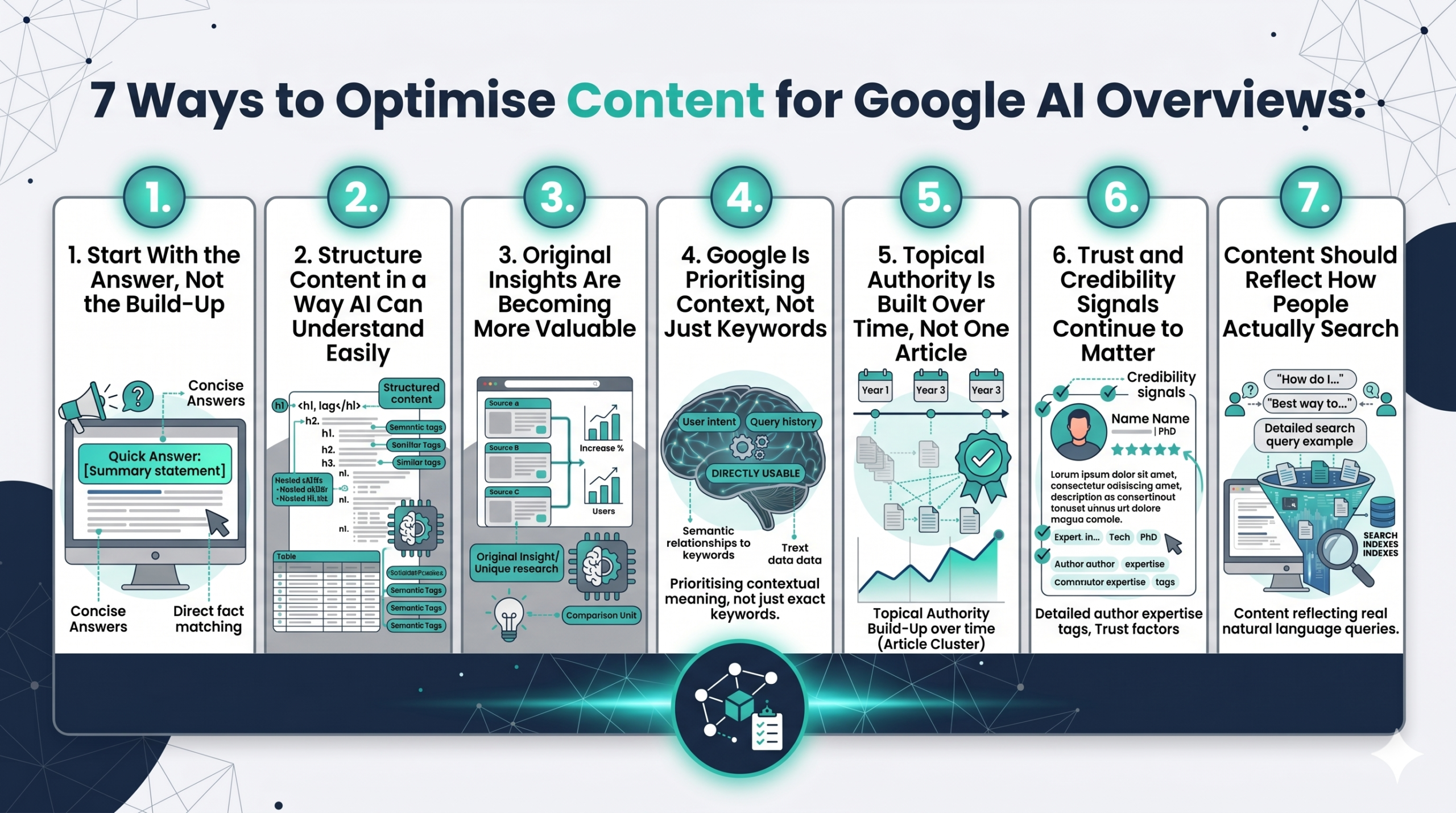
- Google AI Overviews prioritise content that is clear, well-structured, and easy for AI systems to understand
- Direct answers, natural language, and conversational formatting improve the chances of appearing in AI-generated search results
- Original insights, real examples, and strong topical authority are becoming more important than keyword-heavy content
- Trust signals such as credible sources, expertise, and accurate information continue to play a major role in AI search visibility
Google AI Overviews are changing how content appears in search results, and more importantly, how people interact with information. Instead of scrolling through multiple links, users are now often getting direct summaries right on the results page.
For businesses and content creators, this changes the game quite a bit. Traditional SEO is still relevant, but it no longer guarantees visibility on its own. What matters now is whether Google's systems see your content as clear, useful, and reliable enough to pull into those summaries.
Google has also been fairly direct about this in its guidance on creating content for AI-powered search. The focus is still on helpful, people-first content. But in practice, that content now also needs to be easier for machines to interpret and extract.
And that's where things start to shift.
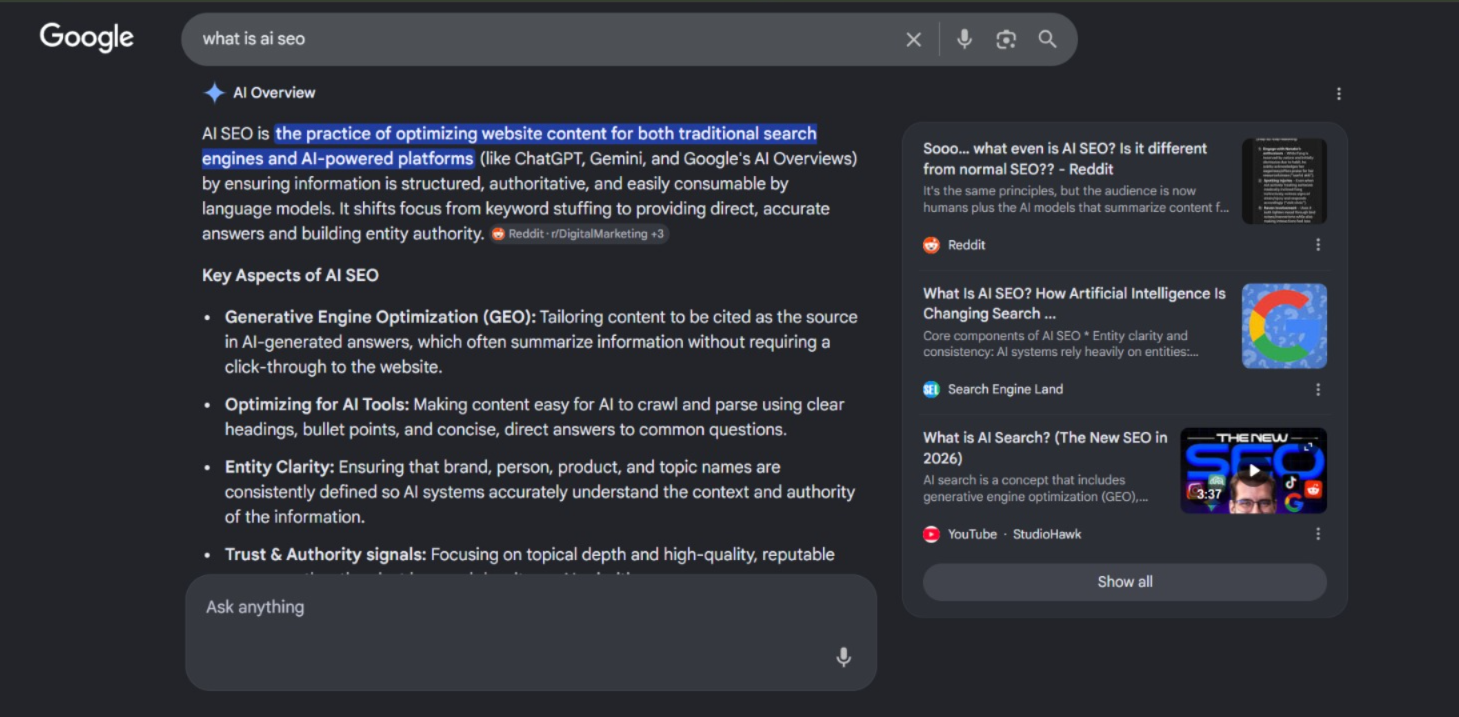
Start With the Answer, Not the Build-Up
One noticeable change in AI-driven search is how quickly information needs to appear. A lot of older SEO content still opens with long introductions before actually answering the question. That approach doesn't work as well anymore, especially when AI systems are scanning for direct, usable answers.
Instead of easing into the topic, it helps to get to the point earlier.
What Strong Answer-First Content Looks Like
Generic opening lines
Keyword-heavy phrasing
Clear explanation upfront
Natural sentences
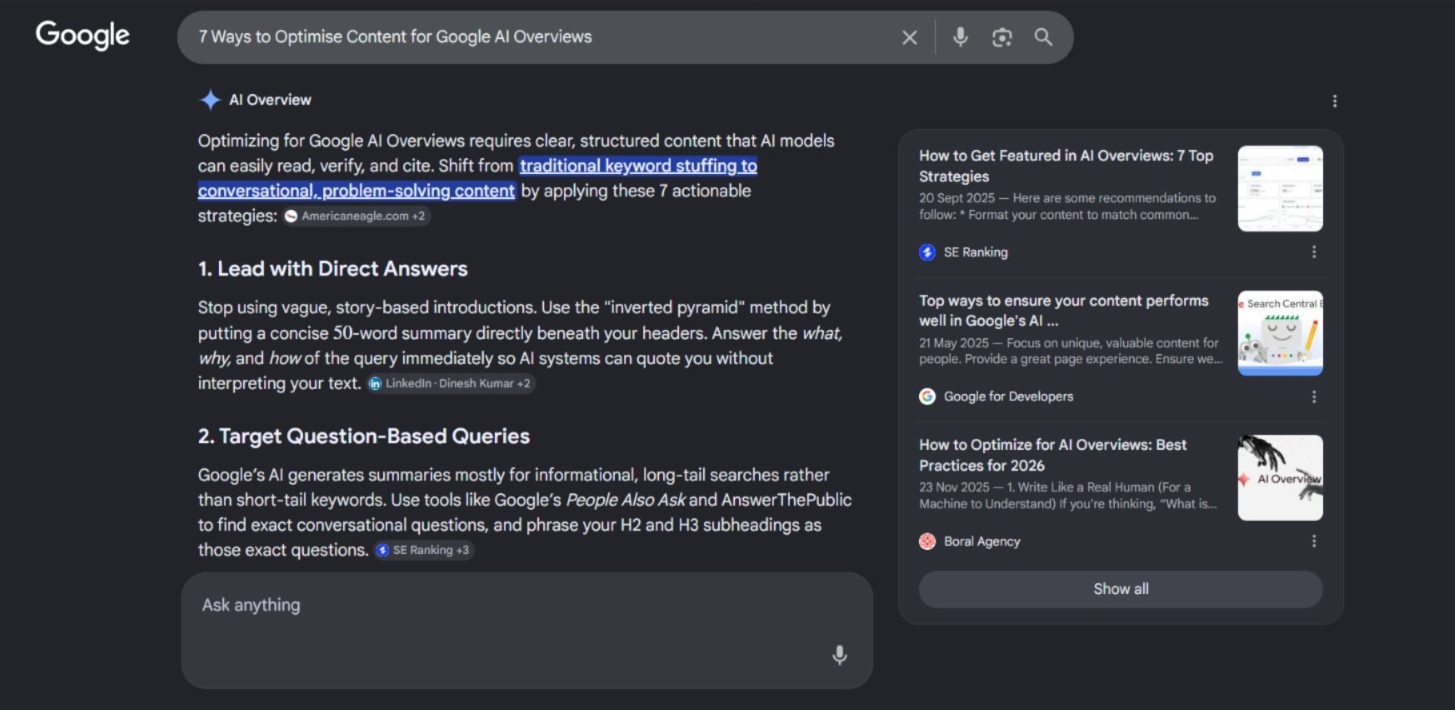
The goal is not to make content overly simplified. It is to make information easier to understand quickly. It's a small shift, but it changes how both users and search engines read your content.
Structure Content in a Way AI Can Understand Easily
Well-structured content is easier for both readers and AI systems to process. Large blocks of text without headings or formatting can make it difficult for search engines to identify key points and relationships between topics.
Important Structural Elements
If a page jumps between ideas or hides key points inside long paragraphs, it becomes harder to extract meaning from it. That's one reason structured content is often mentioned in discussions around improving visibility in AI search environments.
Original Insights Are Becoming More Valuable
There's a lot of similar content online right now. A quick search on almost any SEO topic will show dozens of articles saying the same thing in slightly different wording. Because of that, generic explanations don't stand out anymore.
What tends to perform better now are pages that include:
- Real examples from actual experience
- Case-based explanations
- Practical observations
- Something that feels "lived in," not just summarised
Google Is Prioritising Context, Not Just Keywords
Traditional SEO strategies often focused heavily on exact-match keywords. While keywords still matter, AI search systems are now trying to understand meaning and intent.
Content should focus on:
- Relevance to the user's actual intent
- Clarity and natural language
- Topical depth over keyword repetition
It reads more naturally, and it actually reflects how people search now. It's less about repeating keywords and more about covering the topic properly.
Topical Authority Is Built Over Time, Not One Article
Publishing a single article about a topic is rarely enough to build strong visibility in AI search. Google increasingly evaluates whether a website consistently covers a topic in a connected way.
Example of Topic Coverage
| Limited Coverage | Strong Topical Authority |
|---|---|
| One AI SEO article | Multiple interconnected AI SEO resources |
| Minimal internal linking | Clear topic clusters |
| Surface-level discussions | Comprehensive coverage |
Instead of writing one standalone article, stronger sites build a group of related content:
- AI SEO tools
- AI citation strategies
- AI SEO performance tracking
- AI search optimisation
- AI visibility measurement
Businesses exploring performance metrics can read our guide on Measuring AI SEO Performance: KPIs, Citations & Brand Visibility. For brands comparing platforms, our article on Top 7 AI SEO Tools for Businesses in 2026 explains which tools are genuinely useful.
Trust and Credibility Signals Continue to Matter
Even with AI-generated summaries, trust still plays a major role. Search systems still need to decide which sources are reliable enough to reference — and that usually comes down to how consistent, accurate, and credible the content appears.
Content Should Reflect How People Actually Search
Search behaviour is becoming more conversational. People don't just type keywords anymore — they ask full questions:
- "How do I optimise content for Google AI Overviews?"
- "Why is my website not appearing in AI search?"
- "What makes content more visible in AI-generated results?"
Better Heading Example
FAQ Sections Can Also Help
Well-written FAQ sections improve:
- Semantic relevance
- Long-tail keyword visibility
- Question-based optimisation
- AI extractability
They also create concise answer sections that AI systems can reference more efficiently.
What AI-Friendly Content Usually Looks Like
| Traditional SEO Content | AI-Friendly Content |
|---|---|
| Long introductions | Clear answers early |
| Keyword repetition | Natural language |
| Surface-level information | Topical depth |
| Generic advice | Real examples and expertise |
| Weak structure | Scannable formatting |
| Ranking-focused only | Citation and visibility-focused |
Common Mistakes That Reduce AI Visibility
Content that focuses too heavily on keywords often feels unnatural and less valuable to users.
AI-generated drafts without human expertise or refinement often lack originality and depth.
Even strong information becomes harder for AI systems to interpret when formatting is unclear.
Publishing more content does not automatically improve authority. Comprehensive, well-structured resources perform better than multiple shallow articles.
Final Thoughts
Google AI Overviews are changing how visibility works in search. It's no longer just about ranking pages. It's about whether your content is clear enough, useful enough, and structured well enough to be used as a source.
Websites that are performing well in AI search are typically creating content that:
- Explains ideas clearly
- Avoids unnecessary complexity
- Includes real insights
- Structures content logically
- Focuses on usefulness first
At the end of the day, that's what AI systems are trying to surface anyway — content that actually helps someone understand something quickly, without needing to dig through five different pages. For more on getting cited directly, read our guide on how to get cited by ChatGPT.