
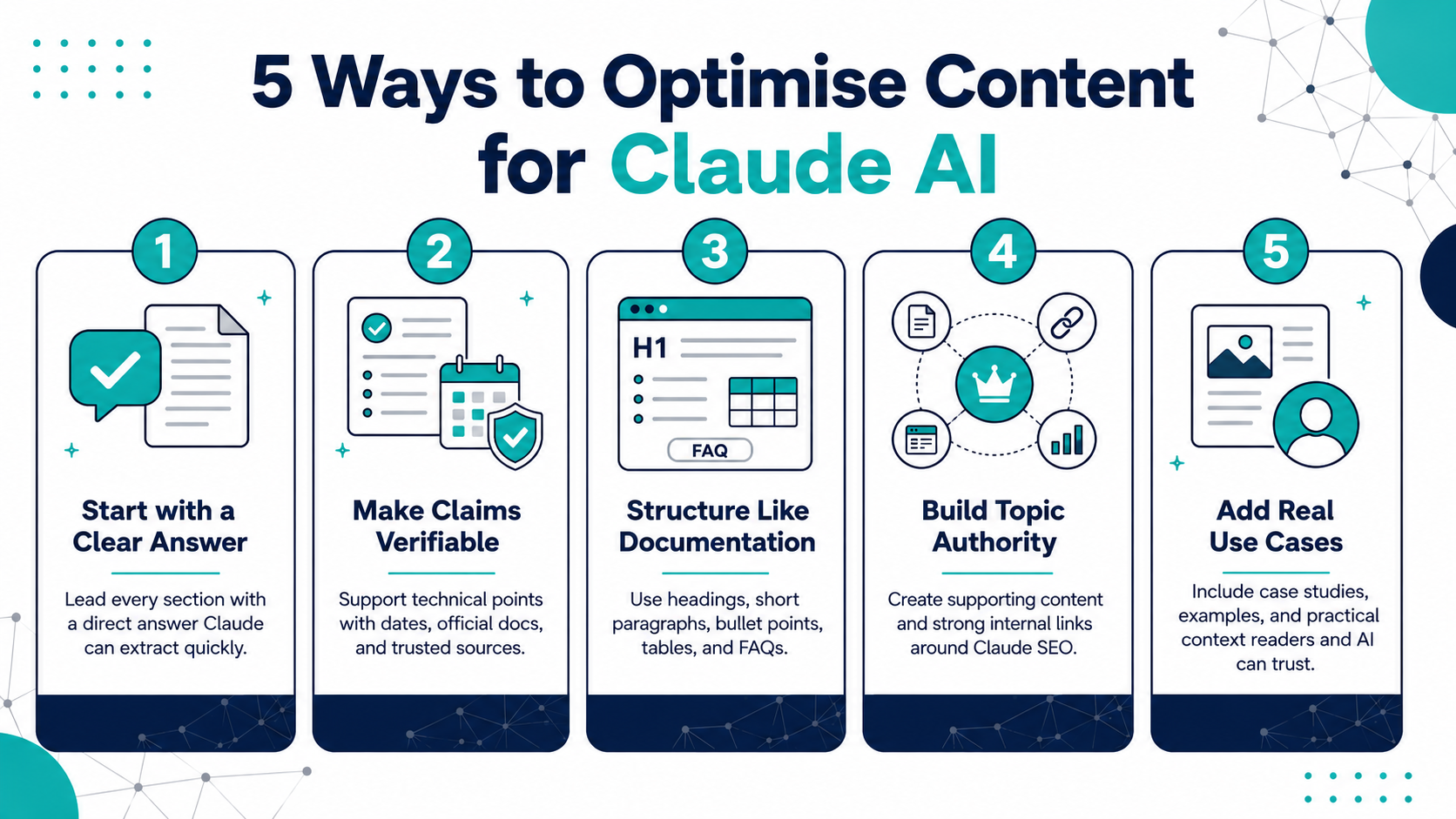
- Claude SEO is about making your content clear, structured, and trustworthy enough for Claude to understand and use as an answer source
- Start each section with a direct answer so Claude can extract the main point quickly
- Technical claims should be supported with reliable sources, official documentation, dates, examples, and citations
- Strong internal linking helps build topic authority around AI SEO, Claude, ChatGPT, Perplexity, and Google AI Overviews
- Humanised examples, case studies, tables, FAQs, and schema markup make your content more useful for both readers and AI systems
If you are starting with Claude SEO, focus on one thing: making your content easy for Claude to understand and trust. Claude prefers content that is clear, accurate, well-structured, and supported by reliable sources.
What Makes Claude SEO Different?
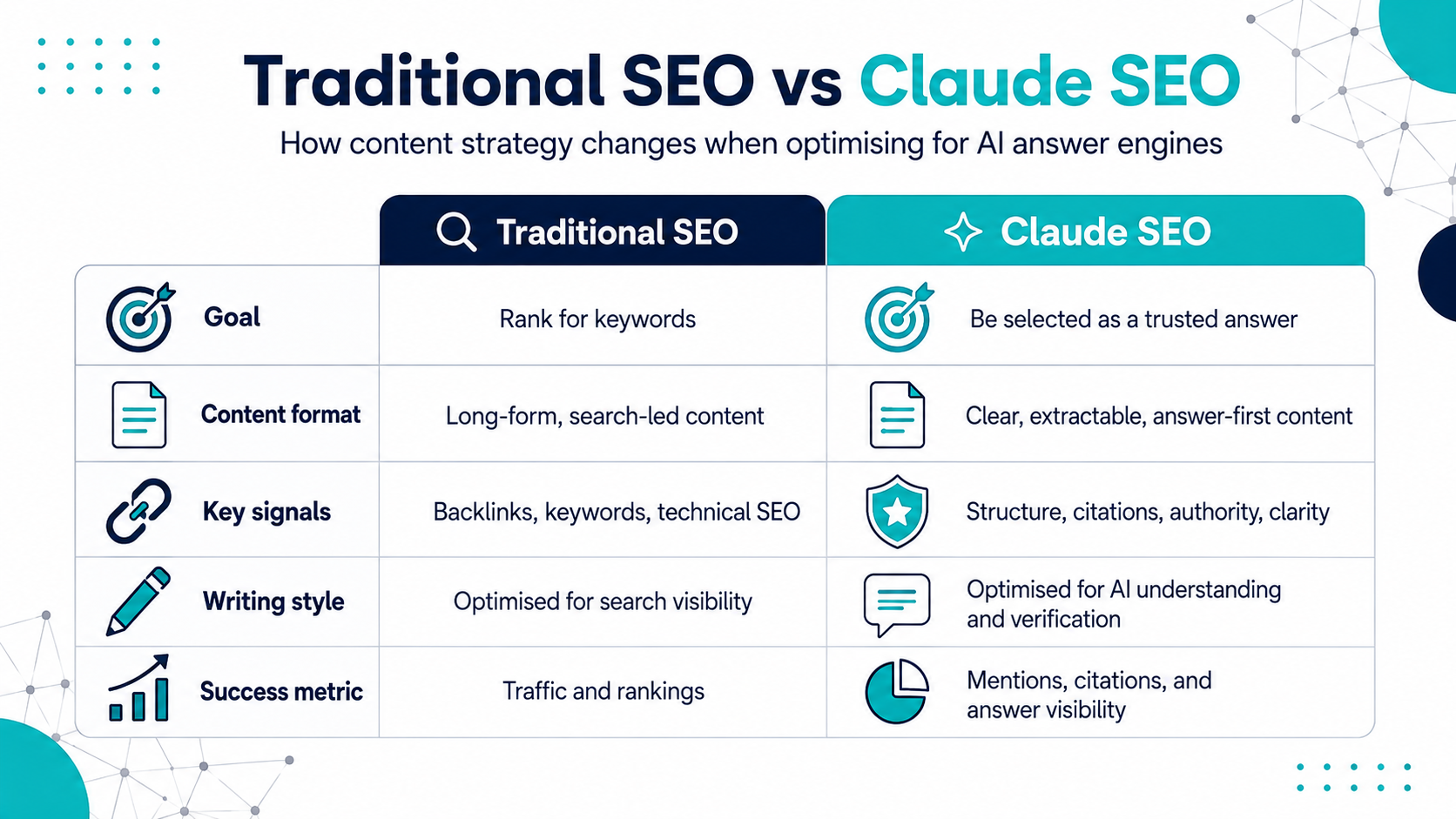
Unlike traditional SEO, which focuses on rankings and keywords, Claude SEO focuses on helping AI systems extract, verify, and confidently use your information when answering questions. According to Anthropic, Claude can access web content via its web search tool and provide citations from search results, making source quality and content structure especially important.
In short, content should not only be written for people — it should also be easy for AI to interpret and validate.
For broader AI search strategy, you can also read our guide on AI SEO trends for 2026.
Start Every Section With a Clear Answer
Claude needs to understand the main point quickly. One of the best ways to do this is by using an "answer-first" structure. Instead of writing a long introduction before giving the answer, start each section with a direct explanation. Then expand with details, examples, and supporting evidence.
The second version is easier for Claude to extract because it already sounds like an answer. This approach is also similar to how AI citation optimisation works for ChatGPT — read our related guide on how to get cited by ChatGPT.
How to Apply This
Use this format for every important section:
- One direct answer
- Short supporting explanation
- Bullet points or table
- Example
- Source or reference where needed
This makes your content more useful for both readers and AI systems.
Make Every Technical Claim Verifiable
Claude is more likely to trust content when the claims can be checked. This is why technical content should include dates, source links, definitions, version numbers, and real examples.
That small difference matters because the second version gives Claude a clear source trail.
What to Cite in Technical Content
| Claim Type | Best Source to Link |
|---|---|
| Product feature | Official product documentation |
| Search behaviour | Google Search Central, Anthropic, Microsoft, or platform docs |
| Structured data | Schema.org or Google Search documentation |
| Industry trend | Research reports, official announcements, or credible industry publications |
| Your own performance | Internal case study, campaign report, or original data |
Structure Content Like Technical Documentation
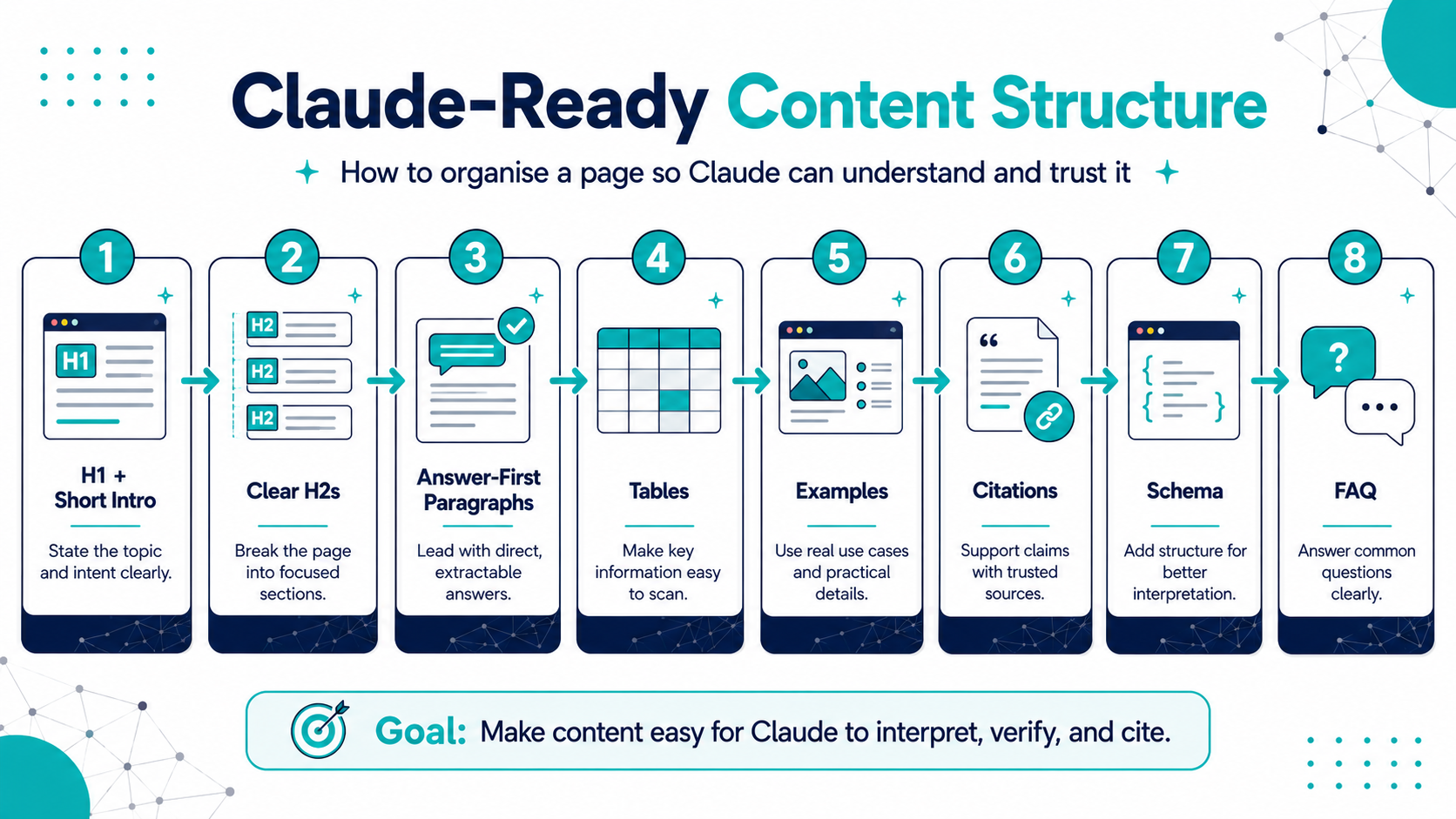
Claude does not read your article like a casual reader. It scans for useful content blocks. That means your headings, tables, lists, and examples matter a lot. Think of your blog as a mini knowledge base.
Use a Clean Structure
Recommended Schema for Claude SEO Content
| Page Type | Suggested Schema |
|---|---|
| Blog article | Article schema |
| FAQ content | FAQPage schema |
| How-to guide | HowTo schema |
| Service page | Organization, Service, LocalBusiness |
| Product documentation | Product, SoftwareApplication, TechArticle |
If you are also targeting Google AI results, connect this strategy with our Google AI Overviews optimisation guide.
Build Topic Authority Around Claude, Not Just One Blog
One article is not enough if you want to build AI visibility. Claude needs to see that your website has depth around the topic. If your main topic is "Claude SEO," your website should have supporting content around:
This helps AI systems understand that your site is not just chasing one keyword — you are building a content ecosystem.
Internal Linking Example
A strong Claude SEO content cluster links to:
- AI SEO trends for 2026
- How to get cited by ChatGPT
- How to optimise content for Google AI Overviews
- How to measure AI SEO performance
- AI SEO updates
Humanise the Content With Real Use Cases
Technical content should still feel human. Claude can summarise generic content easily, but generic content is not memorable. This is where many AI-written articles fail — they explain the topic, but they do not show real context, real problems, or real decision-making.
Case Study-Style Example
A B2B SaaS company wants Claude to mention its API documentation when users ask: "What is the best way to integrate inventory tracking into a CRM?"
Agency Service Page Example
30-Day Claude SEO Checklist
Common Claude SEO Mistakes to Avoid
Claude SEO is not about tricking the model. It is about making your content easier to understand, easier to verify, and more useful as an answer source.
Final Thoughts
Claude SEO is not about writing more content. It is about making your content clearer, more structured, and easier for AI to trust. With the right structure, citations, examples, and technical foundation, your content has a better chance of becoming the answer Claude chooses to reference.
Stay up to date with how AI search is evolving by following our AI SEO updates.
