
Key takeaways
- AI SEO ROI should be evaluated based on revenue impact, rather than rankings or traffic alone.
- Many SMEs struggle to see results because they focus on surface-level metrics instead of business outcomes.
- A structured yet simple financial model is sufficient to measure and track SEO performance effectively.
- Meaningful results typically emerge over a 6–12 month period as SEO efforts begin to compound.
- AI enhances SEO not only by increasing visibility, but by improving efficiency and overall operational scalability.
Table of Contents
Many SMEs invest in SEO and AI tools with the expectation that increased visibility will translate into business growth. However, higher traffic and improved rankings do not always lead to measurable returns.
The key question is not whether your SEO is performing — but whether it is generating revenue.
Here’s the simple answer:
ROI of AI SEO
= (Revenue generated from SEO + AI visibility – total cost) ÷ cost × 100
While the formula itself is straightforward, the challenge lies in identifying the right metrics and accurately attributing revenue across multiple touchpoints. This has become increasingly complex as search behaviour evolves, with AI-driven platforms influencing customer decisions before they reach your website.
What Is AI SEO ROI (And Why Most SMEs Misunderstand It)
AI SEO ROI is no longer just about ranking on Google.
It now includes:
- Organic traffic
- AI-driven visibility (ChatGPT, Google AI Overview)
- Conversion impact
- across the full customer journey
AI SEO ROI measures how much revenue your visibility generates vs how much you spend.
The challenge is that ROI is no longer linear. It builds across multiple touchpoints, which is why many SMEs struggle to connect SEO efforts directly to revenue.
Structured ROI models show that businesses need to account for both direct returns and indirect impact, especially when AI improves efficiency, not just traffic.
Why SMEs Should Care About AI SEO ROI Now
If you’re running a business in Petaling Jaya (or anywhere in Malaysia), the market is already shifting:
- Users want answers, not links
- AI tools recommend brands directly
- Zero-click searches are increasing
That means if your business isn’t visible in these ecosystems, you’re missing demand before users even visit your website.
This is also why many businesses are shifting away from rankings and focusing on revenue-driven SEO strategies, especially when evaluating SEO ROI in Malaysia.
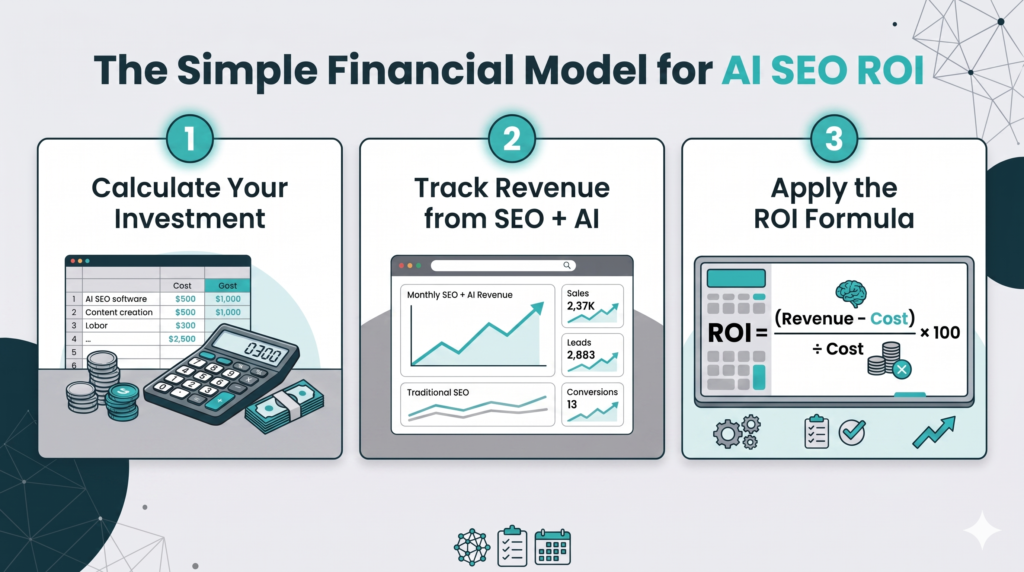
The Simple Financial Model for AI SEO ROI
Step 1: Calculate Your Investment
Include everything:
- SEO agency or freelancer fees
- Content production
- AI tools (ChatGPT, Surfer, etc.)
- Internal team time
Example:
- SEO services: RM3,000/month
- Content: RM2,000/month
- Tools: RM500/month
Total monthly cost = RM5,500
Step 2: Track Revenue from SEO + AI
You need to track:
- Organic traffic conversions
- Leads from blog/content
- Customers mentioning AI platforms
Example:
- 50 leads/month from SEO
- Conversion rate: 10%
- Avg deal value: RM1,000
Revenue = RM5,000/month
This is where many SMEs struggle — not because SEO isn’t working, but because they lack proper tracking systems to connect visibility with revenue outcomes.
Step 3: Apply the ROI Formula
ROI = (Revenue – Cost) ÷ Cost × 100
(RM5,000 – RM5,500) ÷ RM5,500 × 100 = -9% (loss stage)
This is normal in early months.
Now fast forward 6–12 months:
- Traffic grows
- Conversion improves
- Brand visibility increases
Updated example:
- 120 leads/month
- 12% conversion
- RM1,200 avg deal
Revenue = RM17,280
ROI = (17,280 – 5,500) ÷ 5,500 × 100 = 214% ROI
That’s where real ROI starts showing.
AI SEO ROI Model (Expanded)
| Component | What to Measure | Why It Matters |
|---|---|---|
| Traffic | Organic + AI visits | Visibility baseline |
| Leads | Enquiries, calls | Demand signal |
| Conversion rate | Lead → customer | Revenue driver |
| Revenue | Sales from SEO | Core ROI metric |
| Cost | Total investment | Profitability |
| AI visibility | Mentions in AI tools | Future growth |
The 5 Metrics That Actually Matter (Not Vanity Metrics)
Most businesses track the wrong things.
Vanity metrics include:
- Impressions
- Rankings
- Traffic alone
These don’t guarantee revenue.
Instead, focus on:
1. Revenue Attribution
The most important metric.
If SEO is not generating revenue, it’s not working.
2. Conversion Rate
Traffic without conversion = wasted budget.
Even small improvements here can double ROI.
3. Cost Per Lead (CPL)
Lower CPL = higher efficiency.
4. Productivity Gains (AI Impact)
AI can:
- Save 13+ hours/week per employee
- Increase productivity by up to 80%
That translates directly into cost savings.
5. Customer Experience Improvements
AI-driven systems can:
- Reduce response time by 68%
- Increase satisfaction by 15%
Better experience → higher retention → higher ROI.
Real Case Studies (SME Context)
Case Study 1: Content Automation
A small business implemented AI for content creation:
- 60% reduction in content production time
- Significant cost savings annually
- Faster publishing → more traffic
Result:
Lower cost + higher output = improved ROI
Case Study 2: Lead Generation
SMEs using AI-driven lead generation have reported:
- 200–400% ROI within 12 months
These results typically come from structured implementation, not just using tools blindly.
Case Study 3: SEO Revenue Growth (Malaysia)
A Malaysian SEO campaign achieved:
- 283% revenue growth
- 300% traffic increase
But the key takeaway is not traffic —
It is revenue growth tied to SEO efforts.
The Biggest Mistake: Measuring the Wrong Things
A lot of businesses still report:
- “We ranked #1”
- “Traffic increased 200%”
But here’s the uncomfortable truth:
None of that matters if revenue doesn’t increase.
Even recent industry insights warn that:
- Many companies rely on vanity metrics that don’t reflect real business outcomes
That’s why your reporting should always answer:
“How much money did this generate?”
How Long Does AI SEO ROI Take?
| Stage | Timeline | Outcome |
|---|---|---|
| Month 1–3 | Setup | Foundation |
| Month 3–6 | Early traction | Traffic + leads |
| Month 6–12 | Growth | Revenue impact |
| 12+ months | Scale | Strong ROI |
Most SMEs expect instant results — but:
SEO is a compounding asset, not a quick win.
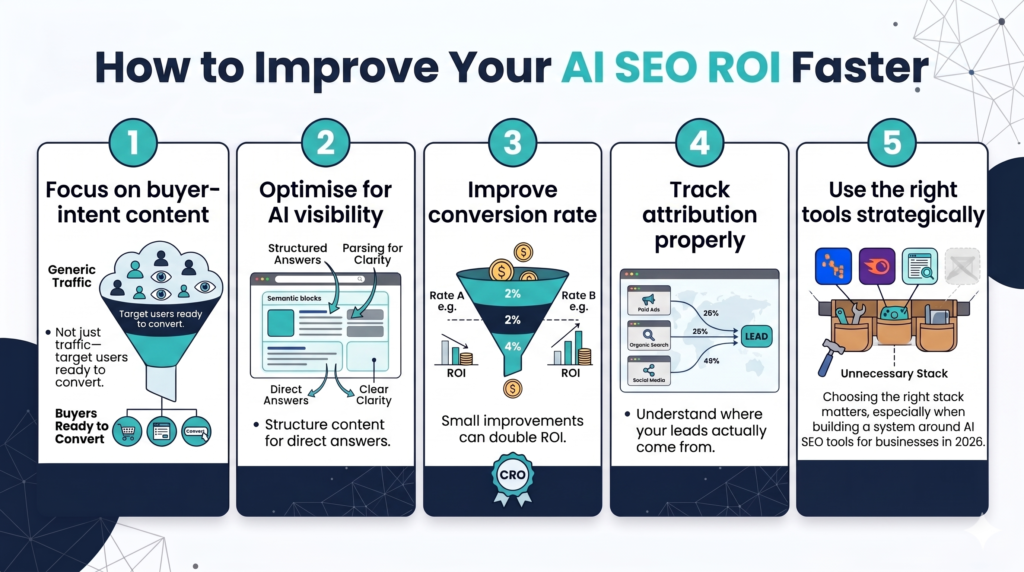
How to Improve Your AI SEO ROI Faster
If your ROI is slow or unclear, check these:
- Focus on buyer-intent content
Not just traffic—target users ready to convert.
- Optimise for AI visibility
Structure content for direct answers and clarity.
- Improve conversion rate
Small improvements can double ROI.
- Track attribution properly
Understand where your leads actually come from.
- Use the right tools strategically
Not all tools are necessary — but choosing the right stack matters, especially when building a system around AI SEO tools for businesses in 2026.
Final Takeaway
AI SEO should ultimately be evaluated based on its impact on revenue, not just visibility.
For SMEs in Malaysia, the goal is to build a system where traffic, AI exposure, and content efforts translate into measurable business outcomes. This requires focusing on the right metrics — particularly conversions and return on investment, rather than surface-level performance indicators.
While the financial model itself is simple, its value lies in consistent application. Businesses that prioritise revenue-driven SEO, supported by AI for efficiency and scalability, will be better positioned for sustainable growth.
FAQ
Is AI SEO worth it for SMEs in Malaysia?
Yes, provided it is implemented with proper strategy and measurement. Most SMEs begin to see meaningful ROI once tracking is aligned with business outcomes rather than just traffic.
What is a good SEO ROI benchmark?
A typical benchmark for SMEs ranges from 3x to 5x return, although this varies depending on industry, competition, and execution quality.
Why is my SEO not generating ROI?
This is usually due to a mismatch between effort and outcome — such as targeting low-intent keywords, weak conversion optimisation, or insufficient tracking to attribute revenue properly
Can AI SEO ROI be measured accurately?
It cannot be measured with absolute precision, as customer journeys are rarely linear. However, it can be assessed reliably through trends in revenue, lead quality, and conversion performance.
What’s the biggest mistake businesses make?
Overemphasising traffic and rankings while underestimating revenue attribution and conversion data.