
Key takeaways
- AI Overviews Optimisation focuses on getting your content cited in AI-generated search summaries.
- AI Overviews combine information from multiple websites to produce direct answers for users.
- Strong E-E-A-T signals, structured content, and semantic clarity increase your chances of being selected.
- AI search visibility is becoming as important as traditional rankings.
Table of Contents
Today, many users receive answers directly from AI-generated summaries on the search results page. One of the biggest changes driving this shift is Google AI Overviews, a feature that uses artificial intelligence to generate quick explanations for search queries by combining information from multiple websites.
Instead of visiting several pages to gather information, users can now see a summary immediately.
This evolution in search has introduced a new strategy known as AI Overviews Optimisation.
Rather than focusing only on ranking in search results, websites must now optimise their content so that AI systems can understand, extract, and reference their information when generating answers.
But what is AIO?
In this guide, we’ll explore what AI Overviews optimisation means, how it works, and how websites can adapt their SEO strategy for AI-driven search.
What Is AIO (AI Overviews Optimisation)?
AI Overviews Optimisation is the process of creating and structuring content so that it can be selected as a source for AI-generated search summaries, particularly those shown in Google AI Overviews.
When a user searches for a question or informational topic, Google may generate a short AI-written explanation at the top of the search page. This summary is built using information gathered from multiple websites.
If your content is considered trustworthy and relevant, it may be referenced as one of the sources used to generate that answer.
Optimising for AI Overviews therefore focuses on helping AI systems:
interpret your content accurately
extract key information quickly
identify your website as a credible source
This approach is closely related to emerging strategies such as
AI SEO, Answer Engine Optimisation (AEO), and Generative Engine Optimisation (GEO)
How AI Overviews Work
AI Overviews rely on large language models that analyse web content and generate natural-language responses.
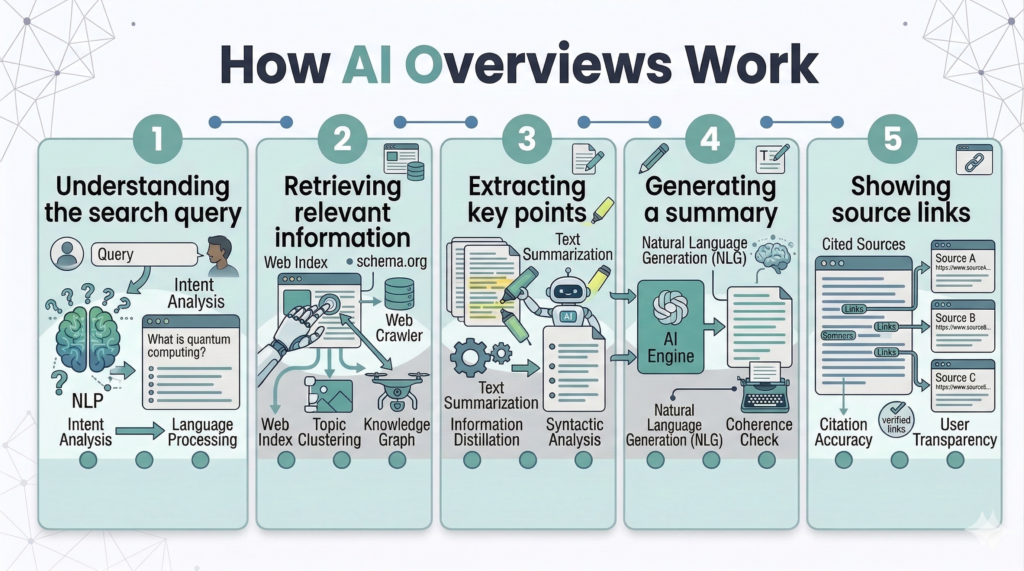
Although the technology behind these systems is complex, the process generally follows several steps:
1. Understanding the search query
The AI system first analyses the user’s question to determine the intent behind the search.
2. Retrieving relevant information
Google then gathers information from webpages that appear relevant and trustworthy.
3. Extracting key points
The system identifies useful explanations, definitions, and supporting details within those pages.
4. Generating a summary
AI combines the extracted information into a concise response that answers the query.
5. Showing source links
In many cases, the overview includes links to the webpages that contributed to the answer.
Because this process relies on extracting information from existing webpages, the clarity and credibility of your content strongly influence whether it may be used as a source.
Why AI Overviews Optimisation Matters
AI-generated answers are changing how people interact with search engines.
Here are three reasons businesses and publishers should pay attention to this shift.
1. AI summaries appear at the top of search results
AI Overviews typically appear above traditional organic listings. This makes them one of the most visible sections of the search page.
If your content contributes to the overview, your brand may gain exposure even before users scroll to other results.
Many users now search using full questions rather than short keywords.
Queries such as:
“What is AI Overviews optimisation?”
“How do AI search summaries work?”
“How to optimise content for AI search?”
are increasingly common. AI systems are designed to respond to these conversational queries with direct explanations.
AI systems attempt to prioritise reliable sources when generating answers.
This means websites with strong Experience, Expertise, Authoritativeness, and Trustworthiness (E-E-A-T) signals are more likely to be selected as references.
Demonstrating expertise through well-researched, transparent content can therefore improve your chances of being included in AI summaries.
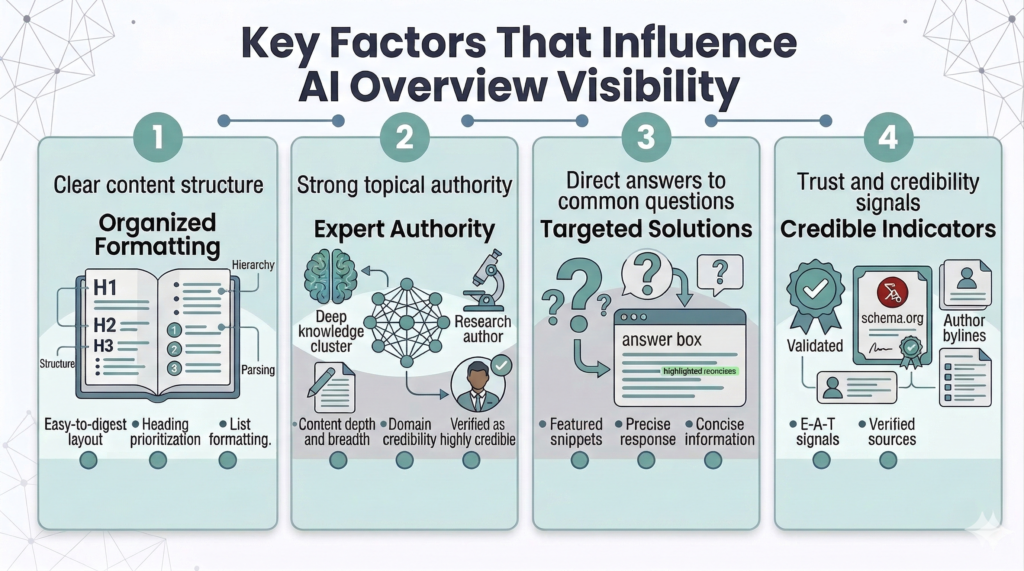
While there is no single formula to guarantee inclusion in AI Overviews, several factors can increase the likelihood that your content will be used as a source.
Clear content structure
AI systems can process information more effectively when articles are organised logically.
Helpful practices include:
descriptive headings
concise paragraphs
bullet lists
step-by-step explanations
These elements help AI models identify and extract important ideas quickly.
Strong topical authority
Websites that consistently publish high-quality content on a specific topic tend to be viewed as more reliable sources.
Building a library of related articles around a subject can strengthen your authority and increase the chances of being referenced by AI systems.
Direct answers to common questions
Many AI Overviews summarise straightforward answers to user questions.
Content that clearly explains a topic or definition is more likely to be included in these summaries.
Adding sections such as FAQs or short definitions can help AI systems identify clear answers within your page.
Trust and credibility signals
AI search systems attempt to prioritise information that appears reliable.
Content that demonstrates credibility may include:
expert authorship or professional experience
references to reputable sources
transparent information about the author or organisation
accurate and regularly updated content
These signals help establish trust and increase the likelihood of AI referencing your material.
AI Overviews Optimisation vs Traditional SEO
AI optimisation does not replace traditional SEO. Instead, it builds on the same foundation.
Traditional SEO focuses primarily on helping webpages rank higher in search results. AI optimisation expands this goal by also focusing on whether your content can be used within AI-generated answers.
| Traditional SEO | AI Overviews Optimisation |
|---|---|
| Focus on search rankings | Focus on AI citations |
| Keyword targeting | Question-based content |
| Backlinks and authority | Expertise and trust |
| Page visibility | Answer visibility |
Successful websites will increasingly need strategies that support both ranking and AI discoverability.
Best Practices for AI Overviews Optimisation
To improve the chances that your content may appear in AI-generated summaries, consider the following practices.
Write clear explanations
Content that explains concepts simply and directly is easier for AI systems to summarise.
Organise information logically
Structured articles help AI models understand the relationships between different sections.
Answer real search questions
Create content that addresses the questions people genuinely ask online.
Demonstrate expertise
Provide insights, examples, or experiences that show subject knowledge.
Maintain accurate and updated content
Reliable information increases trust and improves long-term visibility.
The Future of AI Search
AI-generated summaries are likely to become a permanent part of search.
Instead of navigating through multiple webpages, users are increasingly receiving answers directly within search results. As this trend grows, the role of SEO will continue to evolve.
The goal is no longer just to appear in search rankings but to become a trusted source that AI systems rely on when generating answers.
Websites that prioritise clarity, expertise, and high-quality information will be better positioned to succeed in this new search landscape.
FAQ
How is AI Overviews optimisation different from traditional SEO?
Traditional SEO focuses on ranking webpages in search results. AI Overviews optimisation focuses on structuring content so AI systems can understand and summarise it in generated answers.
Can small websites appear in AI Overviews?
Yes. Smaller websites can appear in AI Overviews if their content provides clear, reliable answers and demonstrates expertise on the topic.
What type of content appears in AI Overviews?
Content that clearly explains a topic, answers common questions, and is well-structured is more likely to appear in AI summaries.
Are AI Overviews part of AI SEO?
Yes. AI Overviews optimisation is part of AI SEO, which aims to make content easier for AI systems to understand and reference.