Key takeaways
- SEO is still essential, but not enough on its own. It helps your content get discovered, but ranking alone doesn’t guarantee visibility in the AI-driven search landscape.
- AEO focuses on being the answer, not just ranking. Structure your content so AI and search engines can extract clear, direct answers. Lead with clarity, use question-based headings, and avoid burying important information.
- GEO is about authority and AI citations. AI prefers content from trusted sources with depth. Build topic clusters, publish consistently, and become a reliable “entity” in your niche.
- AIO is your brand’s reputation in the AI ecosystem. Positive reviews, social mentions, and consistent brand information increase your likelihood of being recommended by AI tools.
Table of Contents
If you want the simplest way to understand how search has changed, it’s this:
SEO helps people find you, AEO helps you become the answer, GEO helps AI cite you, and AIO helps AI recommend you.
That’s the core difference.
But here’s where most marketers get it wrong, they treat these like four completely separate, competing strategies. In reality, they’re part of the same system.
Because of that, people end up overcomplicating something that is actually pretty simple at its core.
Search isn’t really about “searching” anymore.
It’s about getting answers.
And more specifically, it’s about receiving synthesised knowledge, where AI pulls from multiple sources and gives you one clean response.
So the real challenge now is this:
How do you show up inside that answer?
Let’s break it down properly without losing the human side of it, because that still matters more than people think.
The Real Shift: Searching Isn’t Really Searching Anymore
Not too long ago, search was predictable.
You typed a keyword.
You clicked a link.
You read a page.
Simple.
Now, the journey looks very different.
You ask a question, get an answer instantly, through an AI Overview, voice assistant, or chatbot, and most of the time, you don’t even click anything.
That’s what zero-click search looks like.
And it’s becoming the default.
Users aren’t exploring anymore. They’re choosing convenience. They want fast, direct answers, not a list of links to go through.
We’ve already seen this happening with AI search tools. As we explained in our AI SEO breakdown, platforms like ChatGPT and Google AI Overviews are already reducing organic traffic because users get what they need immediately.
So the real question for 2026 isn’t:
How do I rank on page one?
It’s:
Will AI include me in the answer?
If the answer is no, your visibility drops, no matter how “good” your SEO is.
SEO: Still the Foundation (But Not the Finish Line)
Let’s clear something up.
SEO is not dead.
It’s just not enough on its own anymore.
Think of SEO as your foundation. Without it, nothing else works.
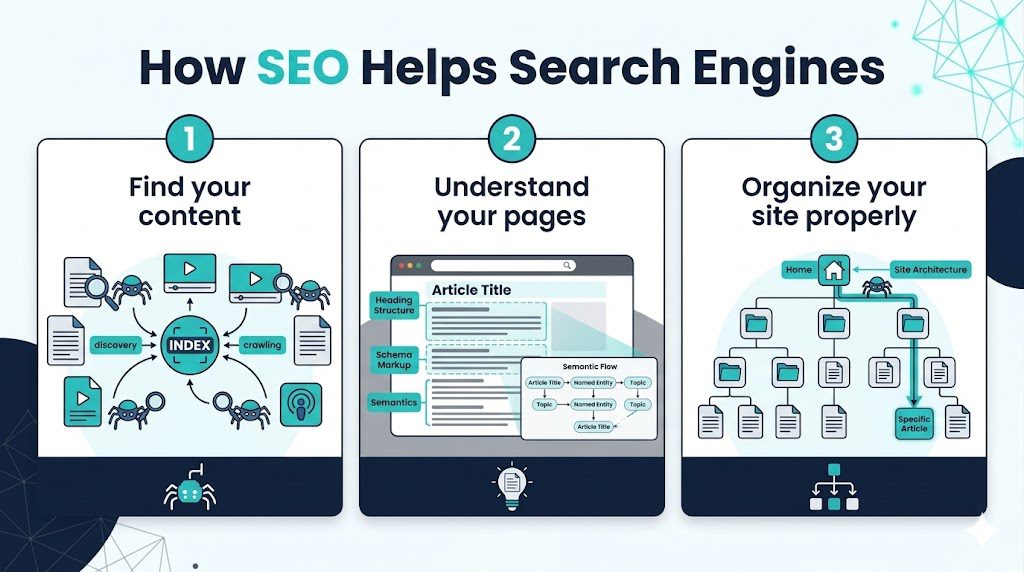
Even AI systems still rely on these basics; structure, clarity, and technical performance.
If your site is slow, messy, or hard to crawl, AI won’t spend time trying to “figure it out.” It’ll just move on.
Real Example: Skincare
Say you’re targeting:
“best cleanser for acne”
With strong SEO, you might rank top 3. That’s great.
But if an AI Overview appears above your result and pulls from other sources instead of yours, your ranking becomes almost irrelevant.
You’re technically there.
But practically invisible.
That’s the limitation of SEO today.
It gets you in the room, but it doesn’t guarantee you’ll be part of the conversation.
This is where things shift.
AEO (Answer Engine Optimisation) is about one thing:
Being the answer.
Not ranking. Not competing. Just answering.
We talked about this in our AEO guide, but the idea is simple: your content needs to be structured in a way that’s easy to extract.
Because AI doesn’t read like a human.
It scans for:
Clear answers.
Simple structure.
Direct information.
The Common Mistake
Most people over-explain.
They start with long intros, background context, or filler.
But AI doesn’t need that.
It wants clarity.
Instead of:
“There are many types of moisturisers available…”
You write:
“The best moisturiser for dry skin contains ceramides and hyaluronic acid.”
Straight answer. No fluff.
That’s what gets picked up.
What Actually Works
- Use question-based headings
- Answer within the first few lines
- Break content into bullet points
- Write like you’re talking to someone
It sounds obvious, but most content still doesn’t do this.
GEO: The Layer Most People Are Still Missing
This is where things really change.
GEO isn’t about ranking.
It’s about whether AI trusts you enough to use you as a source.
Because AI doesn’t just pick one page.
It reads multiple sources, compares them, and builds a response.
Your goal is to be one of those sources.
We explained this in our GEO guide, but here’s the simplest way to understand it:
AI doesn’t trust single articles. It trusts ecosystems.
Simple Comparison
Website A:
- One article on acne
Website B:
- 15 articles on acne (causes, treatments, routines, ingredients)
AI will almost always favour Website B.
Not because it’s “better written”, but because it shows depth and consistency.
That’s what builds authority.
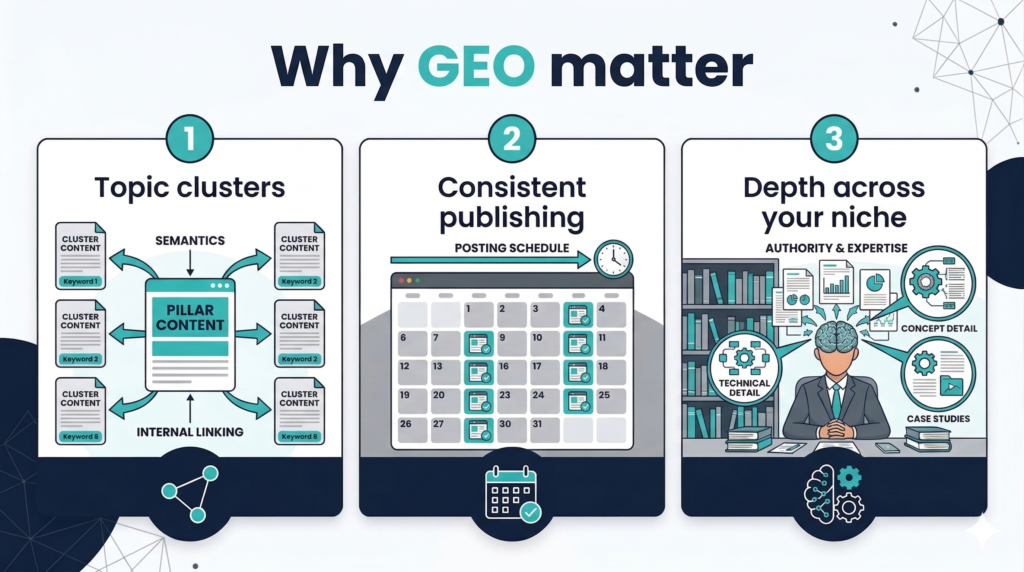
This is where most brands fall short, they write randomly instead of building authority.
AIO: Your Reputation Matters More Than Your Content Alone
AIO is probably the most misunderstood part of all this.
It’s not about using AI tools.
It’s about how AI sees your brand.
Think of it like this:
AIO = your reputation in the eyes of AI
Because AI doesn’t just look at your website.
It looks at everything:
- Reviews
- Mentions
- Social presence
- Consistency
Real Example
Brand A:
- Good content
- No reviews
- No mentions
Brand B:
- Good content
- Strong reviews
- Mentioned across platforms
AI will choose Brand B.
Every time.
Because it looks more trustworthy.
The Real Question
AI is basically asking:
Can I confidently recommend this brand?
If the answer isn’t clear, you won’t show up.
Quick Comparison (So It Actually Makes Sense)
| Strategy | Focus | Outcome |
|---|---|---|
| SEO | Visibility | You get found |
| AEO | Answers | You get found |
| GEO | Authority | You get cited |
| AIO | Trust | You get recommended |
Why It Matters
AI is getting better at tracking:
- How long users stay
- Whether they go back to search
- Whether your page actually solves the problem
So even if you rank or get featured, a bad experience will hurt you over time.
What to Focus On
- Fast loading speed
- Clean layout
- Clear answers
- Mobile-first design
Simple things, but they matter a lot.
E-E-A-T: Your Advantage Over AI Content
With AI generating content everywhere, the value of “just content” has dropped.
What matters now is:
Where it comes from
That’s where E-E-A-T comes in:
- Experience
- Expertise
- Authority
- Trust
The Reality
AI can generate information.
But it can’t:
- Have real experience
- Share personal insight
- Build genuine trust
That’s your advantage.
What You Should Do
- Share real examples
- Show who wrote the content
- Be transparent
- Stay consistent
That’s how you stand out.
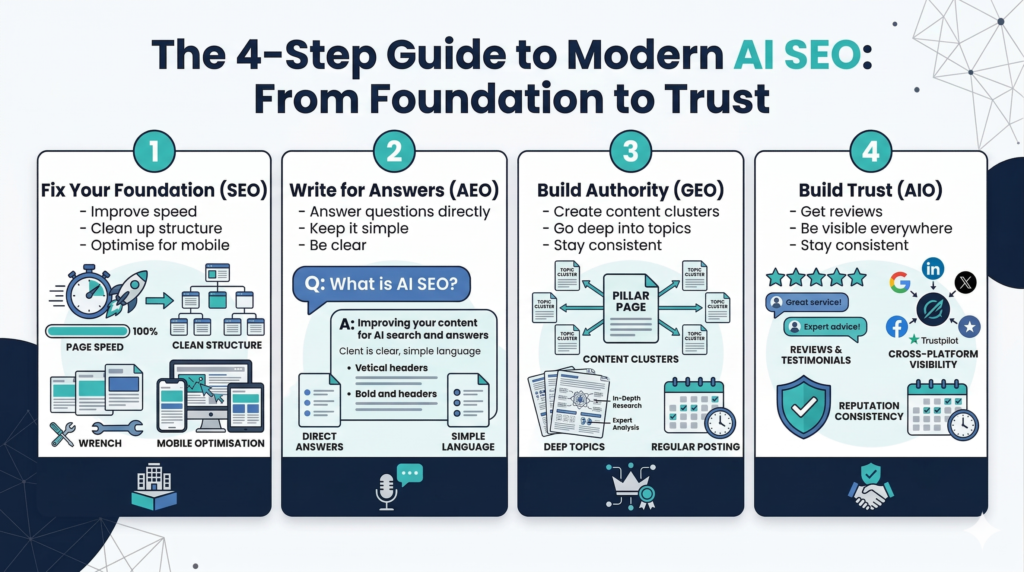
How to Actually Apply All This
You don’t need four separate strategies.
You need one system.
Final Thought
Marketing has changed.
You’re not just trying to rank anymore.
You’re trying to:
- Be understood
- Be trusted
- Be chosen
And the “human” side of content?
That’s not optional anymore.
It’s what makes you valuable.
Because at the end of the day, both people and AI are looking for the same thing:
Something they can trust.
If you focus on that; clarity, depth, and credibility, you won’t need to chase every new acronym.
You’ll already be doing what works.
FAQ
What are the main differences between AI SEO, GEO, AEO, and AIO?
- SEO helps your content get found
- AEO helps your content become the answer
- GEO helps AI cite your content
- AIO helps AI trust and recommend your brand
How do these strategies work together?
They work as layers:
- SEO → makes you visible
- AEO → makes you selectable
- GEO → makes you credible
- AIO → makes you recommendable
Why are these new methods important?
Because users now get answers directly from AI, not just search results. So, you need to be included, trusted, and recommended, not just ranked.