Key takeaways
- Generative Engine Optimisation helps brands appear in AI-generated answers. It focuses on getting your brand cited by AI platforms like ChatGPT, Gemini, and Perplexity.
- Strong SEO foundations still matter, but content must be AI-friendly. Clear structure, factual content, and strong authority help AI understand and reference your content.
- AI visibility goes beyond your website. Mentions across trusted platforms, reviews, and communities increase your chances of being cited by AI.
Table of Contents
Search behaviour is shifting from traditional search engines to AI assistants.
Instead of browsing multiple websites on Google, many users now ask platforms like ChatGPT, Google Gemini, or Perplexity a question and receive a summarized answer instantly.
This change has introduced a new digital marketing discipline: Generative Engine Optimization (GEO).
GEO focuses on helping brands appear in AI-generated answers, not just traditional search rankings.
As AI becomes a major discovery channel, businesses that optimize for GEO can gain greater visibility when users search for information, products, or services.
What Is GEO (Generative Engine Optimization)?
Generative Engine Optimization (GEO) refers to the practice of structuring your content, website, and brand presence so that AI platforms cite or recommend your information when generating answers.
Instead of optimizing solely for rankings on search engines, GEO focuses on ensuring that AI systems recognise your brand as a reliable source of information.
When someone asks an AI assistant a question such as:
“What are the best project management tools for small teams?”
The AI typically generates an answer by gathering relevant information from various sources. It may evaluate product features, reviews, expert opinions, and industry content.
If your brand or content is referenced in that response, your GEO strategy is working.
In this sense, GEO changes the competition. Businesses are no longer competing only for the top position on a search engine results page. They are also competing to become part of the AI-generated answer itself.
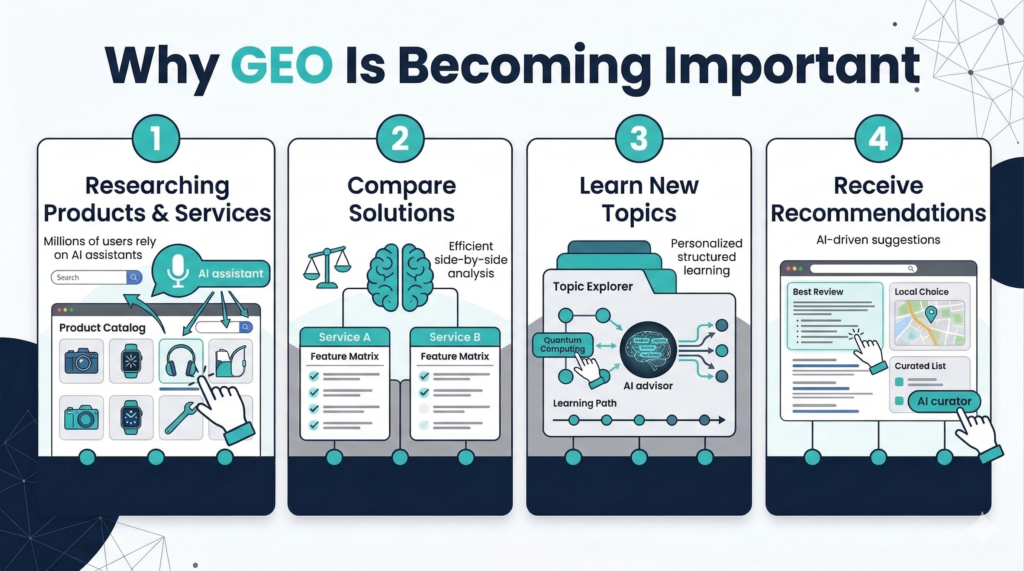
Artificial intelligence is transforming how people discover information online.
Millions of users now rely on AI assistants to:
research products and services
compare solutions
learn new topics
receive recommendations
Rather than visiting several websites, users often receive a summarized answer generated by AI.
The scale of AI adoption is significant. ChatGPT alone reaches hundreds of millions of users each week, while AI features such as Google’s AI Overviews are increasingly integrated into search results.
As a result, visibility inside AI responses is becoming an important form of digital exposure.
Businesses that are frequently cited by AI systems may gain influence even when users never click through to their websites.
This represents a major shift in how online discovery works.
GEO vs Traditional SEO
Generative Engine Optimization builds upon traditional SEO but introduces a different objective.
Traditional SEO focuses on improving a website’s ranking within search engine results pages. Success is typically measured by metrics such as traffic, keyword rankings, and click-through rates.
GEO, however, focuses on how often a brand appears within AI-generated answers.
Here is a simplified comparison.
| Traditional SEO | Generative Engine Optimisation |
|---|---|
| Focus on ranking pages | Focus on appearing in AI answers |
| Measured by clicks and traffic | Measured by mentions and citations |
| Users visit websites | AI summarises information |
| Optimized with keywords and backlinks | Optimized with clarity, authority, and structure |
| Search engines are the main platform | AI assistants are emerging discovery tools |
Despite these differences, GEO does not replace SEO.
Instead, strong SEO foundations support effective GEO strategies. Websites that already demonstrate authority, expertise, and high-quality content are more likely to be referenced by AI systems.
To understand GEO, it helps to understand how AI platforms build responses.
Large language models do not simply display links like traditional search engines. Instead, they retrieve information from multiple sources and combine it into a coherent answer.
This process typically involves several steps:
Identifying relevant content across the web
Retrieving passages related to the user’s question
Synthesizing information into a summarized response
Because AI systems often pull small pieces of content rather than entire pages, the structure and clarity of information become extremely important.
Content that clearly explains a concept or provides factual information is easier for AI systems to interpret and reuse.
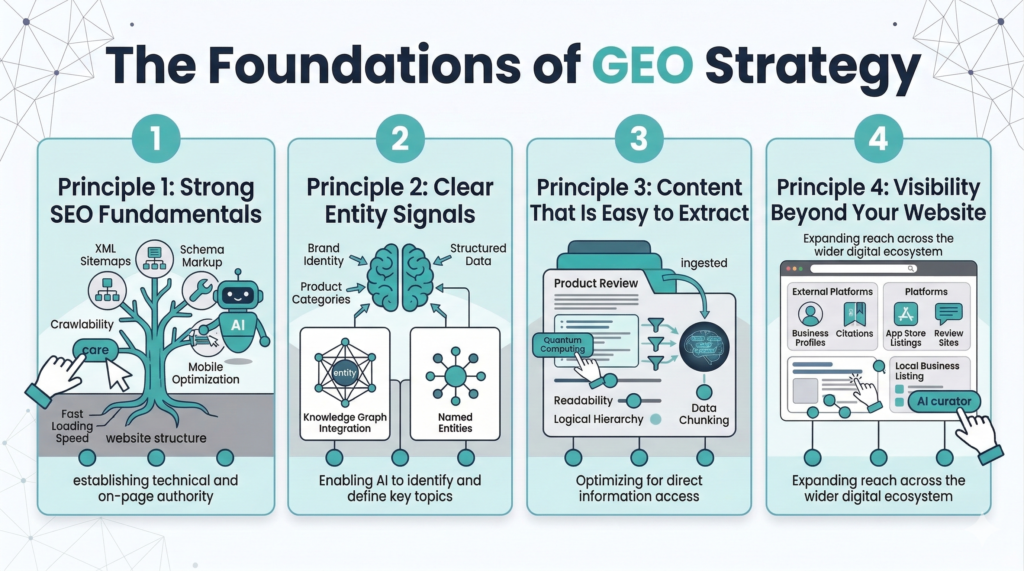
The Foundations of GEO Strategy
Although GEO introduces new considerations, many of its foundations overlap with established SEO principles.
High-quality content, technical accessibility, and strong credibility signals remain essential.
However, GEO also introduces additional strategic priorities.
These include:
making content easy for AI to extract
establishing clear brand identity
building authority across multiple platforms
measuring visibility in AI responses
Understanding these elements can significantly increase the likelihood that your brand will appear in AI-generated answers.
Principle 1: Strong SEO Fundamentals
Traditional SEO still provides the technical foundation for GEO.
Websites that perform well in AI search typically share several characteristics:
accessible and crawlable pages
fast loading speed
clear page structure
credible authorship and expertise
These elements help AI systems retrieve and interpret content with confidence.
For example, a website with poor technical accessibility may prevent AI crawlers from properly processing the information on the page. Similarly, poorly structured content may make it harder for AI systems to extract useful insights.
Because of this, GEO should be viewed as an extension of SEO rather than a replacement for it.
Principle 2: Clear Entity Signals
Another critical component of GEO is entity clarity.
In the context of AI search, an entity refers to a recognizable concept such as a brand, product, company, or category.
AI systems attempt to understand relationships between entities across the web.
For example, if a brand name appears in different contexts or categories, AI systems may struggle to understand what that brand actually represents.
Clear signals help avoid this confusion.
To strengthen entity clarity, businesses should ensure their brand information is consistent across multiple platforms, including:
websites
social profiles
business directories
industry listings
review platforms
When the same information appears consistently across these sources, AI systems gain greater confidence in how they categorize and reference the brand.
Structured data, such as schema markup, can also help search engines and AI systems interpret content more effectively.
Principle 3: Content That Is Easy to Extract
AI systems typically retrieve specific passages from content when generating answers.
This means content must be written in a way that remains meaningful even when taken out of context.
Several writing techniques can improve extractability:
Self-contained paragraphs
Each paragraph should communicate a complete idea without relying heavily on surrounding context.
Clear headings
Headings help AI systems identify which section answers a particular question.
Direct explanations
Straightforward definitions and factual statements are easier for AI systems to extract.
Front-loaded information
Important insights should appear early in a paragraph rather than buried at the end.
For example, a clear explanation like:
“Salting eggplant for 15 minutes before cooking removes bitterness and excess moisture.”
is easier for AI systems to use than a vague narrative description.
Content structured this way increases the likelihood that AI systems will reference it accurately.
Principle 4: Visibility Beyond Your Website
One of the biggest differences between SEO and GEO is that AI platforms gather information from many locations across the internet.
These sources may include:
industry publications
discussion forums
video platforms
review websites
social media platforms
professional communities
This means brand visibility should extend beyond your own website.
Two types of presence play an important role here.
Owned presence
Owned presence refers to content your brand creates directly on platforms such as YouTube, LinkedIn, or community forums.
These channels allow businesses to share expertise, demonstrate products, and participate in industry discussions.
Earned mentions
Earned mentions occur when other people or organizations reference your brand.
Examples include customer reviews, media coverage, or recommendations within community discussions.
When AI systems encounter both owned content and independent mentions across different platforms, they gain stronger signals about your credibility.
Traditional SEO metrics alone cannot fully measure visibility in AI search.
In the past, marketers relied heavily on metrics such as:
keyword rankings
organic traffic
click-through rates
However, AI-generated answers often bypass the traditional click path. A user might see your brand mentioned in an AI response but never visit your website directly.
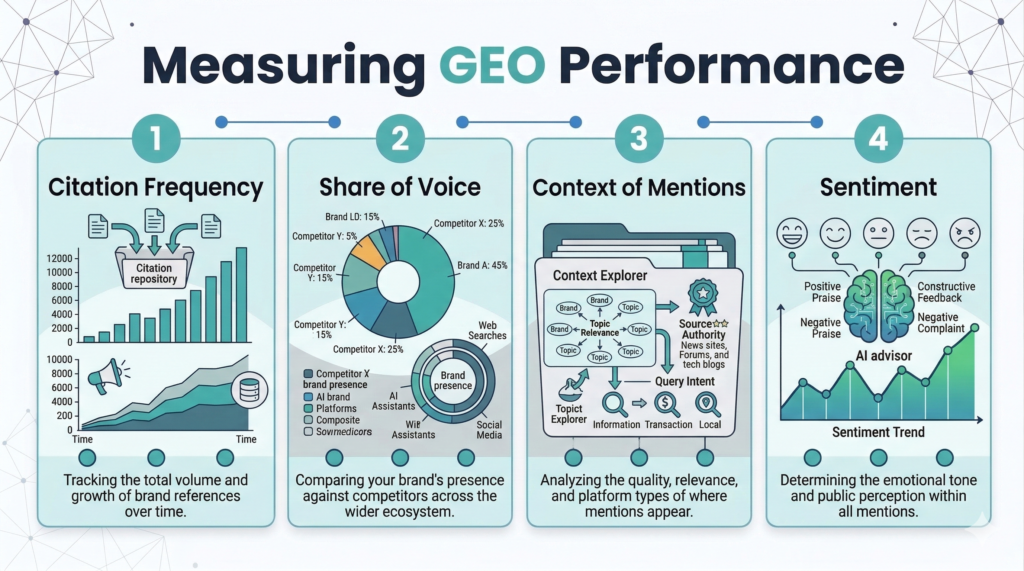
Because of this, new metrics are becoming important.
These include:
Citation frequency
How often AI platforms mention your brand when answering relevant questions.
Share of voice
How frequently your brand appears compared to competitors within AI responses.
Context of mentions
The specific topics or prompts that trigger AI to reference your brand.
Sentiment
Whether the AI presents your brand positively, neutrally, or negatively.
Monitoring these indicators helps businesses understand their visibility within AI search ecosystems.
The Volatility of AI Mentions
One challenge with GEO is that AI responses can change frequently.
Different platforms may prioritize different sources, and AI models are updated regularly.
Research has shown that the sources cited by AI systems can fluctuate from month to month.
However, consistent patterns still emerge.
Brands that appear repeatedly across AI answers usually share similar characteristics:
clear entity signals
structured and extractable content
strong authority within a specific topic
presence across multiple platforms
These factors increase the probability of being referenced, even if the exact citations vary.
Emerging Trends in AI Search
AI search technology continues to evolve rapidly.
Several trends are shaping the future of discovery.
Conversational queries
Users are increasingly asking longer, more conversational questions rather than short keyword phrases.
Multimodal search
Search experiences are expanding beyond text to include images, video, and voice interactions.
Visual search growth
Tools like Google Lens allow users to search using images instead of text.
Personalized AI responses
AI systems may tailor answers based on user context, behavior, and preferences.
Businesses that adapt their content strategies to these trends will be better positioned for future visibility.
Preparing for the Future of AI Discovery
As AI becomes more integrated into search experiences, organizations must adapt their digital strategies.
Successful GEO strategies typically include:
publishing clear, authoritative content
maintaining strong technical SEO foundations
building a consistent brand presence across platforms
monitoring visibility in AI responses
continuously refining content based on user intent
This approach ensures that businesses remain discoverable as AI search evolves.
Conclusion
Generative Engine Optimization represents the next stage of digital discovery.
Instead of focusing solely on search rankings, GEO emphasizes becoming a trusted source within AI-generated answers.
While traditional SEO remains essential, businesses must now also consider how AI systems retrieve, interpret, and reference information.
Organizations that invest in GEO early will gain a competitive advantage as AI assistants continue to influence how users research products, services, and ideas online.
Ultimately, success in the AI era will come from the same principles that have always driven strong digital visibility: clear information, credible expertise, and consistent presence across the web.
FAQ
How is GEO different from traditional SEO?
Traditional search engine optimisation focuses on improving a website’s position in search engine results pages through keywords, backlinks, and technical optimisation. GEO focuses on making content easier for AI systems to understand and summarise in generated answers.
Which AI platforms does GEO target?
GEO typically focuses on platforms such as ChatGPT, Google Gemini, and Perplexity AI, which generate answers by analysing information across the web.
How do you optimise content for generative engines?
Some common GEO strategies include:
Creating clear, structured content
Answering common user questions
Using authoritative sources and citations
Building topical authority in your niche
Ensuring your brand is consistently referenced online
Can GEO replace SEO?
No. GEO complements traditional SEO. SEO helps your website rank on search engines, while GEO helps your content appear in AI-generated responses.